
When designing custom drapery, most designers naturally focus on the visible elements:
- fabric selection,
- color and texture,
- fullness,
- finished length,
- and installation details.
However, one important consideration is often overlooked:
How much space does the drapery require when it is fully opened?
This space is known as stack back.
Stack back refers to the amount of space a drapery panel occupies when it is gathered and fully opened to one side of the window.
Although it may seem like a small technical detail, stack back directly affects:
- how much glass remains visible,
- natural light exposure,
- furniture placement,
- and the overall proportion of the window design.
For large windows, sliding doors, and high-end residential projects, understanding stack back helps designers create window treatments that are both beautiful and functional.
What Is Drapery Stack Back?
When drapery is closed, the fabric extends across the window opening and creates no visible stacking area.
Once the panels are opened, the fabric, pleats, and construction details gather together at the sides of the window.
The final stack back is influenced by several factors:
- heading construction,
- fullness,
- fabric weight,
- lining system,
- hardware selection,
- and the way the drapery is dressed after installation.
In other words, stack back is not determined by one single measurement. It is the result of how the entire window treatment is constructed and used.
Stack Back Changes With Drapery Position
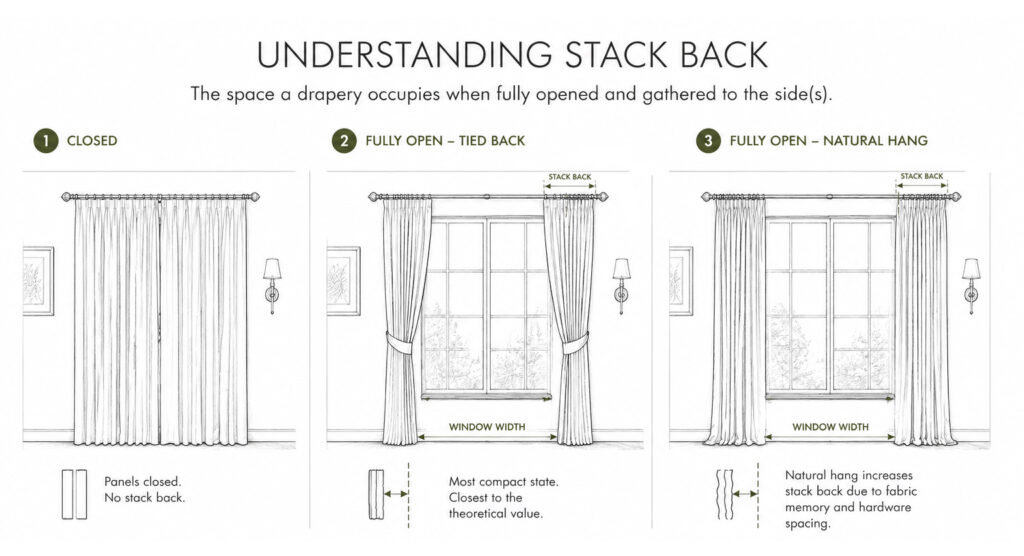
Closed Position
When drapery is fully extended across the window:
- the fabric covers the opening,
- and no side stack space is required.
Fully Open — Tied Back
When panels are secured with tiebacks, the fabric is pulled into a more compact position.
This creates one of the smallest stack conditions because:
- folds are compressed,
- and the fabric movement is restricted.
However, tied-back drapery does not always represent everyday use. Many residential spaces rely on naturally hanging panels when open.
Fully Open — Natural Hang
In practical applications, drapery is often opened without tiebacks.
In this condition:
- fabric naturally relaxes,
- pleats recover their shape,
- rings or carriers maintain spacing.
As a result, actual stack back is often larger than a theoretical compressed measurement.
This difference between theory and reality is one of the most important considerations when planning drapery.
Why Stack Back Matters in Window Design
Stack back is not simply a measurement. It affects how the entire space functions.
Preserving Views and Natural Light
For large windows and expansive glass areas, designers often want the maximum amount of the window to remain visible when drapery is open.
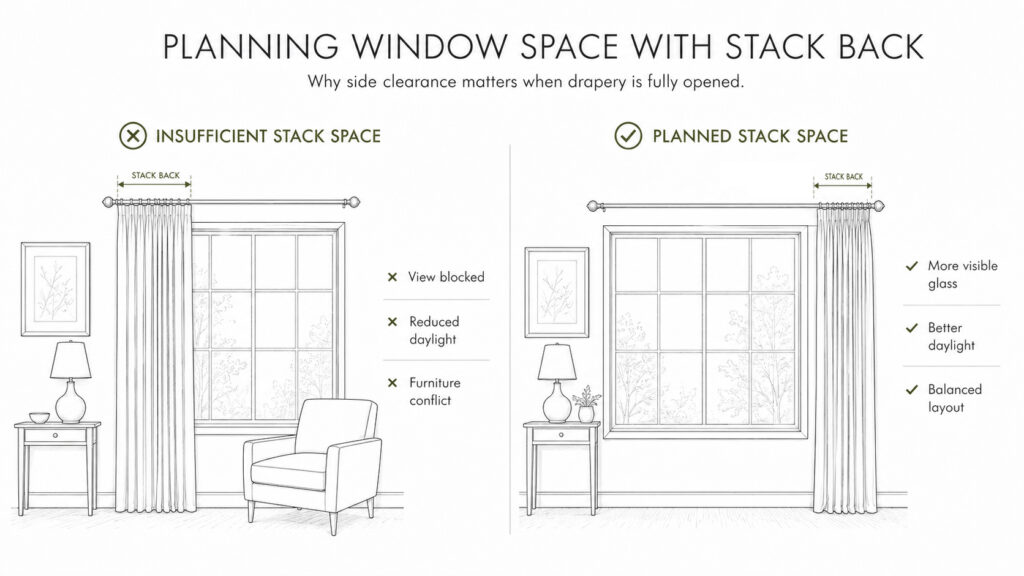
Insufficient stack back planning can result in:
- covered glass area,
- reduced daylight,
- and interrupted exterior views.
Planning Furniture Placement
The area beside a window is often used for:
- sofas,
- side tables,
- lamps,
- or built-in furniture.
Without considering stack back, opened drapery may interfere with:
- furniture placement,
- circulation,
- and the intended use of the space.
Maintaining Window Proportion
A successful window treatment should look balanced both when closed and when open.
The stacked panels should feel intentional rather than oversized or crowded.
How Drapery Style Influences Stack Back
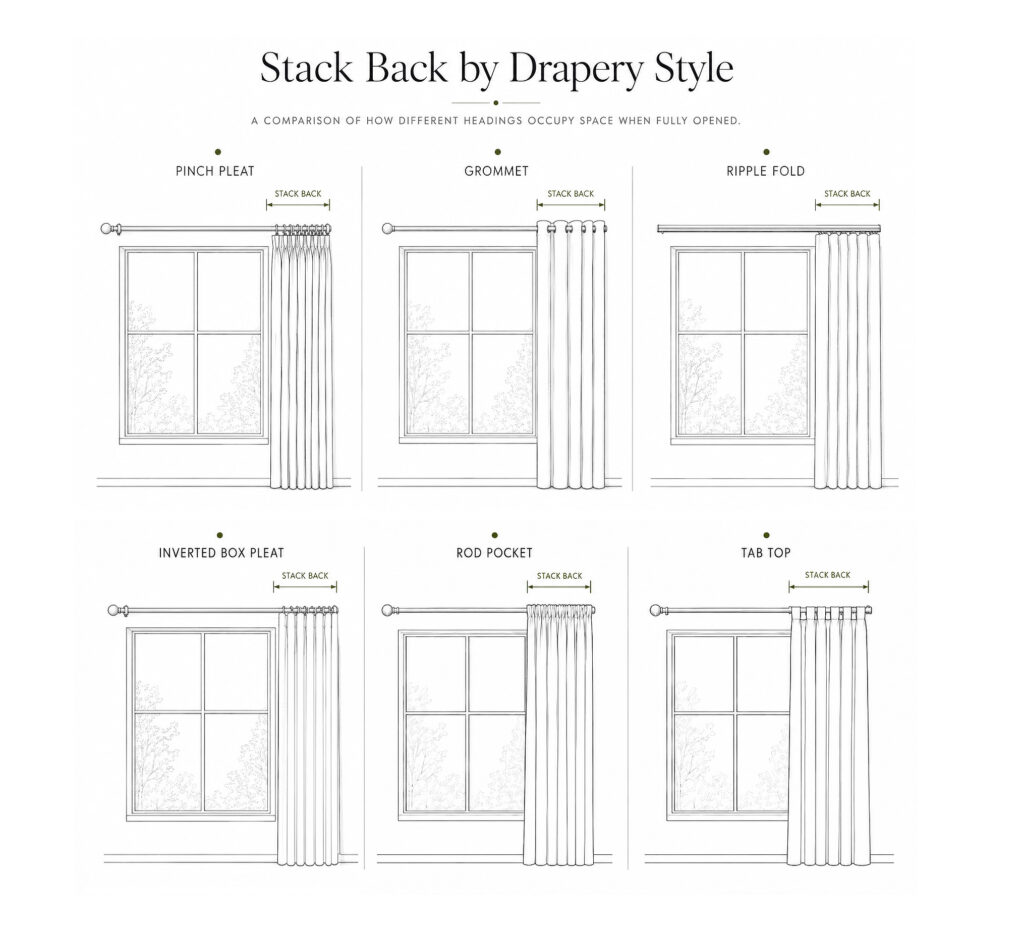
Different heading styles create different folding behaviors.
Even with the same:
- window size,
- fabric,
- and installation location,
different drapery constructions can require different amounts of stacking space.
Pleated Drapery
Common pleated constructions include:
- Double French Pleat,
- Triple French Pleat,
- Double Euro Pleat,
- Triple Euro Pleat.
Although these styles create different visual appearances, their stack behavior is mainly influenced by:
- pleat quantity,
- pleat spacing,
- fullness,
- and fabric construction.
When opened, the pleats compress together into a concentrated stack.
More structured pleated headings generally require more space than flatter constructions.
Grommet Drapery
Grommet drapery uses metal rings inserted directly into the fabric header and slides along a rod.
Its stacking behavior is influenced by:
- grommet size,
- spacing between rings,
- and fabric thickness.
Because the folding pattern is different from pleated headings, the final stack dimension can vary significantly.
Ripple Fold / Wave Drapery
Ripple Fold drapery relies on a track system to maintain a continuous wave formation.
Unlike traditional pleated drapery, the wave pattern is controlled by carrier spacing.
Because the system must maintain:
- consistent wave spacing,
- smooth movement,
- and a clean appearance,
Ripple Fold generally requires more stack space when fully opened.
Factors That Affect Stack Back
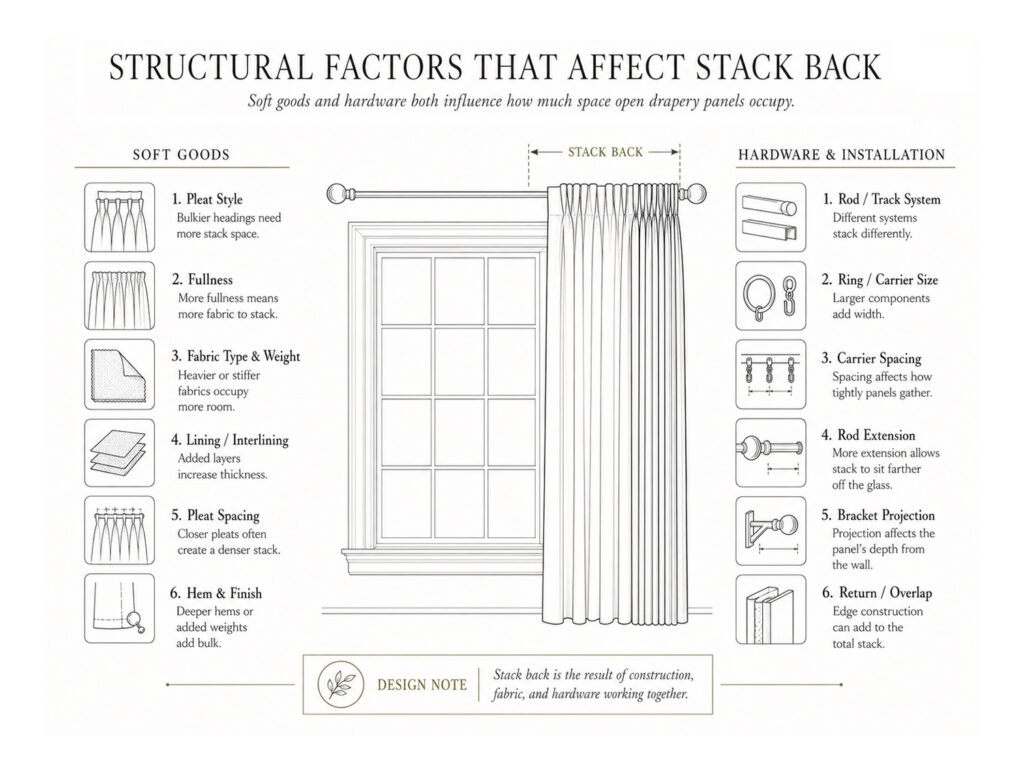
Stack back is the result of several elements working together:
heading construction + fabric behavior + hardware system + dressing method
Heading Construction and Fullness
The way fabric is structured at the top of the drapery determines how it folds and compresses.
Factors include:
- pleat style,
- pleat spacing,
- fullness.
A higher fullness ratio means more fabric must be gathered into the stacked area.
Fabric Construction
Fabric behavior has a significant impact on the final result.
Important characteristics include:
- thickness,
- stiffness,
- softness,
- and drape quality.
Heavier or more structured fabrics generally require more stacking space than lightweight fabrics.
Lining and Interlining
Additional layers such as:
- blackout lining,
- interlining,
- thermal lining,
increase fabric thickness and affect how compactly the drapery can stack.
Hardware and Installation
The hardware system also plays an important role.
Different systems, including:
- rod and rings,
- traverse tracks,
- ripple fold tracks,
create different stacking behaviors.
Carrier spacing, ring size, and installation details all influence the final result.
Return and Overlap
Construction details such as:
- returns,
- overlaps,
- and edge treatments
add additional thickness to the stacked area and should be considered during planning.
Workshop Observation: From Theory to Reality
While stack back can be estimated through design principles, it is difficult to define as one fixed number.
To better understand how different constructions behave in real applications, we tested several drapery styles under workroom conditions.
The testing included:
- Pleated Drapery (Double and Triple French / Euro Pleat),
- Grommet Drapery,
- Ripple Fold / Wave Drapery.
The observations considered different fabric weights, lining conditions, and dressing methods.
Example Stack Back Reference by Drapery Style
| Drapery Style | Approximate Stack Space Requirement |
|---|---|
| Pleated Drapery (French & Euro Pleat) | Approx. 16–28% |
| Grommet Drapery | Approx. 19–28% |
| Ripple Fold / Wave Drapery | Approx. 30–35% |
Planning Window Space With Stack Back
Understanding stack back is not only about measuring the space occupied by drapery. It also helps designers plan the relationship between the window, surrounding furniture, and available wall space.
By considering stack space during the design stage, designers can avoid blocked views, reduced daylight, and conflicts with nearby furniture.
These measurements are based on specific fabric, construction, and hardware conditions.
They are intended as a design reference rather than a fixed standard.
The testing demonstrates an important point:
The construction method itself has a significant influence on stack behavior.
For example, Ripple Fold typically requires more space because the wave formation must maintain its designed shape even when fully opened.
Why Actual Stack Back Differs From Theory
A theoretical calculation often assumes:
- evenly arranged pleats,
- compressed folds,
- consistent spacing.
However, real installations involve:
- fabric memory,
- natural recovery,
- hardware spacing,
- and dressing methods.
Therefore, actual stack back may vary from the theoretical calculation.
Understanding this difference helps designers make better decisions during the planning stage.
Conclusion
Drapery design is not only about calculating width and height.
A successful custom window treatment requires an understanding of:
- how fabric moves,
- how construction affects performance,
- how hardware changes behavior,
- and how the finished treatment interacts with the space.
Stack back may appear to be a small technical detail, but it represents an important principle in custom window treatment design:
Measurements provide guidance, but understanding fabric behavior creates better design decisions.
Related Notes
How to Measure for Drapery: From Site Conditions to Finished Dimensions
A practical guide to measuring custom drapery, including window dimensions, rod width, coverage, stack location, finished length, and surrounding site conditions.
Understanding Drapery Heading Styles: How Different Headings Shape Custom Drapery
A closer look at how pleated, wave, and rod-based headings affect structure, fullness, drape, and the finished appearance of custom window treatments.
Ripplefold vs. Wave Curtain Systems: Fullness and Space Planning
A comparison of Ripplefold and Wave systems, including fullness, carrier spacing, closure, stack behavior, and the installation depth required for wave-style drapery.
Drapery Lining, Blackout & Interlining: A Practical Guide
A closer look at lining and interlining choices and how additional fabric layers influence the construction, performance, weight, and behavior of finished drapery.
Comments are closed.