
When we think about drapery, the face fabric usually gets most of the attention—the color, texture, pattern, and drape.
But the lining behind the fabric can be just as important to the finished result.
It can affect light transmission, privacy, the appearance from the exterior, overall weight, pleat definition, and even the visible tone of a light-colored face fabric. Once blackout lining or interlining is added, the structure and behavior of the drapery can change even more.
This article looks at the role of lining, blackout lining, and interlining, and at the practical specifications that matter when selecting them.
1. Drapery Does Not Have Just One Backing Structure
The simplest drapery construction may consist of face fabric only.
Some decorative panels, sheers, or fabrics intended to retain natural translucency may be left unlined.
For many decorative draperies, however, adding lining helps create a cleaner back, improves privacy, reduces direct light transmission, and adds some body to the finished panel.
For bedrooms, media rooms, or spaces where stronger light control is needed, blackout lining may be considered.
Interlining is different again. It is not simply a substitute for lining. Instead, it is placed between the face fabric and the lining, creating an additional layer within the drapery.
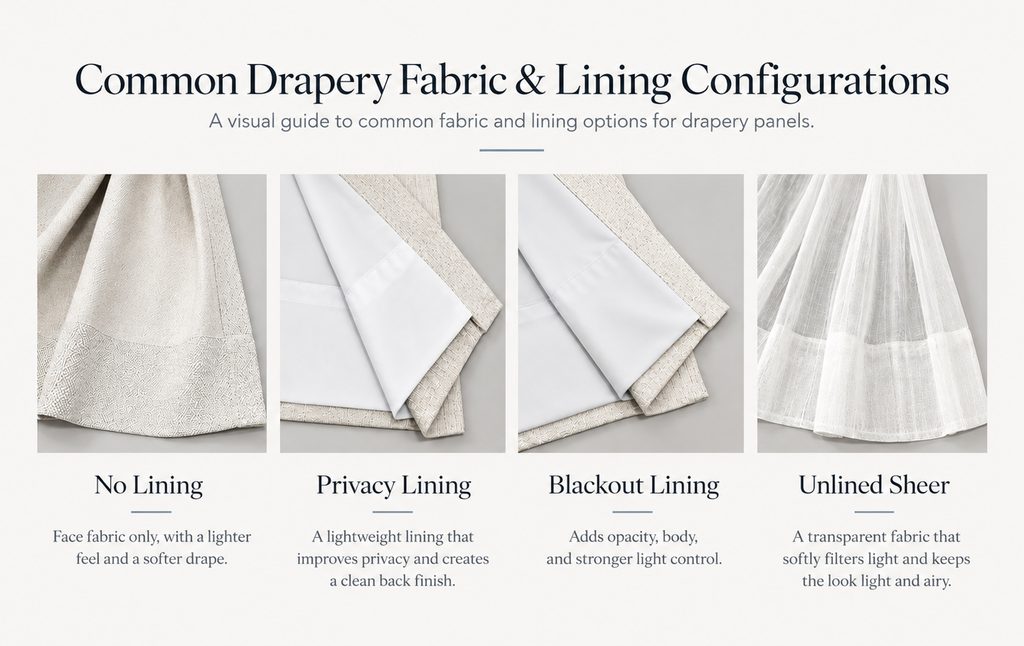
These common configurations provide a useful starting point:
- No Lining
- Privacy Lining
- Blackout Lining
- Unlined Sheer
The right choice depends not only on the room, but also on the face fabric, functional requirements, and the desired finished appearance.
2. Standard Lining: The Basic Backing Layer
Standard lining is an additional fabric layer applied behind the face fabric.
Its common functions include:
- improving privacy
- reducing direct light transmission
- creating a more uniform appearance from the exterior
- offering some protection to the face fabric
- adding a small amount of weight and body
- creating a cleaner finished back
A lined drapery, however, is not automatically a blackout drapery.
Many standard linings still allow some light to pass through. They simply provide more opacity than an unlined face fabric.
This distinction is important because “I want lining” and “I need strong room darkening” are not necessarily the same request.
3. Blackout Lining: Stronger Light Control
The main purpose of blackout lining is stronger opacity and light control.
Compared with standard lining, it generally reduces much more of the light passing through the drapery itself.
But even a highly opaque drapery does not automatically make a room completely dark.
Light can still enter around:
- the top of the treatment
- side gaps
- the bottom
- the center opening
- insufficient overlap
- inadequate returns
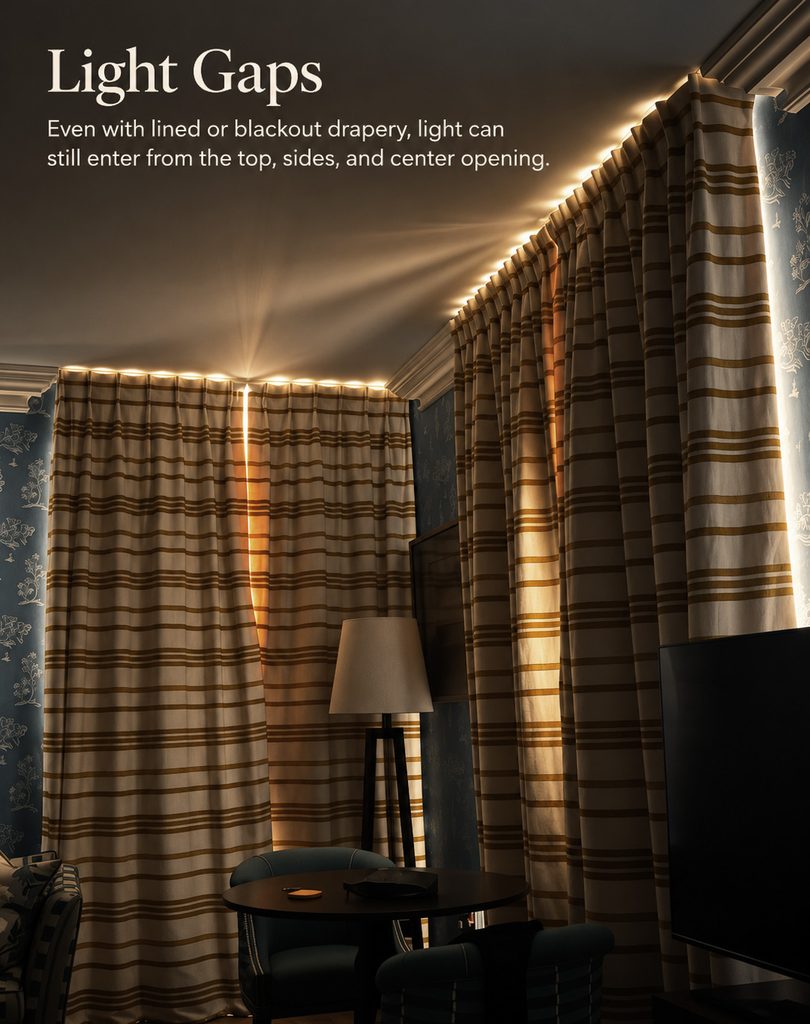
This is why I prefer to think of blackout performance in two parts:
fabric performance and installation planning.
The lining may control the light passing through the panel, but the finished room-darkening effect also depends on rod or track position, returns, overlap, installation depth, and overall coverage.
4. Lining Changes the Way Light Enters a Room
The same window can feel very different depending on the fabric construction.
A sheer allows a high level of natural light into the room.
An unlined decorative fabric filters more light.
Once lining is added, the drapery generally becomes more opaque and reduces light transmission further.
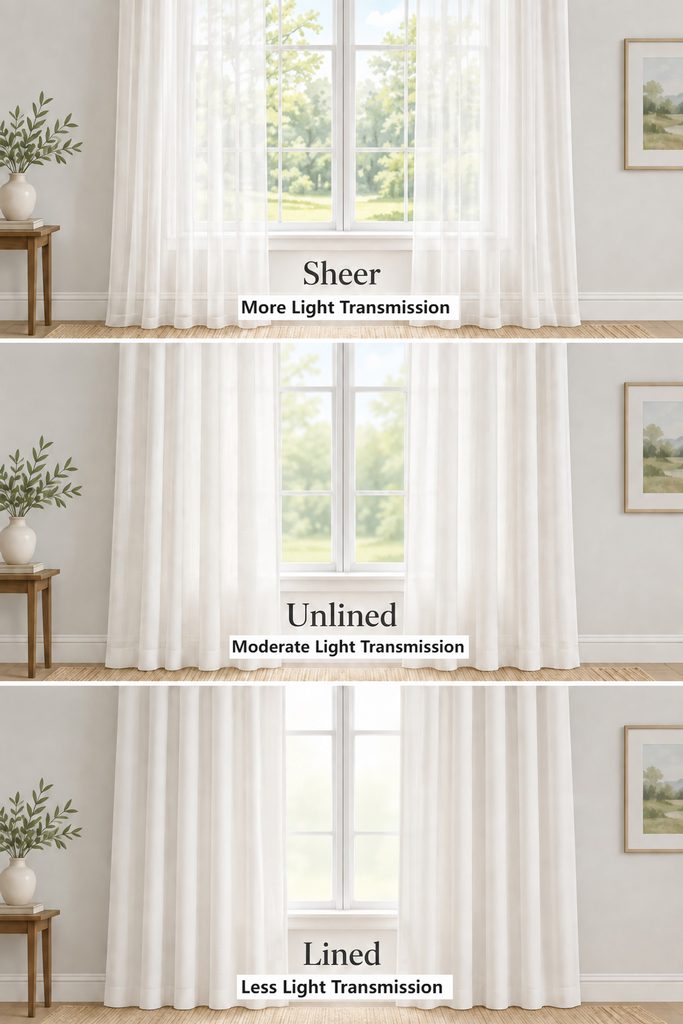
This illustration is intended to show a relative relationship rather than a fixed performance value.
Actual light filtering still depends on factors such as:
- face-fabric density
- yarn size
- weave
- fabric color
- lining color
- lining construction
For this reason, the word “lined” alone does not tell us exactly how much light a finished drapery will block.
5. Interlining Is Not Simply a Heavier Lining
Interlining is often misunderstood as just a thicker lining.
Structurally, it is something different.
A typical interlined drapery is built as:
**Face Fabric
- Face Fabric
- Interlining
- Lining
The interlining sits between the decorative face fabric and the outer lining.
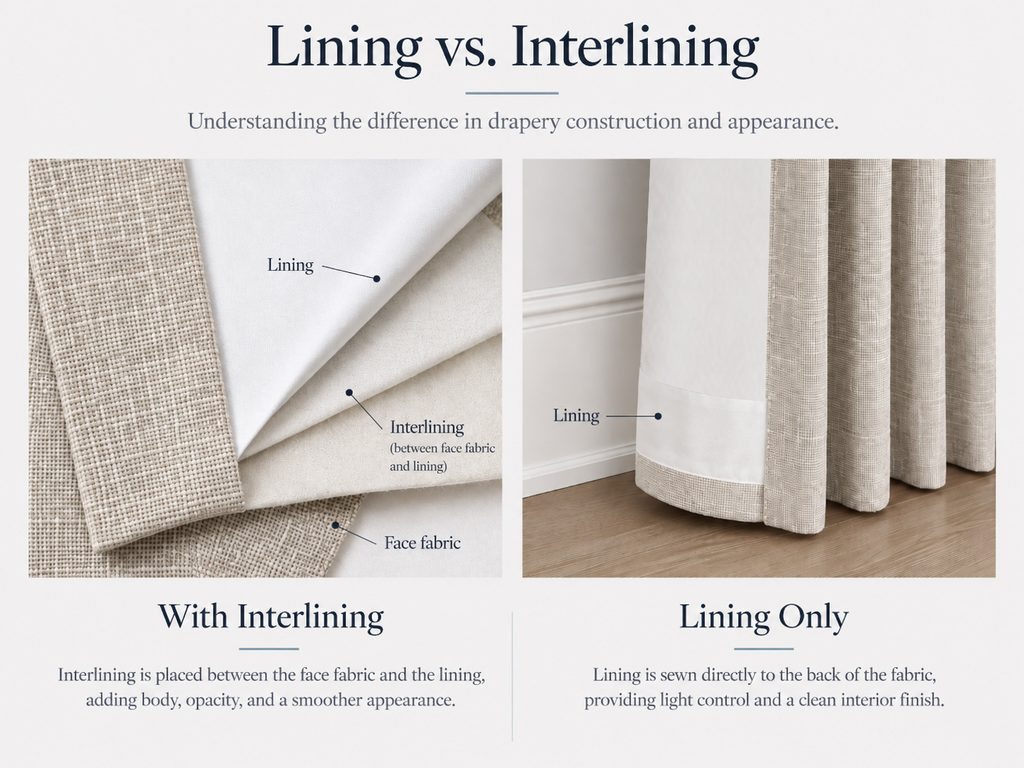
Its role is often more closely related to:
- adding body
- increasing loft
- creating fuller drapery
- improving rounded pleat definition
- increasing thickness
- changing hand and softness
- providing additional insulation
In other words, interlining affects not only function, but also the physical volume and character of the drapery.
It can be especially useful with lighter decorative fabrics, or where a fuller and more traditional finished appearance is desired.
However, interlining is not automatically appropriate for every project.
Adding another layer also means:
- more finished weight
- greater hardware load
- increased stack
- more complex fabrication
- changes in pleat behavior
It is better understood as a construction choice rather than simply a “premium” version of lining.
6. The Same Face Fabric Can Look Different with Different Linings
Lining selection is not only a question of whether a drapery is lined or unlined.
Even within standard linings, different materials can produce noticeably different results.
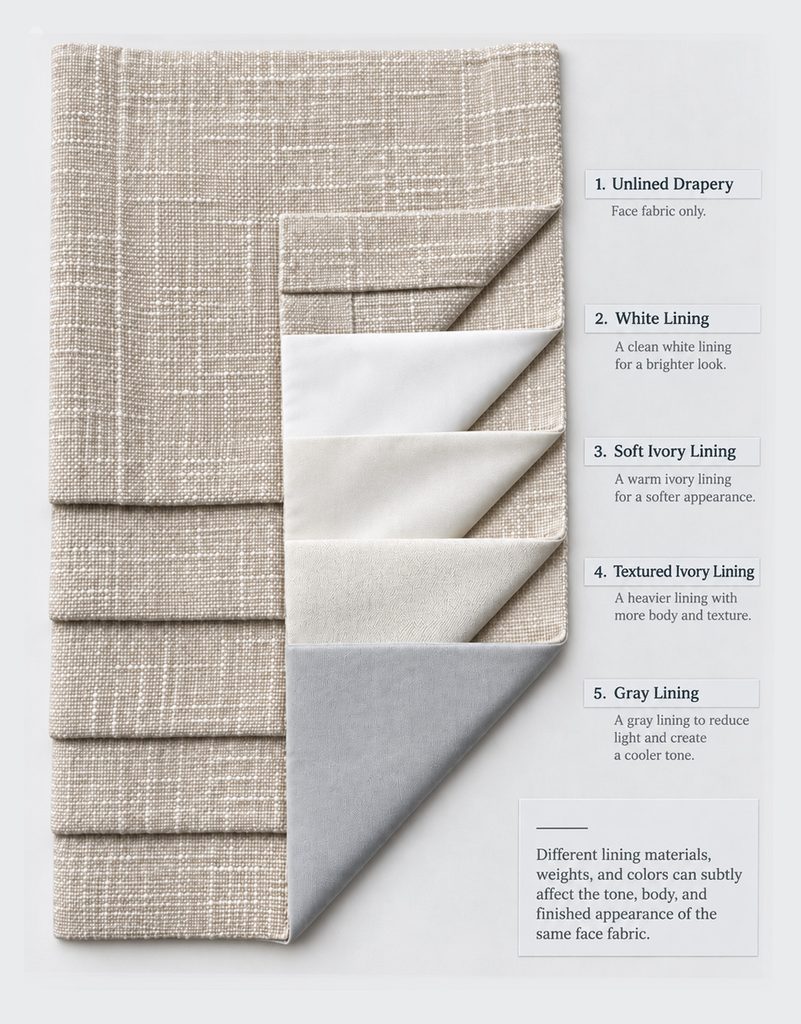
With the same light-colored face fabric, several changes may be visible.
Color
A white lining may make a light face fabric appear cleaner or slightly brighter.
An ivory lining may create a softer, warmer cast.
A gray lining may reduce brightness behind the fabric and can sometimes create a slightly cooler or more muted appearance.
These differences are easier to see with:
- light-colored fabrics
- loosely woven fabrics
- linen-like fabrics
- thinner materials
- partially translucent fabrics
With dense or highly opaque face fabrics, lining color may have much less visible effect.
Weight
Different GSM values can change the body and weight of the finished drapery.
But a higher GSM does not automatically mean a better lining.
Weight is only one part of the material.
The final behavior also depends on:
- fiber content
- construction
- finish
- weave
- coating
Material
Cotton, polyester, and cotton/polyester blends may differ in hand, stability, texture, and drape.
For this reason, I would not select a lining based on GSM alone.
7. Width Is an Important Fabrication Specification
Lining width is easy to overlook, but it can directly affect fabrication.
For example, two linings may have the same fiber content and the same GSM, while one is:
54 in. / 137 cm
and another is:
108 in. / 274 cm
The difference in width can significantly change seam planning.
A wide-width lining may reduce the number of seams required in larger or taller drapery panels.
A standard-width lining may need to be joined according to the panel width and cutting plan.
Width therefore affects:
- seam planning
- fabric usage
- cutting direction
- finished appearance
It is not just a purchasing specification.
8. Finish Can Change the Intended Use
Linings that look very similar may also have different finishing treatments.
For example, one lining sample may be marked:
Finish: Water Repellent
while another may show:
Finish: N/A
This means lining selection should also consider whether the material has:
- a coating
- a water-repellent finish
- another special treatment
- different care requirements
In some cases, these details may matter more than color or GSM.
9. How to Read a Lining Specification
A lining sample card may contain a lot of information, but most of it can be organized into a few practical categories.
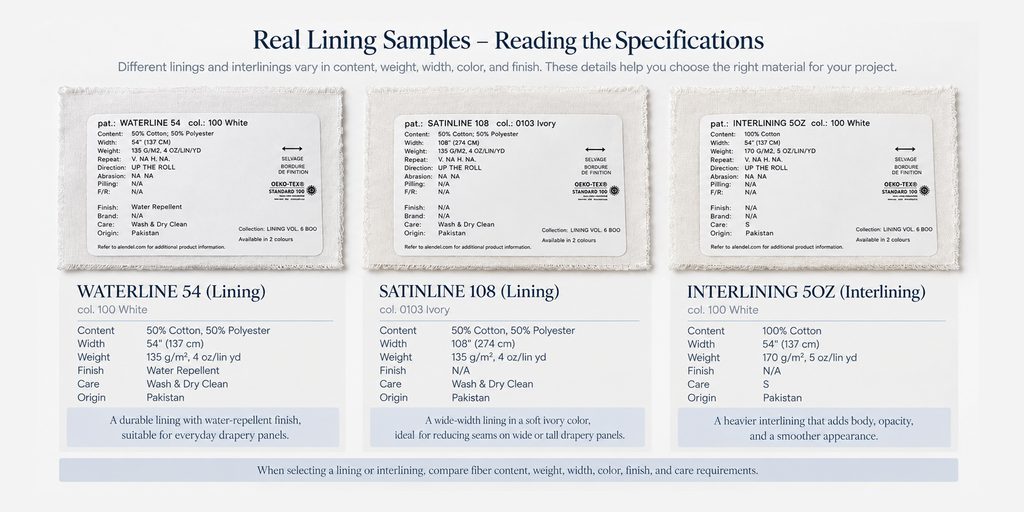
Fiber Content
Examples include:
50% Cotton / 50% Polyester
or:
100% Cotton
Fiber content can influence hand, stability, and material behavior.
Width
Examples:
54 in. / 137 cm
or:
108 in. / 274 cm
Width affects cutting and seam planning.
Weight
Examples:
135 g/m²
or:
170 g/m²
GSM is useful when comparing the weight of different materials by area.
Some sample cards also list:
oz/ln yd
where ln yd means linear yard.
Because the area contained in one linear yard depends on the fabric width, GSM is usually more useful when comparing fabrics of different widths.
Color
White, ivory, and gray are not only backing colors.
With lighter or more translucent face fabrics, they may influence the visible surface tone.
Finish
A note such as:
Water Repellent
indicates an additional finishing treatment.
Care
The care instructions of the lining also matter.
A finished drapery must be maintained as a complete construction, so it is not enough to consider the face fabric alone.
10. Understanding OEKO-TEX® STANDARD 100
Some lining sample cards carry the OEKO-TEX® STANDARD 100 mark.
This certification relates to testing textiles for harmful substances under the applicable STANDARD 100 criteria.
It does not indicate:
- drapery quality
- blackout performance
- durability
- flame resistance
And it should not simply be interpreted as meaning that a fabric is “eco-friendly.”
It is more accurate to understand it as information about harmful-substance testing within the OEKO-TEX STANDARD 100 system.
For lining selection, it is useful certification information, but it does not replace evaluation of the material’s performance, construction, or suitability for the project.
11. What I Look at When Selecting a Lining
Rather than asking:
Which lining is best?
I find it more useful to ask a series of smaller questions.
- How translucent is the face fabric?
- How much natural light should remain?
- How much privacy is needed?
- Is stronger room darkening required?
- Does the face fabric need more body?
- Will lining color influence the face fabric?
- Would interlining improve the desired loft and fullness?
- Is the lining width suitable for the panel size?
- Does the material have a special finish?
- Can the hardware support the added finished weight?
Once these questions are clear, lining selection becomes much easier than choosing by name or GSM alone.
Conclusion
Lining may be hidden behind the face fabric, but it plays an important role in the final behavior of a drapery.
Standard lining, blackout lining, and interlining do not solve exactly the same problems.
And even within the same general lining category, differences in color, weight, width, fiber content, and finish can change the finished result.
For that reason, lining should not be selected only by its type.
It is better evaluated together with the face fabric, construction method, installation conditions, and functional requirements of the project.
Related Articles
- Understanding Drapery Anatomy
A visual guide to the main structural parts of a drapery panel. - Understanding Drapery Leading Edges and Side Edges
A closer look at edge construction, overlap, returns, and finishing details. - How to Measure for Drapery
A practical measuring guide covering coverage, stack-back, returns, overlap, and finished length. - Ripplefold vs. Wave Curtain Systems: Fullness and Space Planning
A comparison of two track-based drapery systems, including fullness, spacing, and installation depth. - Understanding Stationary Panels
A guide to decorative stationary drapery panels and how they relate to proportion, coverage, and window design.