Introduction
Roman Shades are one of the most versatile categories of custom window treatments. They combine the softness of fabric with the functionality of a shade system, creating a balance between decorative expression and practical performance.
At first glance, a Roman Shade may appear to be a simple fabric panel that moves up and down. However, the final appearance, function, and quality of a Roman Shade are influenced by many decisions behind the finished product.
The same fabric can create very different results depending on the visual style, internal construction, operating system, and fabrication details.
To better understand Roman Shades, it is helpful to look beyond individual product names and consider four key dimensions:
- Appearance Families — how the finished shade looks
- Construction Methods — how the shape and folds are created
- Operating Systems — how the shade functions and moves
- Fabrication Details — how finishing choices influence quality and appearance
Together, these elements form the foundation for designing, selecting, and producing custom Roman Shades.
Understanding Roman Shade Appearance Families
The appearance of a Roman Shade is the first element people notice. Different folding styles, fabric behaviors, and decorative approaches create different visual expressions.
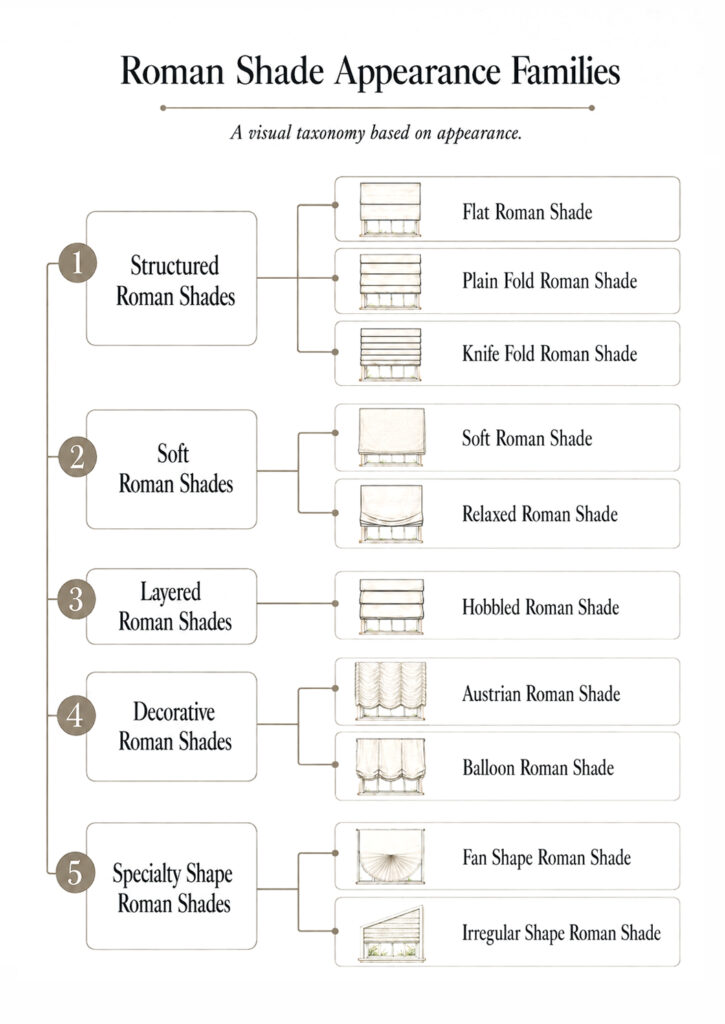
Structured Roman Shades create a more tailored appearance through defined horizontal folds and controlled lines. Soft and Relaxed Roman Shades emphasize fabric movement and a more natural, relaxed character. Layered and Decorative Roman Shades introduce additional depth through overlapping folds, gathering, and fabric fullness, while Specialty Shape Roman Shades expand design possibilities for unique architectural windows.
Understanding these appearance families helps designers identify the overall visual direction before selecting construction methods or operating systems.
Understanding Roman Shade Construction Methods
While appearance describes the final look, construction determines how that look is achieved.
The internal structure of a Roman Shade influences fold definition, stability, fabric behavior, and long-term performance.
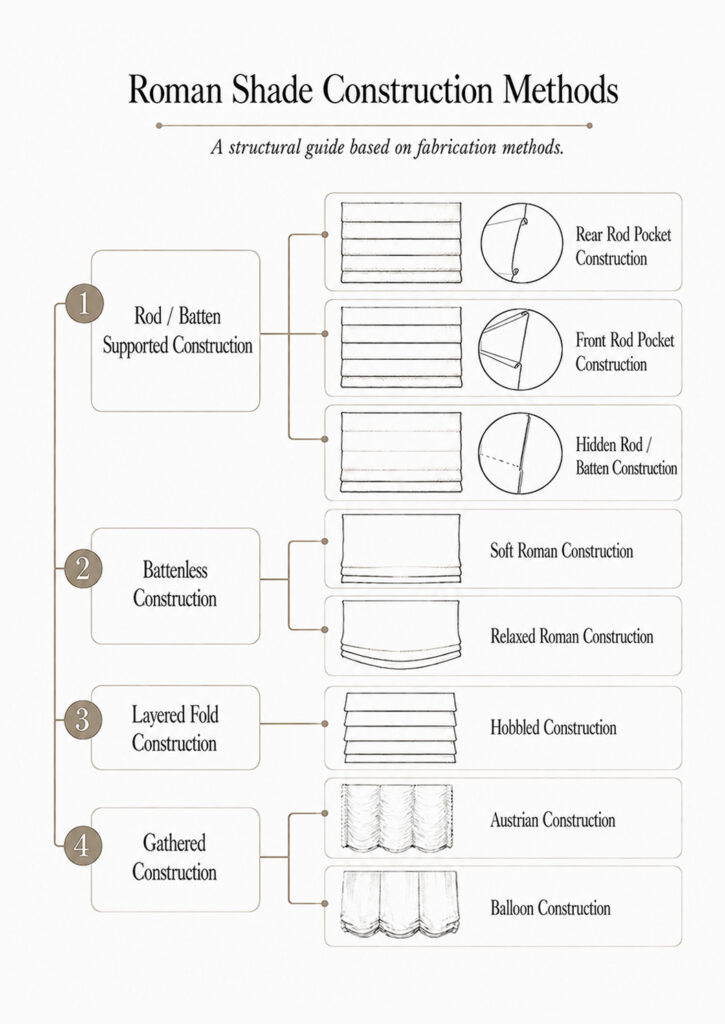
Rod and batten supported constructions use internal support elements to create more structured and controlled folds.
Battenless constructions remove horizontal support elements, allowing the fabric itself to create a softer and more natural appearance.
Layered fold constructions create dimensional effects through overlapping fabric layers, while gathered constructions rely on fabric fullness and gathering techniques to achieve decorative volume.
Understanding construction methods helps explain why two Roman Shades made from similar fabrics can have completely different visual results.
Understanding Roman Shade Operating Systems
A Roman Shade is not only defined by its appearance and construction. The operating system determines how the shade is controlled and how it performs in daily use.
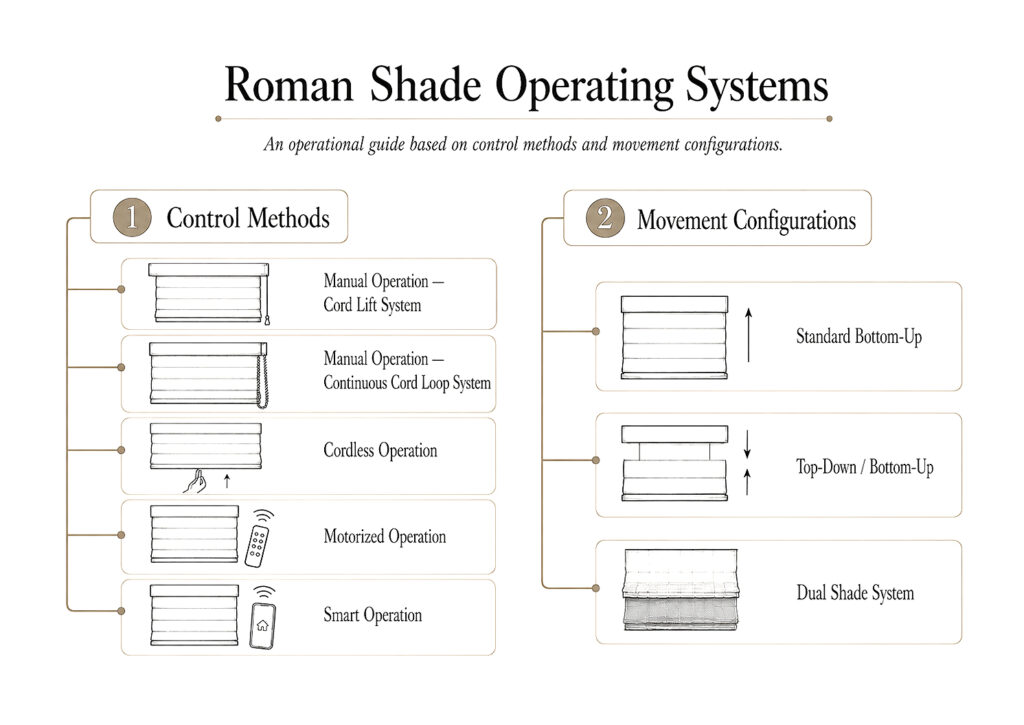
Control methods and movement configurations should be considered separately because they represent different aspects of operation.
Control methods describe how users operate the shade, including:
- Manual Operation
- Cordless Operation
- Motorized Operation
- Smart Operation
Movement configurations describe how the shade moves and what functions it provides, including:
- Standard Bottom-Up Operation
- Top-Down / Bottom-Up Operation
- Dual Shade Systems
The same movement configuration may be available through different operating methods depending on the system design.
Understanding Roman Shade Fabrication Details
Beyond style and function, fabrication details often determine whether a Roman Shade feels simple or refined.
Small decisions in material layering, edge finishing, seam placement, and decorative elements influence the final appearance and overall quality.
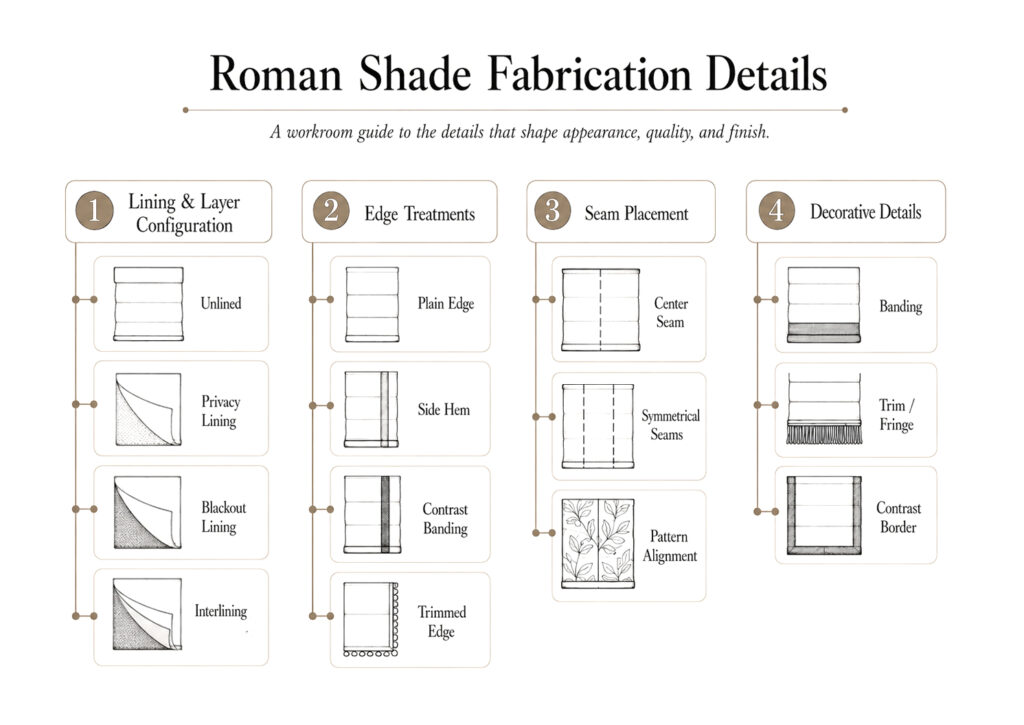
Lining and layer configuration affect light control, body, and fabric performance.
Edge treatments define the finishing quality and visual character of the shade.
Seam placement becomes especially important when working with wide windows, patterned fabrics, or fabrics that require joining.
Decorative details such as banding, trim, and contrast borders provide additional opportunities to enhance proportion and design expression.
These finishing decisions may appear subtle, but they often create the difference between a basic Roman Shade and a highly refined custom piece.
Conclusion
Roman Shades are more than fabric panels that move up and down. They are the result of multiple design and fabrication decisions working together.
Understanding Roman Shades requires looking beyond a single style name and considering:
- Visual appearance
- Construction method
- Operating system
- Fabrication details
By understanding these four dimensions, designers, workrooms, and manufacturers can make more informed decisions when creating Roman Shades that are both functional and visually refined.
Related Notes
Roman Shade Styles — A Visual Reference Guide
A visual overview of Roman shade styles, from structured and relaxed designs to balloon, Austrian, layered, and specialty forms.
Understanding Roman Shades: A Complete Guide to Styles, Construction, Operation, and Details
A broader introduction to Roman shades, exploring how appearance, construction, operation, and fabrication details work together in the finished treatment.
How to Measure for Roman Shades
A practical guide to measuring Roman shades, including inside and outside mounts, finished dimensions, mounting conditions, and installation considerations. Measuring decisions directly affect the finished proportion and appearance of a Roman shade.
One Room, Many Window Treatments: A Visual Study of Style and Mood
A room-based visual study showing how Roman shades, relaxed Roman shades, drapery, and other window treatments can change proportion, softness, light, and the overall mood of the same space.
Comments are closed.