
Wave-style drapery can look deceptively simple.
Instead of the defined pleats found in traditional headings such as pinch pleat, the fabric moves along the track in a continuous series of soft, even S-curves. From across a room, different wave systems can look very similar.
Once we look at how they are made, however, the construction is not always the same.
In an earlier article, I introduced the basic ideas behind Ripplefold and Wave curtains, including tape, carriers, fullness, and closure options. In this article, I want to look more closely at two common approaches:
- Snap Tape Ripplefold Systems
- Transparent Wave Tape Systems
Both can create a similar continuous wave, but they use different heading structures and different methods of controlling the fabric.
This is not intended as a universal classification of every wave curtain system. Hardware, tape construction, terminology, and dimensions vary by manufacturer and region. The purpose here is simply to understand the underlying logic.
1. Similar Appearance, Different Heading Systems
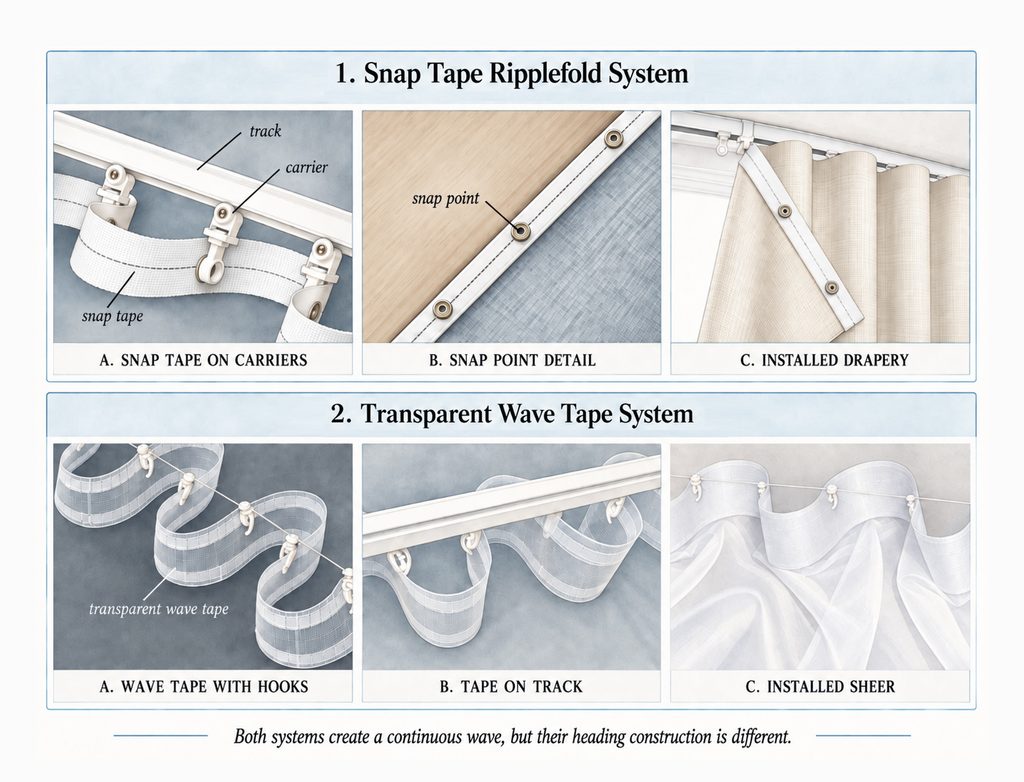
A snap tape Ripplefold system uses a heading tape with pre-set snaps. Once the tape has been sewn to the curtain, those snaps connect directly to compatible carriers in the track.
A transparent wave tape system uses a different type of heading tape. The tape typically provides multiple hook positions or pockets, allowing hooks to connect the curtain to a compatible carrier system.
From the front, both treatments may produce a very similar rhythm of repeated waves.
From a workroom perspective, however, the construction logic is different.
The snap system relies on pre-set snap positions and compatible carriers, while the transparent tape system allows more flexibility in how hook positions are selected.
The appearance may be similar, but the system behind it is not necessarily the same.
2. Fabric Determines Whether the Wave Falls Naturally
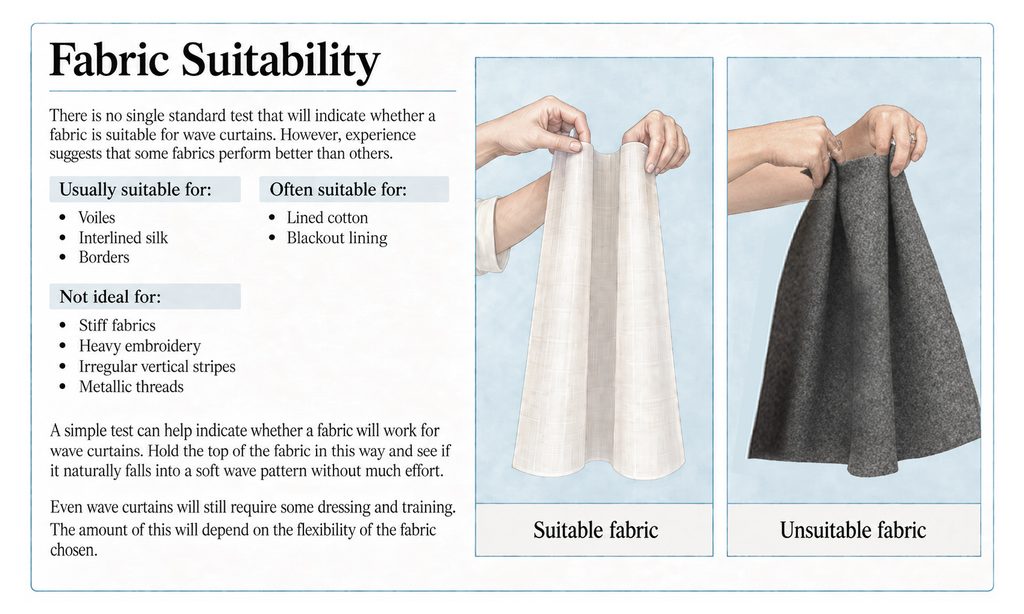
Regardless of the heading system, the track and tape only establish the rhythm of the folds.
The fabric itself determines whether that rhythm becomes a soft, natural wave.
Fabrics with a flexible hand and good drape generally perform well because they can move easily into repeated curves. Sheers, voiles, and many soft decorative fabrics are often good candidates.
Lined fabrics can also work well, provided the finished panel does not become too stiff or bulky.
Very stiff fabrics, heavily structured textiles, dense embroidery, or materials that resist bending may be more difficult to control. Some strong stripes or metallic fabrics may also behave unpredictably as they move repeatedly forward and backward.
A simple fabric test can be surprisingly useful: gather the top edge into a loose wave and observe how the fabric falls.
If the curves form naturally, the fabric is more likely to work well in a wave heading.
I tend to think of it this way:
The tape establishes the rhythm; the fabric creates the wave.
3. Heading System and Draw Configuration Are Separate Decisions
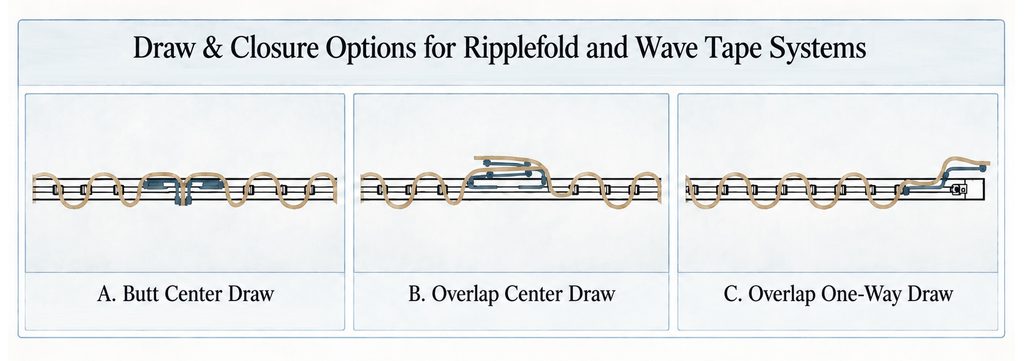
The type of heading system does not automatically determine how the curtain must open or close.
These are two separate decisions.
The heading system determines how the fabric connects to the track and how the repeated wave is created.
The draw and closure configuration determines how the curtain moves and how the panels meet when closed.
Common arrangements include:
Butt Center Draw
Two panels meet directly at the center without overlapping.
This creates a clean center line and keeps the two sides visually balanced.
Overlap Center Draw
One panel extends slightly in front of the other at the center.
This can provide additional coverage at the meeting point, but it requires compatible master-carrier or overlap hardware.
Overlap One-Way Draw
A single panel can also use overlap hardware at the leading edge to improve coverage when the curtain is closed.
The important point is that closure is not determined by the tape alone.
Whether a particular butt or overlap arrangement is possible depends on the track and hardware being used.
4. Different Systems Use Different Connection Hardware
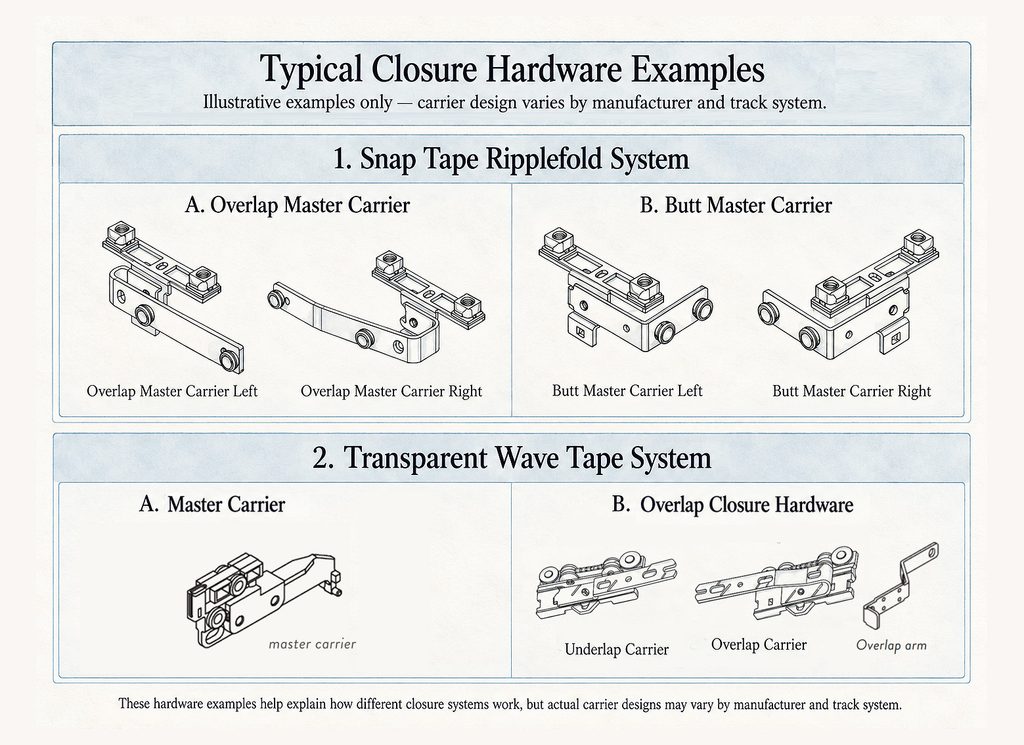
The two heading systems also use different ways of connecting the curtain to the master carrier, so their hardware should not be assumed to be interchangeable.
In a snap tape Ripplefold system, the snaps in the heading tape connect directly to compatible master carriers.
A transparent wave tape system uses a different hook-and-carrier connection. Depending on the track system, different forms of master carrier, overlap carrier, or overlap arm may be used.
The hardware shown in the illustration should therefore be understood as typical examples rather than a universal standard.
The more important question is:
Are the tape, hooks, carriers, and master carriers designed to work together as one compatible system?
That is usually more useful than judging components simply by their appearance.
5. What Closure and Return Look Like in the Finished Curtain
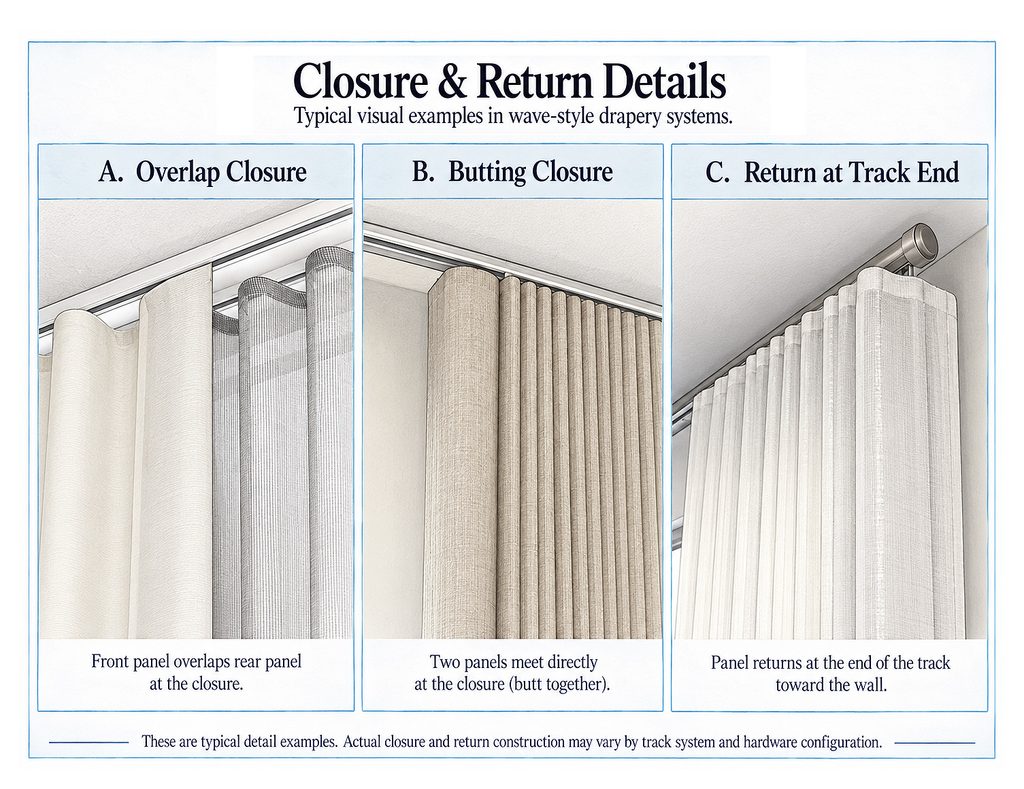
Once installed, the hardware decisions become visible in a few simple details.
Butting Closure
Two panels meet directly at the center.
The transition is simple and visually clean, although the exact center alignment will depend on the track and master-carrier setup.
Overlap Closure
One panel passes slightly in front of the other.
This can help reduce a visible center gap and may be useful where additional coverage is desirable.
Return at the Track End
At the end of the track, the curtain can turn back toward the wall to form a return.
A return helps finish the side of the treatment and can also reduce the amount of exposed hardware when viewed from the room.
As with the center closure, the exact return construction varies by track system and hardware configuration.
6. Spacing Is What Shapes the Wave
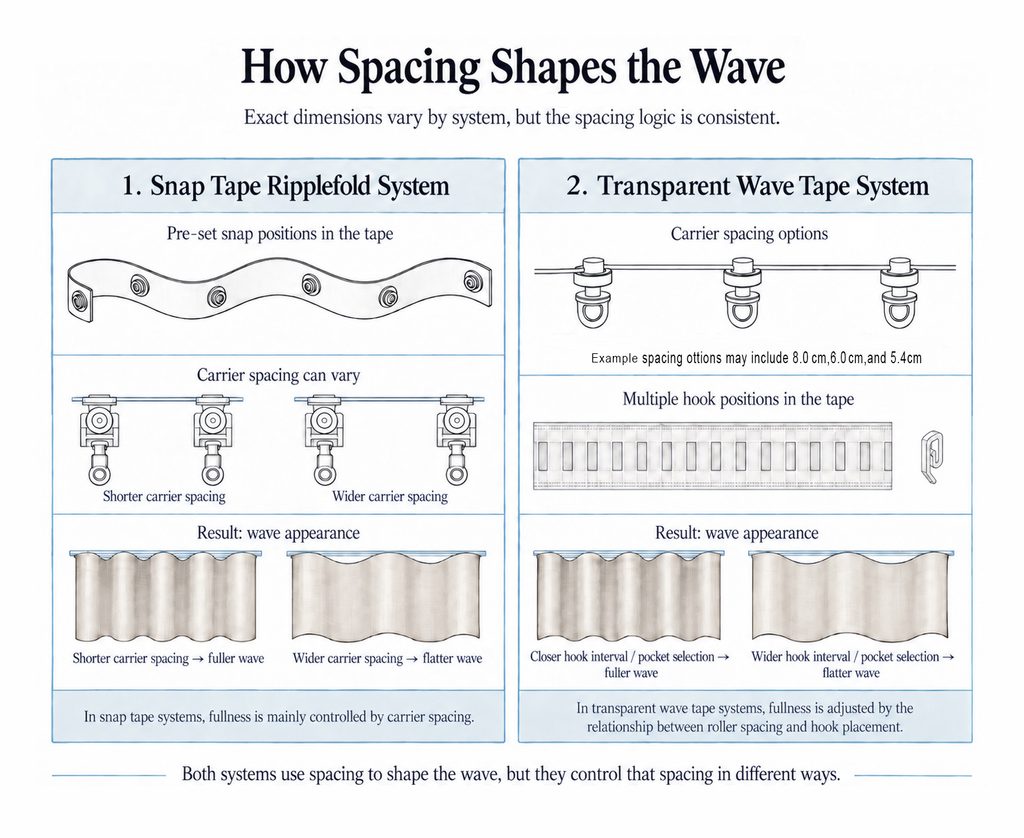
This is where the two systems become especially interesting.
Both rely on repeated spacing to create the wave, but they control that spacing in different ways.
Snap Tape Ripplefold System
Within a selected snap tape system, the snap positions are generally pre-set.
Different fullness levels can then be created by using different carrier spacing.
In simple terms:
- Shorter carrier spacing creates a denser, fuller wave.
- Wider carrier spacing creates a more open, flatter wave.
The exact snap pitch and carrier spacing depend on the particular system, so the numbers should always be checked against the manufacturer’s specifications.
The important principle is the relationship between the fixed snap positions and the carrier spacing.
Transparent Wave Tape System
Transparent wave tape usually provides multiple hook positions along the heading.
The carrier or roller spacing is still part of the system, but hook placement introduces another level of adjustment.
By selecting different hook intervals, the workroom can change the amount of fabric used between repeated wave positions.
This means the final wave is shaped by the relationship between:
- carrier or roller spacing
- hook placement
- fabric allowance
Some systems may use carrier spacings such as 8.0 cm, 6.0 cm, or 5.4 cm, but these should be treated only as examples rather than universal standards.
The main idea is much more useful than memorizing the numbers:
Both systems use spacing to shape the wave, but they control that spacing in different ways.
7. Fullness Is More Than a Percentage
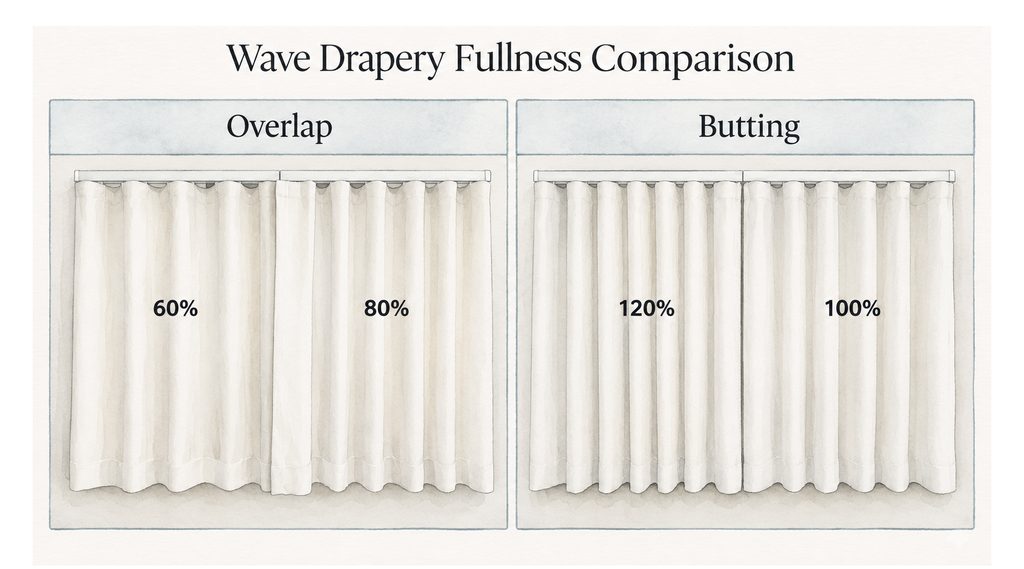
Numbers such as 60%, 80%, 100%, or 120% fullness can seem abstract until they are viewed as finished curtains.
Lower fullness generally creates a more open wave with a wider visual rhythm.
Higher fullness introduces more fabric, creating a denser and more substantial appearance.
But fullness should not be selected by appearance alone.
It also influences:
- fabric requirement
- number of carriers
- stackback
- installation depth
- overall visual weight
A fuller curtain may look richer, but it also requires more fabric and usually occupies more space.
For that reason, fullness is best considered together with the fabric, track system, window width, and available installation space.
8. Installation Depth and Stackback
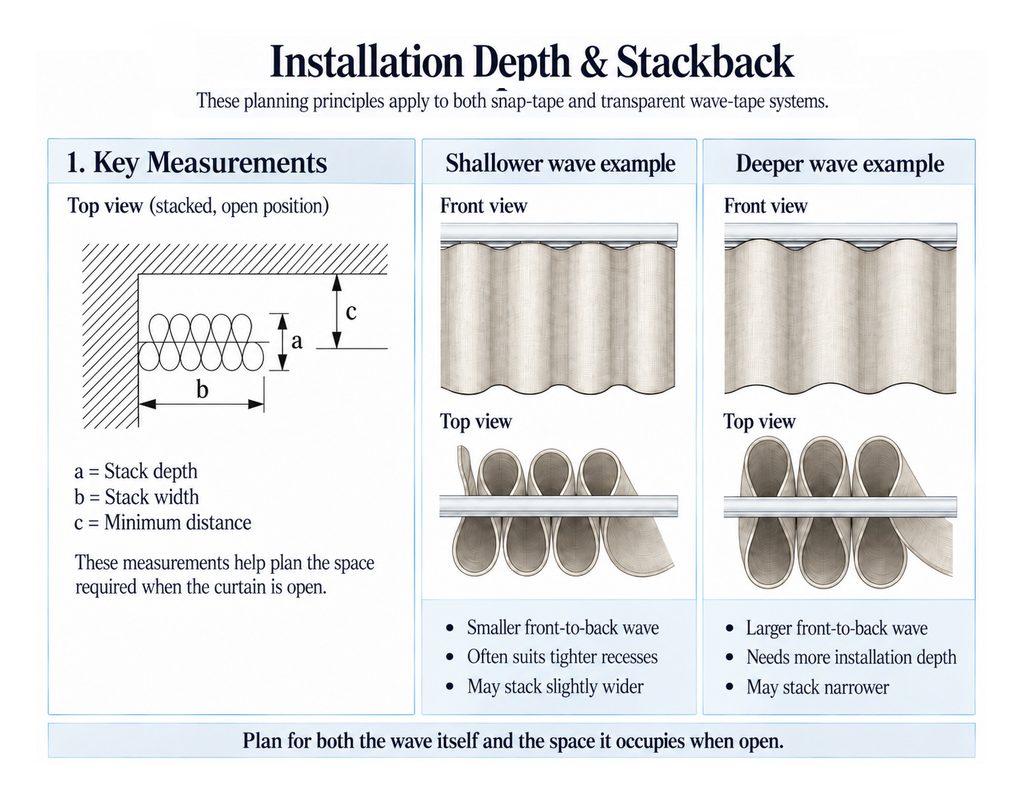
Wave curtains are often selected for their clean appearance, but space planning is just as important as the heading itself.
Two dimensions deserve particular attention.
Installation Depth / Minimum Distance
This is the front-to-back clearance required for the curtain to form its wave and move freely.
The curtain needs enough room to avoid interfering with the wall, glass, window trim, handles, recess edges, or another curtain layer.
Stackback
When the curtain is opened, it occupies space in two directions.
Stack depth describes how much thickness the open curtain occupies from front to back.
Stack width describes how much horizontal track length is occupied by the curtain when it is gathered to the side.
These measurements are not fixed.
They can be affected by:
- carrier or glider spacing
- hook spacing
- fullness
- wave depth
- fabric thickness
- lining
- track hardware
A deeper wave generally requires more front-to-back clearance.
A shallower wave may work better in a tighter recess, but that does not necessarily mean it will create the smallest stack width when open.
This is an important distinction.
Space planning for a wave curtain should consider both:
How much depth is needed when the curtain is closed, and how much width is needed when it is open.
Actual dimensions should always be confirmed using the technical information for the selected track system.
Final Thoughts
Ripplefold and Wave curtains may appear very similar from across a room, but the finished result depends on much more than the S-shaped fold itself.
Heading tape, carrier spacing, hook placement, fullness, fabric behavior, closure hardware, and installation space all work together.
For that reason, I find it more useful to think of wave drapery as a system, rather than simply as a heading style.
Different systems can use different methods to achieve a similar visual effect.
Understanding those methods—and knowing which variables need to be checked—is often more useful than memorizing one fixed set of dimensions.
Related Articles
If you would like to continue exploring the structure and planning behind custom drapery, these articles may also be useful:
Comments are closed.