
Not every window is well suited to full, operable drapery.
In some rooms, a window may sit close to a corner, built-in cabinetry, furniture, or another nearby window. Even when the window itself is generously sized, the amount of usable wall space around it may still be limited.
The issue is often not the drapery itself, but whether there is enough space for the treatment to return, stack back, and remain easy to operate.
In these situations, it is usually more helpful to understand the limitation first, then choose a treatment direction that works with the space rather than forcing a full drapery solution.
What Causes Limited Drapery Space?
Drapery needs more than the width of the window opening.
When panels are opened, fabric needs room to stack beside the glass. Returns also require side space, depending on the hardware and treatment configuration.
The more useful question is:
How much usable wall space is actually available around the window?
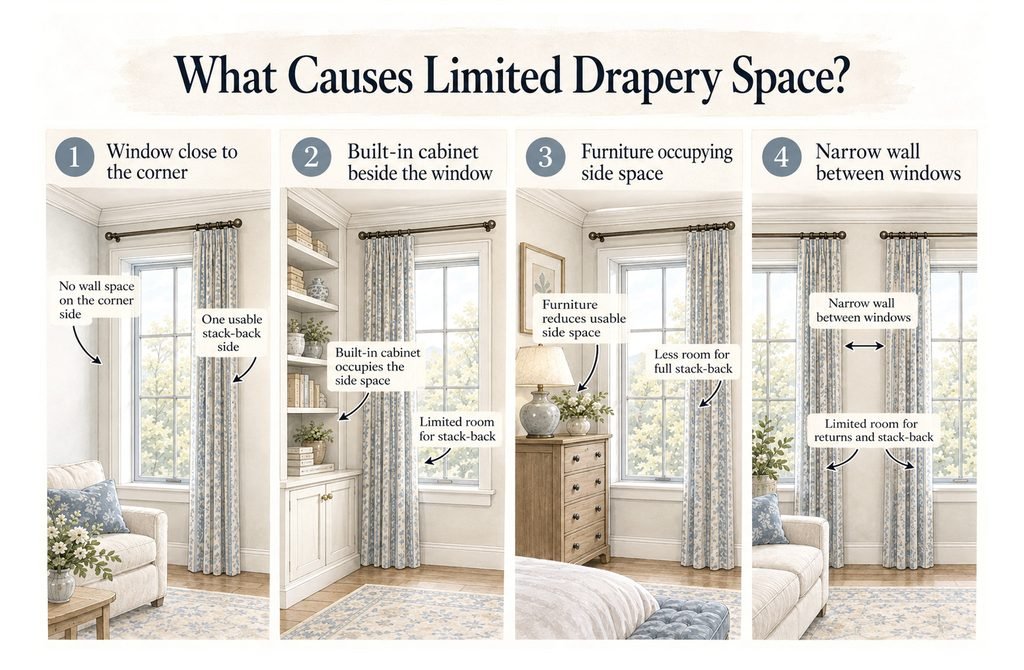
Common limitations include the following.
A Window Close to the Corner
When a window sits very close to a wall corner, one side may have little or no usable wall space for stack-back.
This does not necessarily mean drapery is impossible. It simply means the two sides of the window are no longer equal.
If the opposite side has enough space, one-sided stacking may be more practical than trying to create a balanced two-sided treatment.
Built-In Cabinetry Beside the Window
Built-in cabinets, shelving, or fixed millwork can occupy the same side space that drapery would normally use.
Unlike movable furniture, built-ins are part of the room condition, so the treatment often needs to adapt around them.
Furniture Occupying Side Space
A dresser, nightstand, console, or other furniture piece can also reduce usable stack-back space.
The wall may technically still exist, but it is no longer completely available to the drapery.
A Narrow Wall Between Windows
When two windows are positioned close together, the wall between them may need to accommodate returns and stack-back from both sides.
If that wall section is too narrow, the two drapery systems can begin to compete for the same space.
What Happens When Stack-Back Space Is Limited?
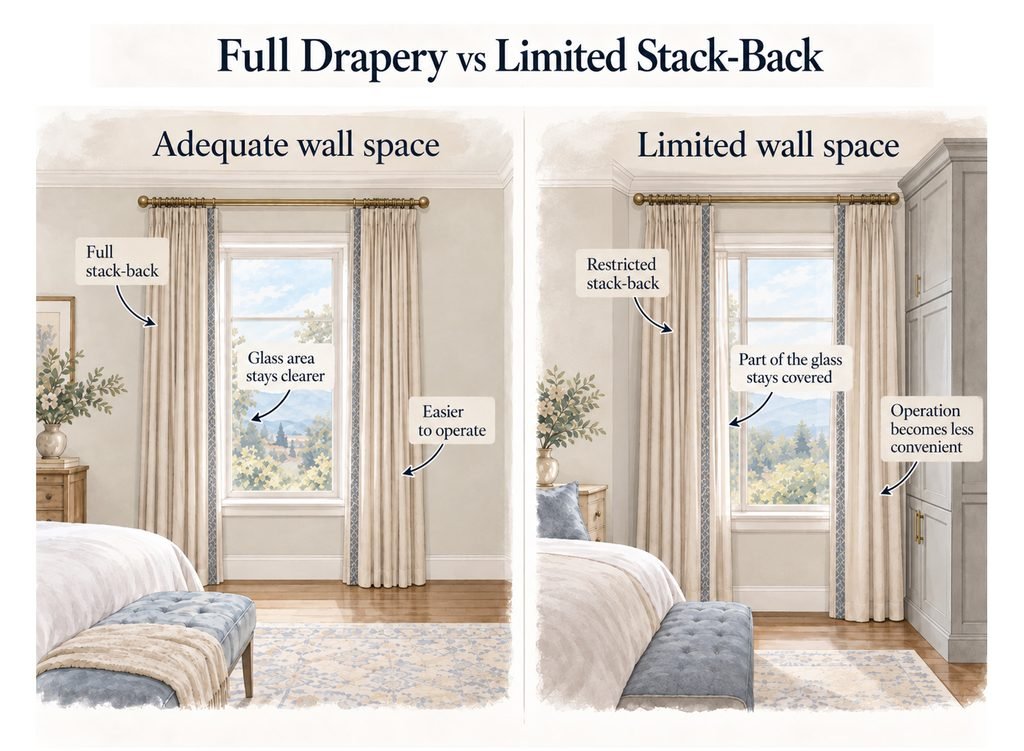
When adequate wall space is available, drapery can stack farther away from the glass, leaving more of the window exposed.
This usually helps maintain a clearer view, better daylight, and easier daily operation.
When stack-back space is limited, several things may happen:
- part of the glass remains covered
- the window can appear visually narrower
- fabric may feel crowded
- operation may become less convenient
- nearby furniture or built-ins may interfere with the treatment
- the overall composition may feel less balanced
Stack-back is therefore not only a technical detail about where the fabric goes when the drapery is open.
It also affects:
view, daylight, proportion, operation, and overall composition.
Alternatives When Full Drapery Is Not Practical
Limited wall space does not mean the window has to remain untreated.
In many cases, the better approach is to redistribute the functional and decorative roles among different products.
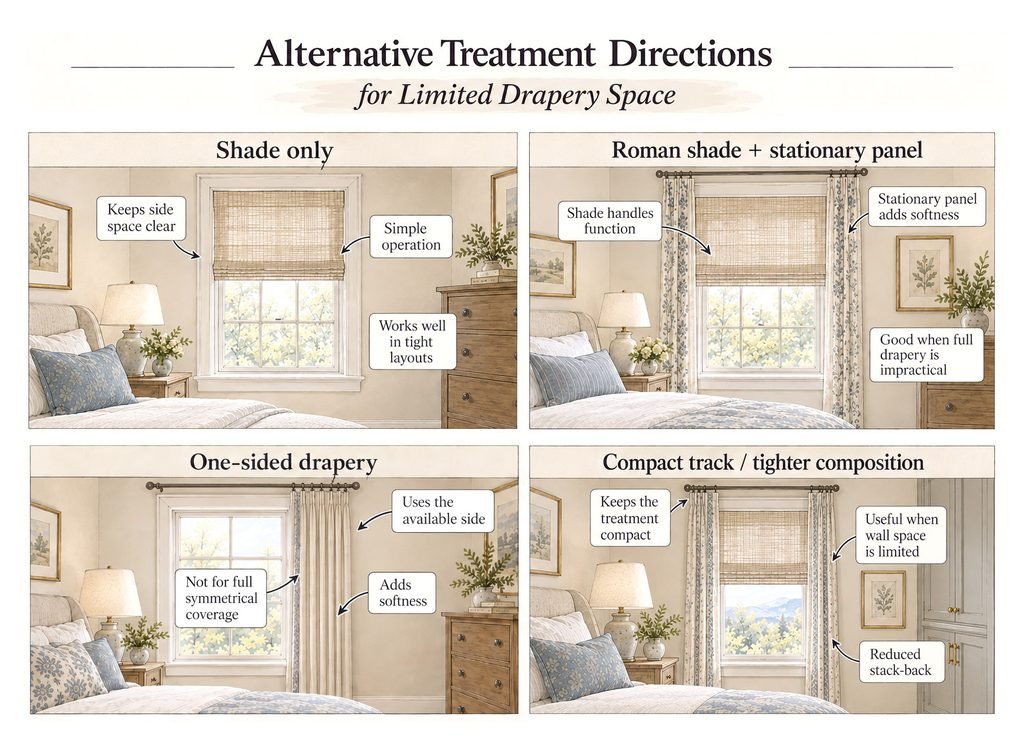
Shade Only
When side space is very limited, a shade can be one of the simplest solutions.
Roman shades, roller shades, and woven shades can provide privacy and light control without relying on wall space beside the window.
This approach works especially well in:
- tight layouts
- rooms with furniture close to the window
- spaces with built-ins
- situations where a cleaner window area is preferred
The result is compact and straightforward to operate.
Roman Shade + Stationary Panel
When some fabric softness is still desired but full operable drapery is not practical, the functional and decorative roles can be separated.
The Roman shade handles:
- privacy
- light control
- daily operation
The stationary panel adds:
- softness
- vertical proportion
- a decorative finish
Because the panel does not need to move every day, it requires much less functional stack-back space.
One-Sided Drapery
When the two sides of a window have very different conditions, it can make sense to use the side that actually has room.
For example, if one side is limited by a corner, furniture, or built-in cabinetry while the opposite side has usable wall space, the drapery can stack toward the open side.
This can be designed as:
- one-way draw operable drapery
- or a one-sided stationary panel
The point is not asymmetry for its own sake.
It is simply to use the space that is genuinely available.
Compact Track or Tighter Composition
Some rooms are not severely restricted, but the available wall space is still tighter than ideal.
In these cases, the overall treatment can sometimes be made more compact through:
- a tighter track layout
- a smaller return
- narrower decorative panels
- reduced fabric volume
- using a shade for most of the functional work
There is an important limit to this approach:
A compact system can optimize limited space, but it cannot create stack-back space that does not exist.
If the wall condition is severely restricted, changing the track alone will not solve the underlying problem.
Wall Width Is Only Part of the Decision
The same amount of wall space can lead to very different design decisions depending on how the window is used.
If the window provides an important view, keeping the glass area clear may be a priority.
If the view is less important, or if the drapery is primarily decorative, some fabric remaining in front of the glass may be acceptable.
Other questions also matter:
- Does the room need maximum daylight?
- How much privacy is required?
- Does the window itself need frequent access?
- Will the drapery be operated every day?
- Are there nearby built-ins, vents, radiators, or furniture?
- Is full opening actually necessary?
Limited space alone does not determine the answer.
The window’s function determines how important that limitation becomes.
A Practical Planning Sequence
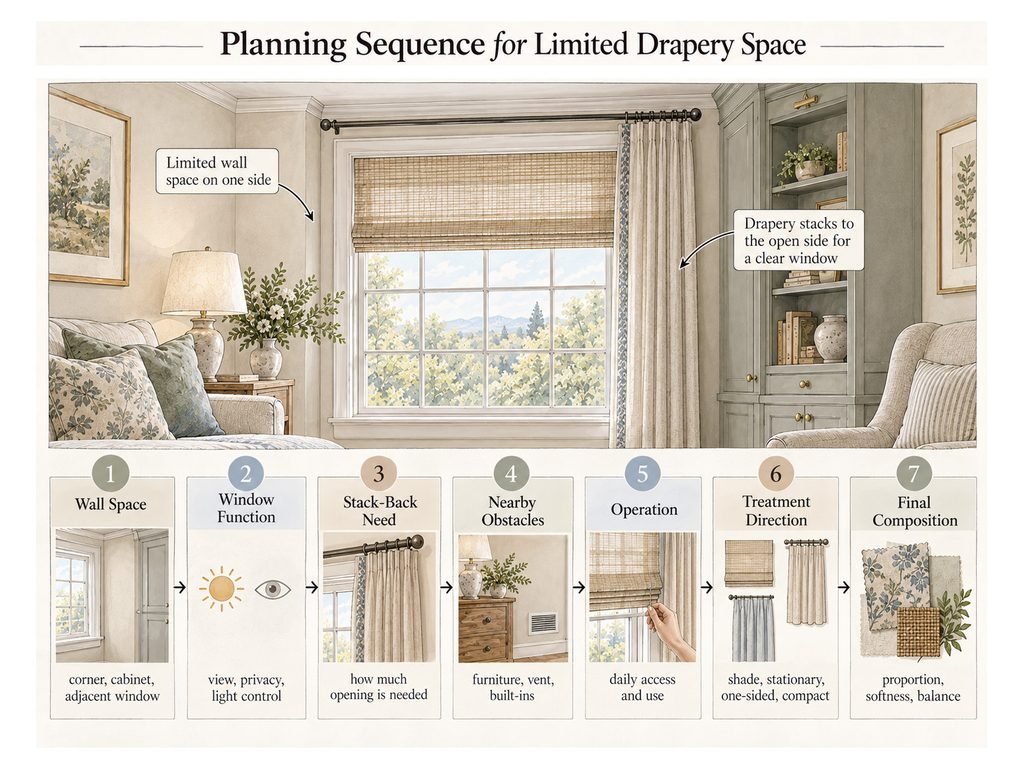
When drapery space is limited, the following sequence can help organize the decision-making process:
Wall Space → Window Function → Stack-Back Need → Nearby Obstacles → Operation → Treatment Direction → Final Composition
Wall Space
Start by identifying how much usable wall space exists on each side of the window.
Window Function
Consider view, privacy, and light-control requirements.
Stack-Back Need
Determine how much of the glass should remain exposed when the treatment is open.
Nearby Obstacles
Check for furniture, built-ins, vents, radiators, or other architectural restrictions.
Operation
Consider how the treatment will be used day to day and whether access is convenient.
Treatment Direction
Only then decide whether the best direction is:
- a shade
- a stationary panel
- one-sided drapery
- a compact treatment
- or another combination
Final Composition
The final step is to refine:
- proportion
- softness
- balance
- fabric
- pattern
- finish
Final Thoughts
When wall space beside a window is limited, the real question is usually not:
Can drapery still be used?
A more useful question is:
How much usable space is available, which functions need to be preserved, and which parts of the treatment need to change?
Sometimes a shade-only solution is the clearest answer. In other situations, a Roman shade with stationary panels, one-sided drapery, or a more compact composition may work better.
Limited space does not always mean compromise.
It simply means the treatment needs to respond more carefully to the room.