
In custom window treatment design, not every drapery panel needs to open, close, or provide privacy.
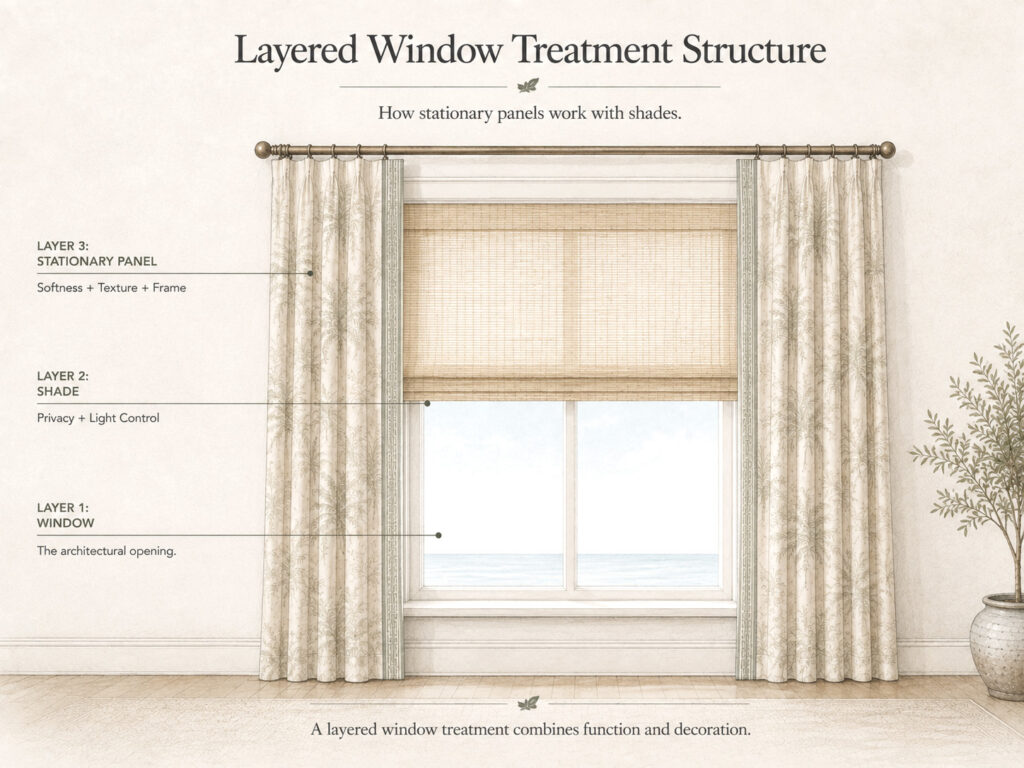
A stationary panel is a fixed decorative drapery panel used to frame a window, soften architectural lines, and introduce fabric into a space without covering the view.
In many interiors, the window itself already provides enough natural light, openness, or visual interest. A fully operable drapery treatment may not be necessary. At the same time, leaving the window completely untreated can sometimes make the space feel too hard, too open, or visually unfinished.
Stationary panels offer a middle ground.
They preserve the openness of the window while adding softness, proportion, texture, and a stronger sense of completion to the overall design.
What Is a Stationary Panel?
A stationary panel is a drapery panel that remains fixed in place rather than opening and closing as part of the daily operation of the window treatment.
Its purpose is primarily decorative and architectural.
Depending on the design, stationary panels can help:
- frame the window opening;
- soften hard architectural edges;
- introduce fabric texture and color;
- strengthen vertical proportions;
- create a more layered and finished window treatment.
Because the panels are not designed for regular movement, their width, fullness, placement, and visual weight can be planned differently from fully operable drapery.
Stationary Panel vs. Functional Drapery
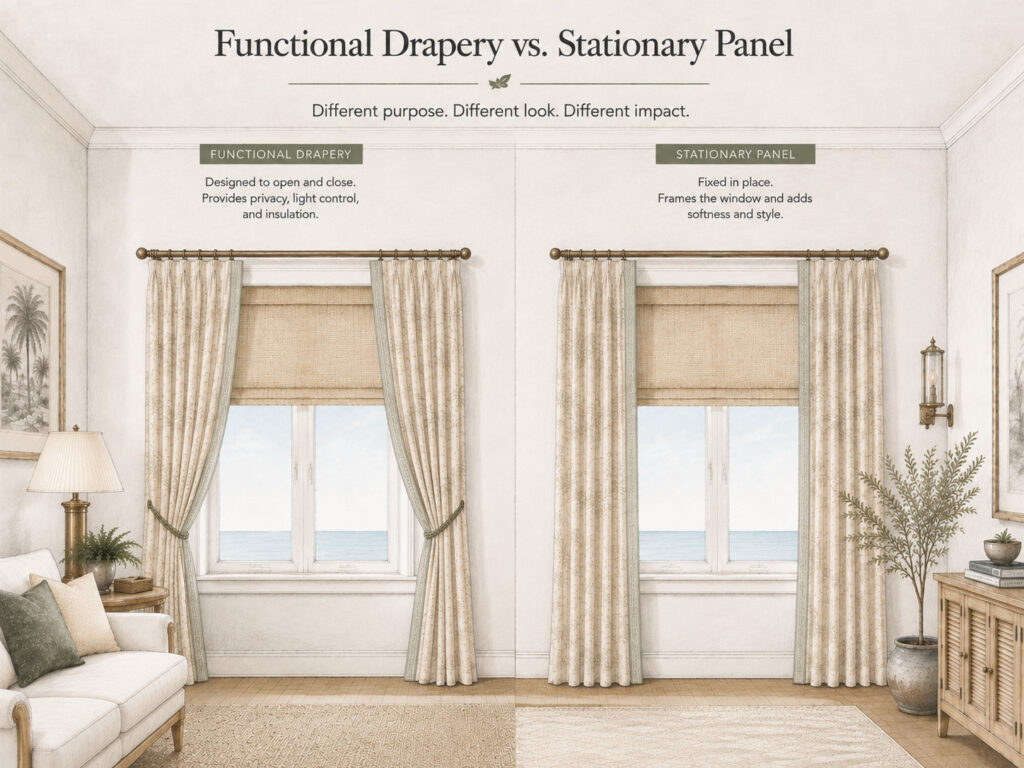
Stationary panels and functional drapery may look similar at first glance, but they serve different purposes.
Functional drapery is designed to move. It may provide privacy, light control, insulation, or room darkening, and its construction must account for operation, stack back, fabric volume, hardware, and clearance.
Stationary panels, by contrast, remain in a fixed position.
Their role is less about operation and more about composition.
Instead of asking how the drapery will open and close, the design focus shifts toward questions such as:
- How should the window be framed?
- How much fabric is needed to create visual balance?
- Where should the panels begin and end?
- How should they relate to the architecture and the other window treatments in the room?
Why Use Stationary Panels?
Frame the Window
Windows are often strong architectural features within a room, but large areas of glass can also feel visually exposed or disconnected from the surrounding walls.
Stationary panels create a soft vertical frame around the opening.
They help define the window without covering it, allowing the view and natural light to remain part of the composition.
Add Softness Without Blocking the View
Many contemporary interiors are designed around natural light, open views, and large windows.
In these spaces, full drapery may introduce more fabric than the room needs.
Stationary panels allow designers to bring in the softness and texture of fabric while keeping the central glass area open.
This makes them especially useful when the goal is to soften the architecture rather than control the window itself.
Improve Visual Proportion
The proportion of a window can have a strong effect on the room.
Tall windows may feel overly vertical. Wide windows may need stronger framing. Groups of windows may benefit from a clearer visual connection.
Stationary panels can help adjust this balance by adding height, rhythm, or visual weight where it is needed.
The effect is subtle, but it can significantly change how the window relates to the surrounding space.
With or Without Stationary Panels
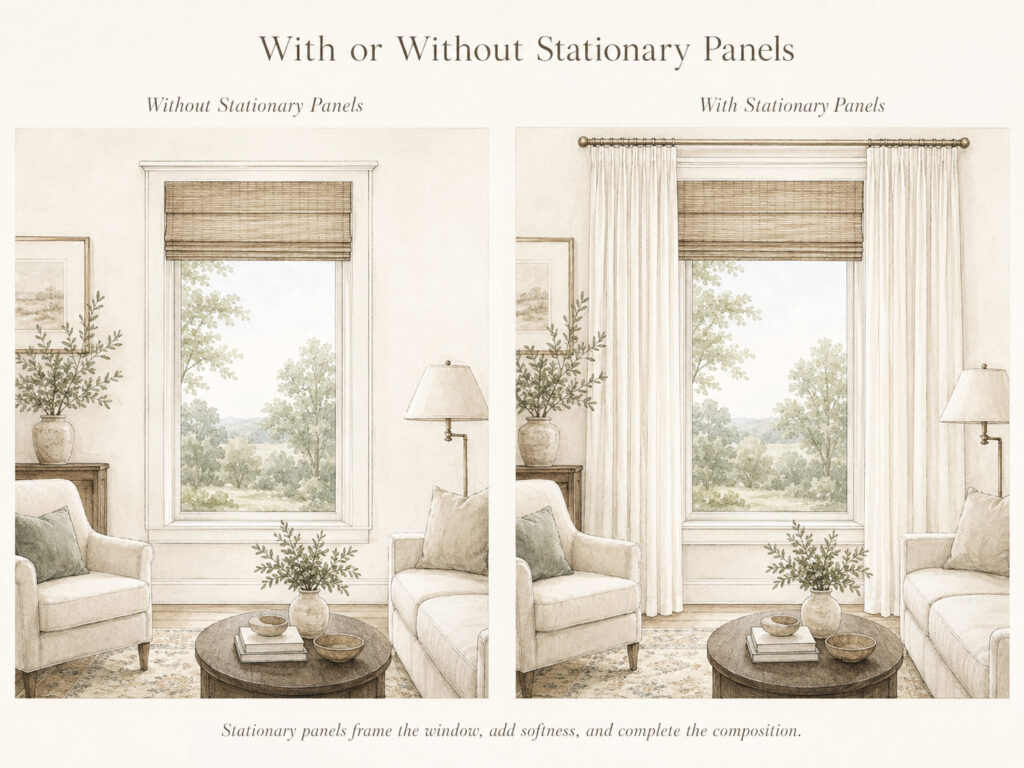
The difference between a window with and without stationary panels is not simply the addition of fabric.
It is often a difference in visual balance.
Without stationary panels, the window may feel more architectural and minimal, but it can also appear isolated from the rest of the room.
With stationary panels, the opening becomes more integrated into the overall composition.
The fabric helps connect the window to the furnishings, softens the surrounding wall surface, and creates a clearer sense of completion.
Stationary Panels for Different Window Types
Stationary panels are not limited to one particular window type.
Their role can change depending on the height, width, shape, arrangement, and architectural character of the opening.
On one project, they may be used to emphasize vertical proportion. On another, they may soften the angles of a bay window, frame a standard window, or complement an arched opening without covering its architectural shape.
There is no single formula.
The design should respond to the window itself:
- which architectural lines should remain visible;
- which proportions need to be strengthened or balanced;
- how much visual space the fabric should occupy;
- whether the panels should be combined with Roman shades, roller shades, or another treatment;
- and how to introduce softness without compromising light or the view.
The value of a stationary panel is not that it changes the window. It is that it helps the existing architecture feel more complete.
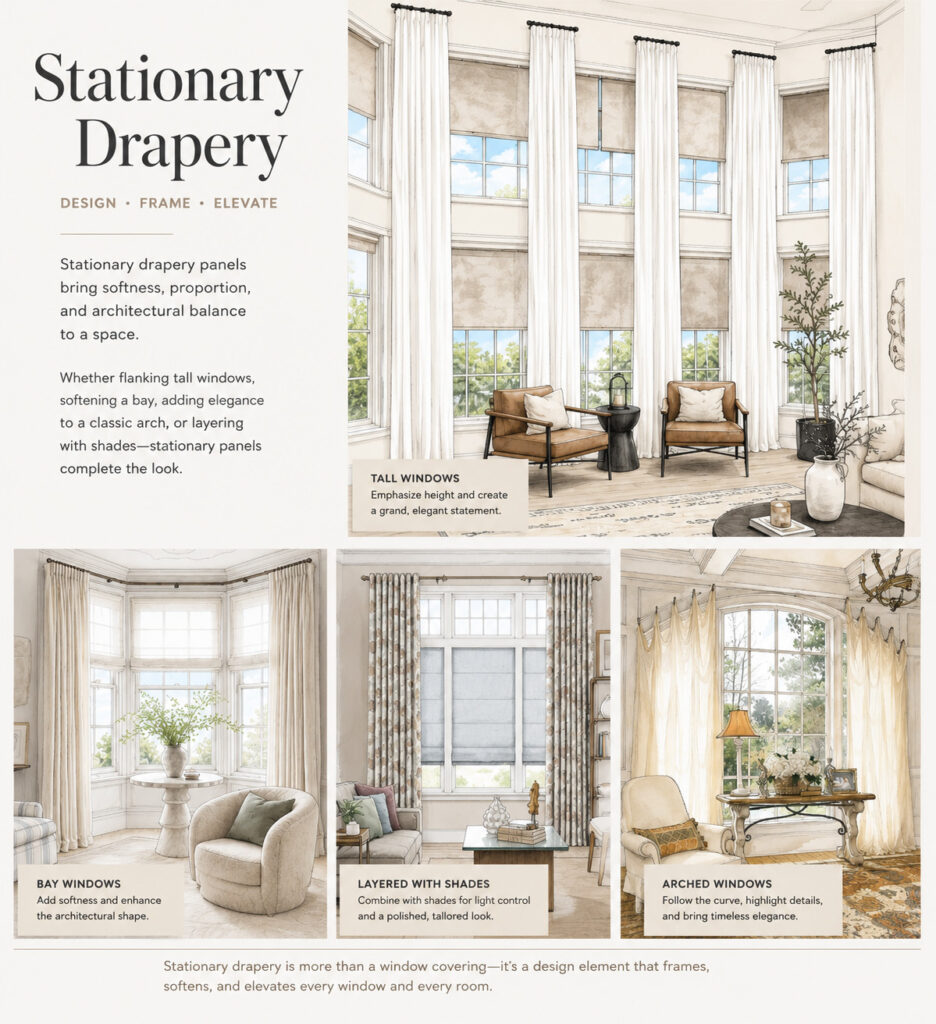
The examples shown here—including tall windows, a bay window, an arched window, and a standard window layered with shades—represent only a few possible applications.
In practice, stationary panels can be adapted to many different architectural conditions. Their flexibility is part of what makes them useful in custom window treatment design.
Final Thoughts
Stationary panels may appear simple, but their effect depends on careful proportion and placement.
They are not a substitute for functional drapery. They are a separate design tool.
Used well, stationary panels can frame a view, soften architecture, improve proportion, and bring fabric into a room without overwhelming the window.
As with many custom window treatments, the strongest result usually comes from understanding what the window already does well—and then adding only what is needed to complete the design.
Related Notes
Drapery Length, Coverage, and Layering: A Visual Guide
A visual guide to drapery length, floor behavior, coverage, draw direction, layering, and other design choices that influence proportion, function, and the overall appearance of a window treatment.
Drapery Lengths Explained: Sill, Apron, Float, Kiss, Break & Puddle
A closer look at six common drapery lengths and how different relationships with the sill, apron, and floor affect the finished appearance.
Understanding Drapery Heading Styles: How Different Headings Shape Custom Drapery
An exploration of how pleated, wave, and rod-based headings influence the structure, fullness, and visual character of custom drapery.
How to Measure for Drapery
A practical guide to measuring custom drapery, including window dimensions, coverage, rod width, stack back, finished length, and site conditions.
Comments are closed.