
Earlier this year, I stayed at a design-led hotel in London.
The window treatments immediately caught my attention. Beyond the color and pattern, I found myself looking closely at the installation, concealed track, blackout roller shade, lining construction, hand finishing, and some of the small details that affect daily use.
I took these photographs during my stay, and when I looked through them again later, I realized they offered a useful opportunity to study a completed window treatment system in a real setting.
This treatment is not simply decorative. It brings together:
appearance, privacy, light control, installation, construction, and everyday operation.
Rather than treating it as a standard solution to copy, I wanted to look at how the different parts work together in an actual room.
1. The Room as a Whole
The drapery is clearly part of the overall interior rather than an isolated decorative element.
The blue patterned wallpaper, large-scale floral upholstered headboard, and yellow-and-cream striped drapery all have a strong visual presence.
Taken individually, none of these elements is particularly quiet. Yet together, the room still feels coordinated.
One reason is the difference in pattern scale:
- the wallpaper uses a relatively small repeat
- the upholstered headboard introduces a much larger floral pattern
- the drapery uses a strong horizontal stripe
At the same time, blues, yellows, creams, and neutrals repeat across the room, connecting these different patterns through a consistent color palette.
The drapery therefore contributes to more than privacy or light control. It also affects:
- vertical proportion
- pattern balance
- color rhythm
- softness
- visual weight
In this room, the window treatment is part of the composition of the space rather than something added at the end.

2. Installation and Layered Treatment
One of the most interesting details in this project is the way the hardware is handled.
The drapery runs on a ceiling-mounted track, with the white track mounted directly to the ceiling.
Instead of leaving the track exposed, a fabric-covered fascia has been added in front of it using the same fabric as the drapery.
When the curtains are open, the visible edge still reads as fabric rather than exposed white hardware.
It is a small detail, but it makes the finished treatment feel much more integrated.
Behind the drapery is a separate blackout roller shade.
So this is not a single-layer treatment. It is a true layered system:
blackout roller shade + operable drapery
The two layers do not serve exactly the same purpose.
The drapery contributes:
- decorative presence
- softness
- privacy
- some room darkening
The roller shade adds another independent layer of light control.
In a hotel room, where sleep comfort can be especially important, this extra layer helps strengthen the overall room-darkening performance.
The value of the layering is not simply that there are more products.
It is that different layers are doing different jobs.
Another detail visible at the side is the return. The drapery does not simply stop at the front plane; it turns back toward the wall.
This creates a more finished side edge and reduces the amount of back-side construction visible from the front.
The photographs also show a drapery wand / draw wand used to operate the treatment.
Because the drapery includes face fabric, interlining, and blackout lining, the finished panels are relatively heavy. A wand makes the treatment easier to move while reducing the need to repeatedly handle the fabric itself.
In a hotel environment, that small detail also supports:
operation, maintenance, and fabric protection.

3. Construction and Workroom Details
Once the drapery is opened from the back, the construction becomes even more interesting.
The photographs clearly show at least three layers:
Face Fabric → Interlining → Blackout Lining
Each layer has a different role.
Face Fabric
The striped face fabric defines the visible color, texture, and pattern of the treatment.
At the side edge, the face fabric turns toward the back rather than allowing the lining to run directly to the visible edge.
This creates a cleaner finished face.
Interlining
The interlining is noticeably thick and soft.
It adds:
- body
- fullness
- softness
- insulation
- improved drape
This extra layer helps explain why the finished drapery has such a substantial, tailored appearance.
Blackout Lining
The inner blackout lining provides privacy and improves room-darkening performance.
However, blackout lining alone does not mean that the finished room will be completely free of light.
That depends on the entire installed system.
Another close-up shows hand slip-stitching between the face fabric and interlining.
The purpose is not to create visible decorative stitching, but to secure the internal layers while keeping visible stitching on the front to a minimum.
This is typical of custom drapery construction: the structure is held together internally while the face remains as clean as possible.
The bottom corner is also carefully finished.
The face fabric, interlining, lining, side turn-back, and hem are handled separately before coming together at the corner.
For floor-length drapery, these small finishing details have a noticeable effect on how stable and refined the treatment looks once installed.

4. Light Control in the Real Room
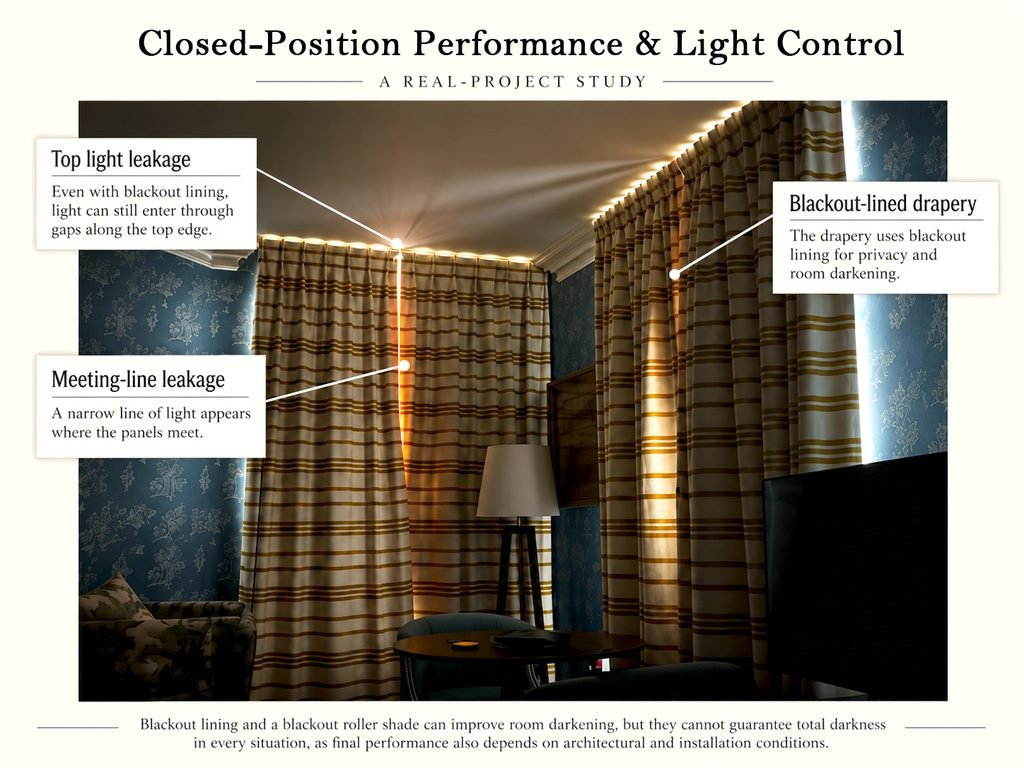
The photograph of the drapery fully closed is especially useful because it shows what happens in real use.
The drapery itself is blackout-lined, yet light can still be seen entering at several locations:
- along the top edge
- at the meeting line between the panels
- at some edges between the treatment and the surrounding architecture
This illustrates an important distinction:
Blackout fabric does not automatically create a blackout room.
The fabric controls how much light passes through the material itself.
The final room-darkening performance also depends on factors such as:
- track position
- ceiling condition
- side gaps
- overlap
- meeting-line design
- roller shade placement
- window frame
- surrounding architectural details
- installation accuracy
This also helps explain why the room includes a blackout roller shade behind the drapery.
The roller shade creates another light-control layer and can improve overall room-darkening performance when used together with the curtains.
But even then, it is important not to assume:
blackout-lined drapery + blackout roller shade = complete darkness
Final performance still depends on the way the products meet the architecture.
In other words, light control is not only a product specification.
It is a relationship between:
material + construction + installation + architectural conditions.
5. What This Project Shows
What I find most interesting about this room is that it does not choose between appearance and function.
Visually, the striped drapery, patterned wallpaper, and upholstered headboard all make strong statements.
At the same time, the treatment includes carefully considered technical details such as:
- concealed hardware
- layered light control
- returns
- a drapery wand
- interlining
- blackout lining
- hand finishing
These elements are not presented as separate technical features. They are absorbed into the overall design.
That is perhaps the most useful lesson from this project.
A good window treatment is not only about how the curtain looks, and it is not only about how much light it blocks.
It needs to consider:
appearance, operation, privacy, light control, construction, maintenance, and installation conditions together.
Real projects are valuable because they show how all of these decisions eventually meet in one finished system.
And the final result is rarely determined by one fabric, one piece of hardware, or one product alone.
It comes from the relationship between:
product selection + construction + installation + user needs + architectural conditions.