
Bedroom window treatments usually need to do more than simply look good.
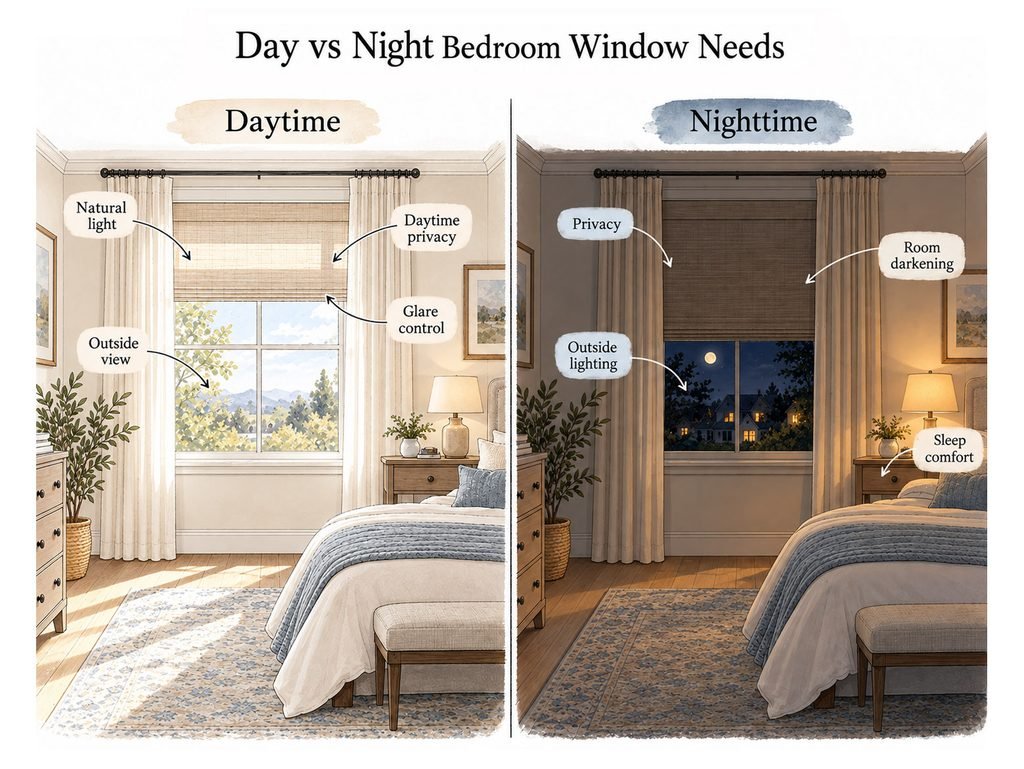
Unlike some other rooms, a bedroom often has different requirements during the day and at night. Natural light may be welcome during the day, while privacy, room darkening, and sleep comfort become more important after dark.
Furniture placement also matters. A bed, nightstand, radiator, HVAC vent, or limited wall space can change what is practical long before fabric, color, or style is considered.
For that reason, bedroom window treatment planning often works best when the room itself comes first and the product choice comes later.
Day and Night Bring Different Needs
During the day, the goal is often to balance natural light with privacy.
Some bedrooms benefit from maintaining an outside view, while others need more screening from neighboring buildings or nearby walkways. Strong sunlight may also create glare or make the room uncomfortable at certain times of day.
At night, the priorities can change.
Once interior lights are on, materials that provided enough privacy during the day may become more transparent from outside. Streetlights, landscape lighting, early morning sun, and other exterior light sources can also affect sleep.
Before choosing between drapery, a Roman shade, a woven shade, or another treatment, it helps to understand a few basic conditions:
- How much daylight should remain during the day?
- How much daytime privacy is needed?
- Is stronger nighttime privacy required?
- Is room darkening sufficient, or is blackout performance important?
- Are exterior lights or early morning sun a concern?
These answers begin to define the treatment more clearly.
Room Layout Often Comes Before Product Choice
A window treatment may look appropriate in a photograph but become inconvenient once it is placed in a real bedroom.
When there is generous wall space beside a window, operable drapery can stack back comfortably and remain easy to use. When a bed, nightstand, or other furniture sits close to the window, the same treatment may become difficult to operate.
Nightstands are a good example.
If drapery needs to move behind lamps, books, or objects placed on a nightstand every day, the arrangement may look finished but function poorly. In this condition, a more compact shade-focused treatment may make more sense.
A bed placed close to a window creates a similar issue. Large amounts of fabric between the bed and the window can feel crowded and may make regular operation less convenient. Roman shades, roller shades, or other treatments contained within the window area can often work more comfortably.
The area below the window also matters.
If a radiator or HVAC vent is located beneath it, floor-length drapery may interfere with heat or airflow. A treatment that stays within or above the window opening can often be a more practical choice.
For this reason, it is useful to look first at:
wall space, furniture placement, window access, and nearby mechanical elements
before deciding on the treatment itself.

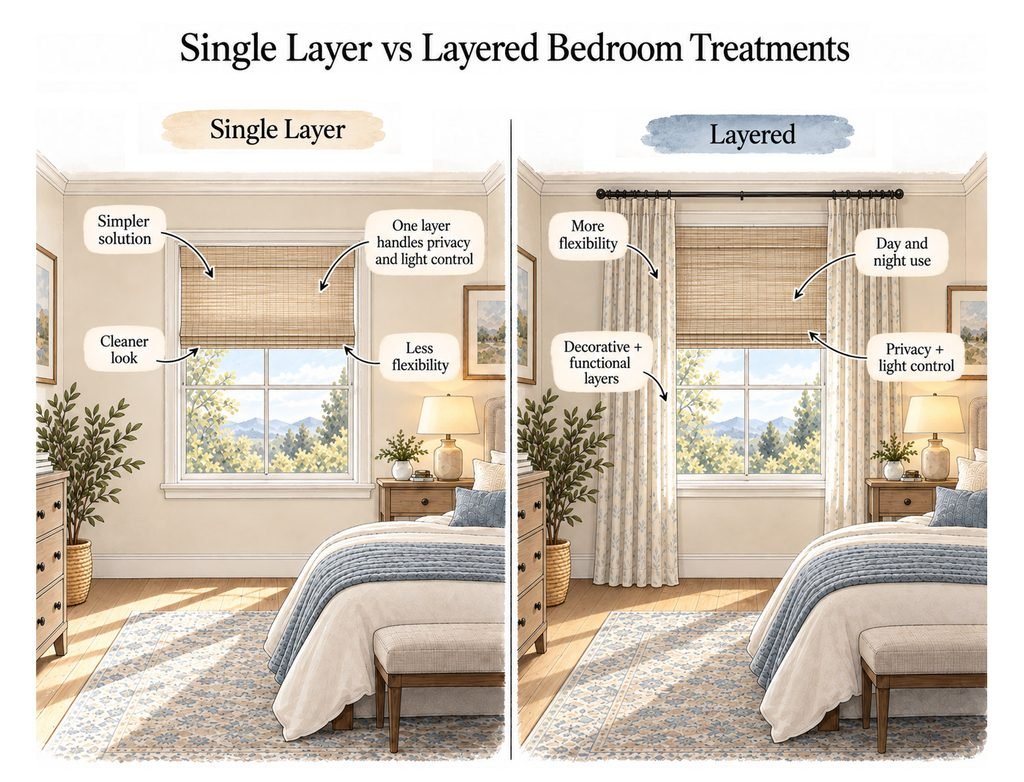
Single Layer or Layered Treatment?
Layered window treatments are common in bedrooms, but layering is not automatically the better solution.
In some rooms, one well-selected treatment is enough.
A single shade, for example, may provide the required privacy and light control while keeping the window area clean and compact. This can be especially useful in smaller rooms or where furniture limits the space around the window.
A single-layer treatment generally offers:
- a simpler construction
- a cleaner visual appearance
- less space around the window
- straightforward daily operation
The trade-off is usually less flexibility.
Layering becomes more useful when different needs are better handled by different layers.
One layer might manage daylight filtering or daytime privacy, while another provides stronger room darkening, nighttime privacy, or a softer decorative finish.
Typical combinations can include:
- shade + drapery
- sheer + lined drapery
- Roman shade + stationary panels
- blackout shade + decorative drapery
The value of layering is not simply that there is more fabric or more detail.
The important question is whether each layer has a clear role.
Daily Operation Matters
Bedroom window treatments are often used every day.
That makes operation an important part of the design rather than a detail to consider at the end.
A few practical questions can quickly reveal whether a treatment will work comfortably:
- Can it be opened and closed easily?
- Will it need to be adjusted every day?
- Does furniture block access to the treatment?
- Will moving fabric interfere with a bed or nightstand?
- Is the control position easy to reach?
- Would motorization improve the way the window is used?
A treatment can look beautifully resolved and still become frustrating if normal operation is awkward.
Function and appearance need to work together.
Appearance Comes After the Main Conditions Are Resolved
Once privacy, light control, sleep requirements, furniture placement, and operation have been considered, the visual design becomes much easier to refine.
This is where decisions about the following elements become more meaningful:
- fabric softness
- fullness
- pattern scale
- color
- lining
- hardware finish
- decorative trim
- overall visual balance
Bedrooms are often associated with softness and calm, but that does not mean every bedroom needs light-colored fabrics or delicate treatments.
A stronger drapery treatment may suit one room, while a simple shade may feel more appropriate in another.
The important point is that appearance should support the room rather than override its practical needs.
A Simple Bedroom Window Treatment Planning Sequence
A useful way to organize the decision-making process is:
Privacy → Light Control → Sleep Needs → Furniture Layout → Operation → Layering → Appearance
This is not the only way to plan a bedroom window treatment, but it helps prevent one common problem: choosing the style too early.
When the room’s functional conditions are understood first, the final treatment usually becomes easier to define.

Final Thoughts
There is no single window treatment that is right for every bedroom.
Window position, furniture layout, orientation, privacy conditions, exterior light, and individual sleep preferences can all change the final solution.
Rather than beginning with a particular product, it is often more useful to begin with the room itself:
What does this bedroom need the window treatment to do?
Once that question is clear, the choice between a single shade, drapery, a layered treatment, or another combination becomes much more purposeful.