
Observing the Details of a Drapery Heading
When looking closely at Pinch Pleat drapery from different brands and workrooms, we may notice subtle differences in the finished heading, even when similar fabrics, fullness, and pleat spacing are used.
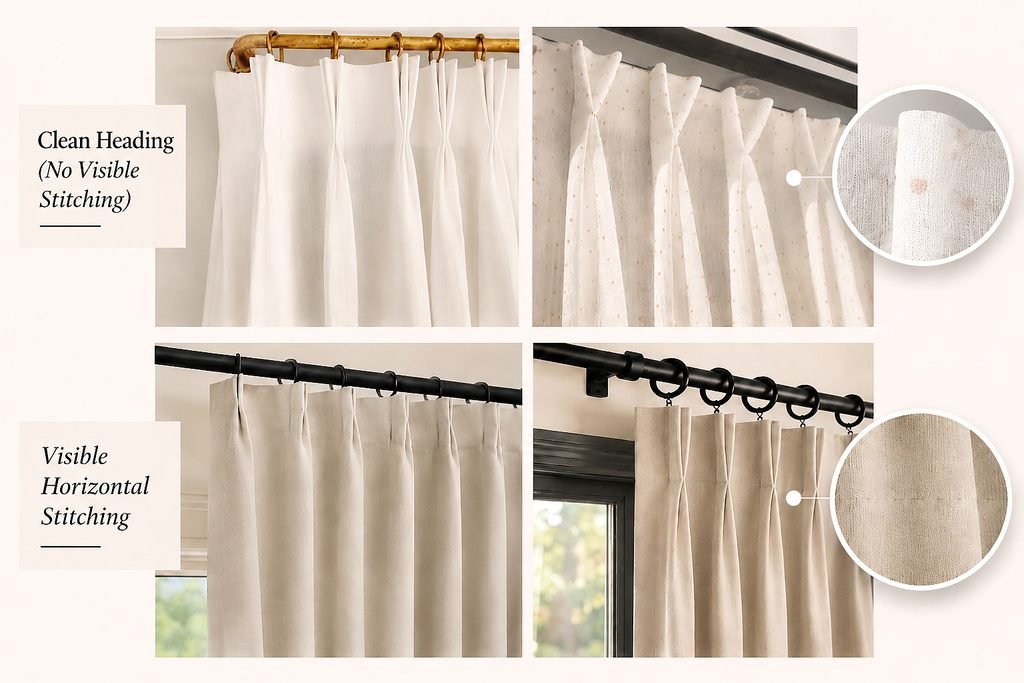
Some headings have a clean, smooth appearance with no obvious horizontal stitch line across the front. Others show a visible horizontal line running along the heading.
Although these headings share a similar pleat style and serve the same basic function, differences in construction details can create noticeably different visual results.
In many high-end custom drapery examples we have observed, the front of the heading maintains a clean appearance without an obvious horizontal stitch line. This raises an interesting question: what creates this visual difference, and how is it related to the internal support structure and construction methods?
Using Pinch Pleat drapery as an example, this article looks at the appearance of horizontal stitching, explores different ways of finishing buckram, and examines how hooks are positioned at the heading.
1. The Role of Buckram in Pinch Pleat Headings
Buckram is a stiffening material used in drapery headings to provide structure and support. It helps the heading maintain its shape and provides a stable foundation for forming pleats.
Depending on the construction, buckram can be finished in several ways.
Exposed Buckram
The buckram remains visible on the back of the heading rather than being fully covered by the face fabric. Its surface and edges can be seen from the reverse side.
Fabric-Wrapped Buckram
The face fabric is folded over the buckram, enclosing the support material within the fabric.
Fabric and Lining Wrapped Buckram
For lined drapery, the face fabric and lining can be used together to wrap and enclose the buckram, creating a layered construction.
These approaches describe how the buckram is covered. They do not, by themselves, determine whether a horizontal stitch line will be visible on the front of the finished heading.
Any of these constructions may be finished with or without an obvious horizontal stitch line, depending on the method used to secure the layers.

2. Visible Stitching and Clean Heading Finishes
During Pinch Pleat heading construction, the fabric and buckram need to remain properly aligned so that the pleats can be formed consistently.
One approach is to add a continuous horizontal stitch along the lower edge of the buckram, securing the relevant layers together. This can help limit movement between the materials during subsequent handling and make positioning more consistent during pleating.
Another approach aims to avoid a visible horizontal stitch line on the front of the finished heading, resulting in a cleaner and more continuous appearance.
It is important to understand that these two visual results do not correspond to two specific buckram-covering methods. Whether the buckram is exposed, wrapped with face fabric, or enclosed together with the lining, the finished heading may have visible stitching or no obvious horizontal stitch line.
Workrooms also use different methods to secure the layers, depending on fabric characteristics, available equipment, and production preferences. These may include machine stitching, heat bonding, or a combination of methods.
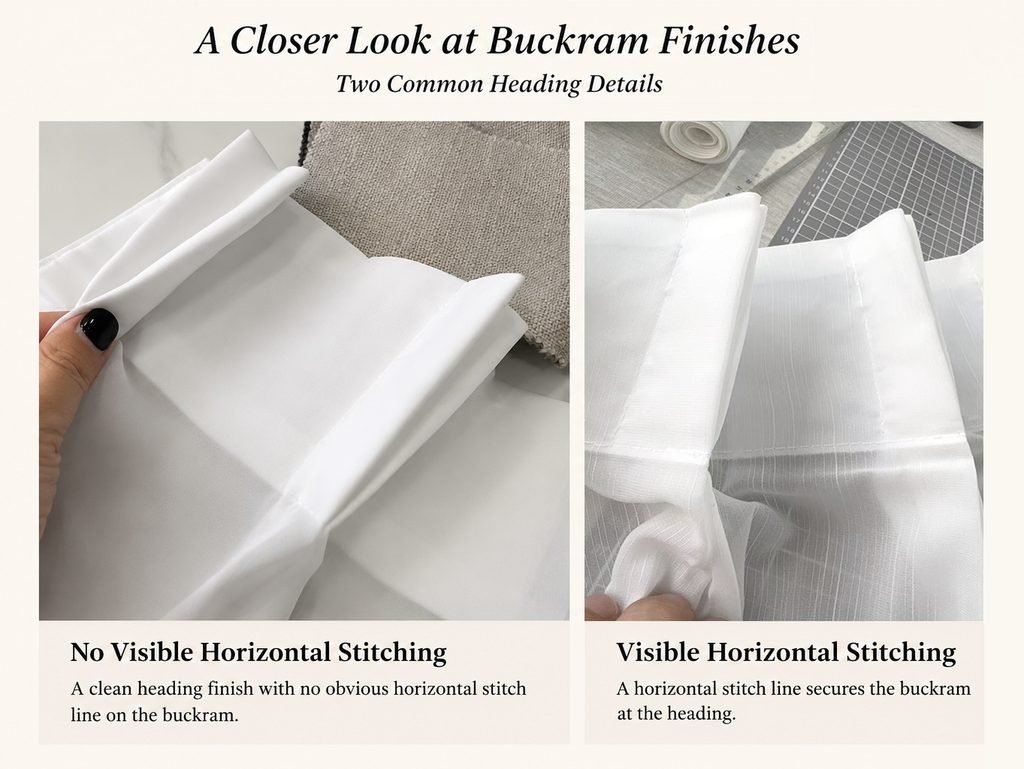
To make these differences easier to observe, we use sheer drapery as a practical reference. Its transparency makes the material layers and horizontal stitch lines easier to identify.
The following comparison comes from actual samples, showing how the heading looks with and without visible horizontal stitching.
3. How Construction Choices Affect the Making Process
Different methods of securing the heading layers affect not only the finished appearance but also the work involved in production.
For example, a continuous stitch along the lower edge of the buckram can help stabilize the position of the fabric and support material. In production processes that rely on repeated positioning and machine pleating, this may offer practical advantages.
When no obvious horizontal stitch line is used, greater attention may be needed to keep the fabric and buckram properly aligned and smooth during construction. Any movement between the layers can affect the evenness of the heading.
This can be particularly important when working with lightweight or slippery sheer fabrics. Pressing can help improve the alignment and make the layers easier to handle, although the appropriate approach will depend on the fabric itself.
Machine stitching, heat bonding, and different layered constructions each have their own production considerations. Workrooms choose their methods according to the materials, equipment, and workflow involved.
For this reason, the presence or absence of a horizontal stitch line should not be used as the sole measure of construction quality. The overall result matters more: the layers should remain smooth, the pleats should be consistent, and the finished heading should maintain its shape when hung.
4. Hook Placement at the Drapery Heading
In addition to buckram construction and finishing, hook selection and placement are also important details in Pinch Pleat drapery.
Two commonly encountered options are Small Pin Hooks and Adjustable Hooks.
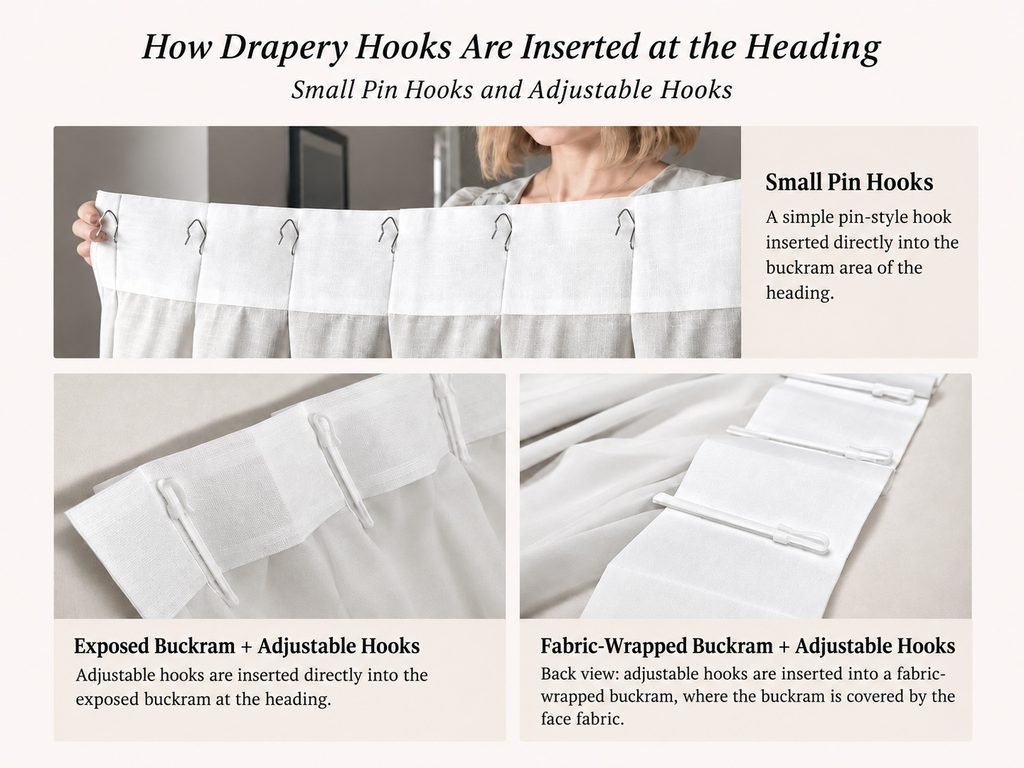
Small Pin Hooks
Small pin hooks are inserted directly into the supported area of the heading. Their compact size allows them to remain relatively discreet once installed.
In many high-end custom drapery examples we have observed, small pin hooks are commonly used with Pinch Pleat headings. They can work with compatible track gliders or drapery rings while maintaining a clean appearance at the top of the panel.
Adjustable Hooks
Adjustable hooks allow the hanging height of a drapery panel to be changed by adjusting the hook position.
They are commonly found in ready-made and e-commerce drapery products, where flexibility in installation height can be useful.
Depending on the heading construction, adjustable hooks may be inserted into exposed buckram or into a fabric-wrapped buckram area. The correct insertion position depends on the support structure and the design of the hook.
Hook selection should also take into account the track, gliders, or decorative rod hardware being used, as well as the desired finished hanging height.
5. Looking Beyond the Pleat Shape
The finished appearance of Pinch Pleat drapery depends on more than pleat count, spacing, and fullness. The internal support structure and finishing details also play an important role.
A horizontal stitch line may seem like a small detail, but it can influence the visual continuity of the heading.
At the same time, the way buckram is covered, how the material layers are secured, and where the hooks are inserted all contribute to the finished result.
Different construction methods can achieve similar pleat shapes and functional results. For designers and workrooms, understanding the relationship between these details is more useful than assuming there is only one correct way to construct a heading.
In future articles, we will take a closer look at individual buckram-covering methods, machine stitching, heat bonding, and other heading construction details, exploring how they work and where they are used.
Ultimately, a well-finished heading is not defined by one construction method, but by how well its structure, appearance, and function work together.