
The heading of a drapery panel may occupy only a small portion of the finished treatment, but it has a strong influence on the structure, rhythm, and way the fabric falls.
Some heading styles are clearly different from one another. Others may look quite similar at first glance, yet small changes in pleat placement, number of folds, header support, or the way the fabric connects to a rod or track can create noticeably different results.
Terminology can also vary between regions, brands, and workrooms. This guide is not intended to document every possible drapery heading variation. Instead, it brings together a selection of common and representative styles as a visual and construction reference.
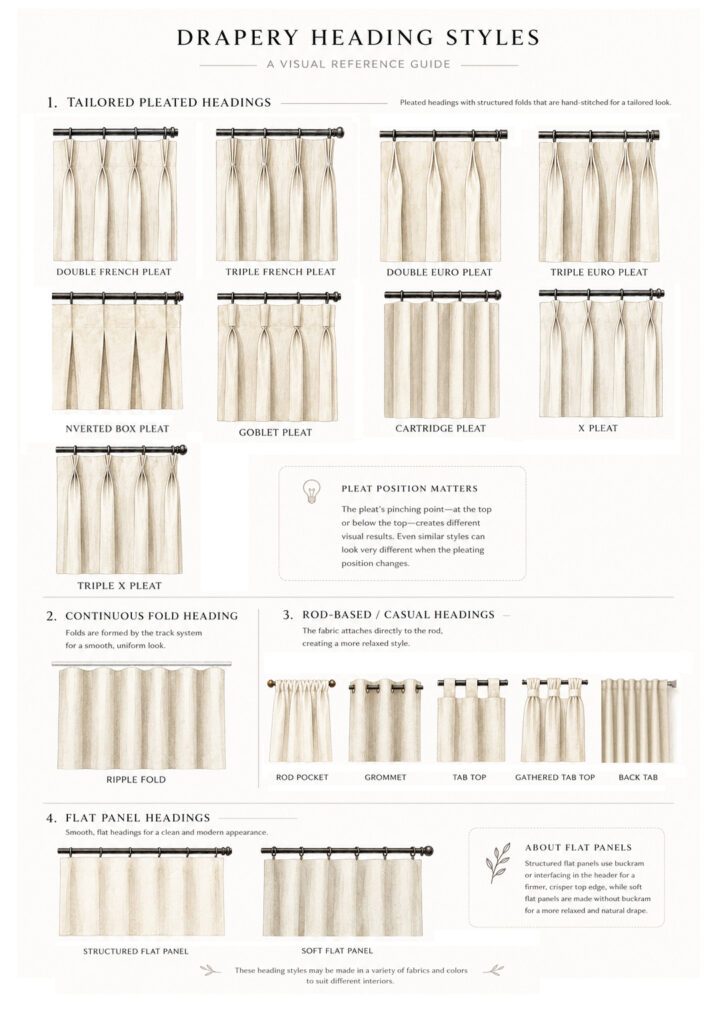
1. Tailored Pleated Headings
Tailored pleated headings are formed through folding, stitching, and securing the fabric into a defined structure.
Even when the same fabric is used, changing the number of folds or the position where the pleat is secured can significantly alter the top profile and the vertical rhythm of the drapery.
Double French Pleat
French Pleat, also commonly known as Pinch Pleat, is one of the most recognizable heading styles in custom drapery.
The pleat is typically secured below the top edge, allowing the upper portion to open slightly above the pinch point.
A Double French Pleat uses two folds, creating a tailored appearance with less bulk than a triple version.
Triple French Pleat
Triple French Pleat uses three folds within each pleat.
Compared with a Double French Pleat, it creates a fuller and more decorative top profile and generally requires greater fabric fullness.
Double Euro Pleat
Euro Pleat differs from French Pleat mainly in where the pleat is secured.
The folds are stitched or pinched close to the top edge, allowing the fabric to open and fall downward from the top.
A Double Euro Pleat uses two folds and typically creates a clean, vertical appearance.
Triple Euro Pleat
Triple Euro Pleat uses three folds while maintaining the same top-secured construction.
The additional fold adds more fullness and depth while preserving the long vertical line associated with Euro Pleats.
Inverted Box Pleat
An Inverted Box Pleat presents a relatively flat face, while the fullness is folded inward behind the front surface.
This creates a more geometric and architectural appearance without a visible pinch point on the face of the heading.
Goblet Pleat
Goblet Pleat forms a rounded, cup-like shape at the top of each pleat.
It is more sculptural and decorative than a standard French or Euro Pleat and is often used when the heading itself is intended to become a visible design feature.
Cartridge Pleat
Cartridge Pleat consists of evenly spaced cylindrical folds across the top of the drapery.
Rather than creating a distinct pinch point, the fabric forms a repeated series of soft vertical tubes, producing a regular and dimensional rhythm.
X Pleat
X Pleat is secured around the middle of the pleat, allowing the fabric to open above and below the fastening point and create an X-shaped profile.
It is less commonly seen in North American drapery references than French or Euro Pleats, but it is used in some Asian markets and custom workroom applications.
Triple X Pleat
Triple X Pleat is a three-fold variation of the X Pleat.
It keeps the same mid-pleat securing point while introducing additional folds for a fuller and more decorative appearance.
Pleat Position Matters
Pleated headings can use a similar number of folds while producing very different results depending on where the pleat is secured.
French Pleat and Euro Pleat, for example, may both be made as double or triple pleats, but the pinching position changes how the top opens and how the folds continue down the panel.
When comparing pleated headings, it is therefore important to look not only at the number of folds, but also at where and how the pleat is formed.
2. Continuous Fold Heading
Ripple Fold
Ripple Fold follows a different construction logic from traditional hand-formed pleats.
Its shape is created through the relationship between the track system, carrier spacing, snap tape, and fullness.
When extended, the fabric forms a continuous series of S-shaped folds rather than individually stitched pleats.
The result is usually cleaner, more modern, and more architectural in appearance.
3. Rod-Based / Casual Headings
In these heading styles, the way the fabric connects to the rod becomes part of the visual design.
Compared with tailored pleated headings, they are generally simpler in construction and often create a more relaxed appearance.
Rod Pocket
A Rod Pocket is formed by creating a channel across the top of the panel and passing the rod directly through it.
The fabric gathers naturally along the rod, producing a soft and informal series of small folds.
Grommet
Grommet drapery uses metal rings installed directly into the heading, with the rod passing through the openings.
The spacing between the grommets naturally creates broad vertical waves.
The result is simple, direct, and contemporary.
Tab Top
Tab Top drapery is suspended from visible fabric loops attached to the top of the panel.
Because the loops remain visible, they become part of the heading design and contribute to a casual, relaxed appearance.
Gathered Tab Top
Gathered Tab Top introduces gathering or tied detail into the tab construction.
Compared with a standard Tab Top, it feels softer and more decorative, with a stronger handcrafted character.
Back Tab
Back Tab drapery uses fabric tabs attached to the reverse side of the panel.
The hanging method is largely hidden from the front, allowing the fabric to form broad vertical folds with a cleaner face than a conventional Tab Top.
4. Flat Panel Headings
Not every drapery heading requires a visible pleat structure.
Flat Panel headings reduce the amount of shaping at the top and allow the fabric surface and natural drape to become more prominent.
Even when two panels appear similarly flat from the front, differences in header construction can change the finished result considerably.
Structured Flat Panel
A Structured Flat Panel uses buckram or another reinforcing material within the header.
This helps the top edge remain firmer and more stable, creating a cleaner and more controlled profile between the rings.
It works well when a crisp, tailored top line is preferred.
Soft Flat Panel
A Soft Flat Panel is made without buckram, or with significantly less header reinforcement.
As a result, the top follows the natural weight and behavior of the fabric more closely, creating softer movement and a more relaxed appearance.
The terms “Structured Flat Panel” and “Soft Flat Panel” are used here to distinguish two common construction approaches and visual results. Individual workrooms may use different terminology.
Choosing a Heading Style
A heading style should not be selected by appearance alone.
In a custom drapery project, it also needs to work with:
- fabric weight and drape;
- required fullness;
- rod or track system;
- stack back;
- whether the panel is functional or stationary;
- the desired level of structure or softness;
- and the workroom’s construction method.
The same heading can look quite different when used with a different fabric, fullness ratio, or hardware system.
The most successful choice is therefore one that supports the fabric, construction, function, and overall design intention of the treatment.
The heading may be only one part of the drapery, but it plays an important role in determining the final proportion, rhythm, and way the fabric falls.
Related Reading
→ Ripple Fold Drapery / Wave Curtain Guide
A closer look at ripple fold systems, fullness, carriers, and closure options.
→ Understanding Drapery Heading Styles
How Different Headings Shape Custom Drapery
→ Understanding Stationary Panels
A Decorative Approach to Window Design
Comments are closed.