
In custom drapery, many of the terms we use every day refer to very specific parts of the panel, construction details, or installation relationships.
Heading, leading edge, side edge, side hem, return, overlap, lining, and interlining may sound like simple vocabulary, but they do not all describe the same kind of thing. Some refer to position, some to fabrication, and others only become clear once the drapery is installed or fully closed.
That distinction matters. A side edge is not the same thing as a side hem. A leading edge describes the center-facing side of a panel, while overlap describes what happens when two leading edges cross at the center.
I wanted to bring these terms together in one visual reference and look at them as parts of the same system. My hope is that this overview makes the structure of a drapery panel easier to understand and provides a useful reference for design, specifying, ordering, and workroom communication.
Starting with a Drapery Panel
The easiest place to begin is with the panel itself.
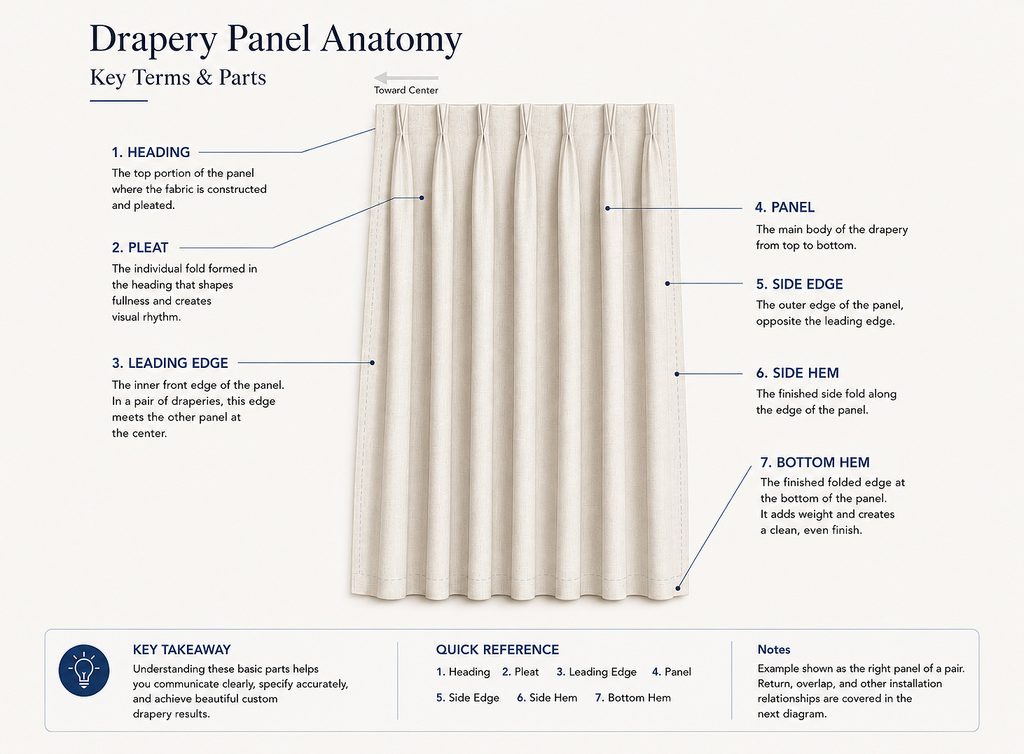
At the top is the heading—the finished upper section of the drapery where the fabric is shaped, supported, and connected to the hanging system.
Within the heading, the pleat creates the repeated structure that gives the top of the drapery its rhythm and form. Different pleat styles can completely change the appearance of the panel, but structurally, the pleat remains part of the heading.
The body of the drapery is the panel.
On a pair of drapery panels, the two vertical sides do not have the same relationship to the window.
The side facing the center is the leading edge.
The opposite side is the side edge.
These terms describe position.
A side hem, however, describes construction. It is the finished folded edge created along the side of the panel.
The bottom hem is the finished fold at the lower edge. In addition to creating a clean finish, it adds weight and helps the panel hang with a more controlled line.
Leading Edge, Side Edge, and Side Hem
Because these three terms all relate to the sides of a panel, they are easy to group together. In practice, though, they describe different things.
The leading edge is the center-facing side of the panel.
When a pair of draperies closes, the two leading edges move toward one another.
The side edge is the outer edge of the panel, away from the center.
The side hem is the finished folded construction along the side.
A useful way to think about them is:
- Leading edge = position
- Side edge = position
- Side hem = construction
That distinction becomes especially useful in drawings, specifications, and workroom instructions.
Return: How Drapery Finishes at the Side
A return is not simply another edge of the panel.
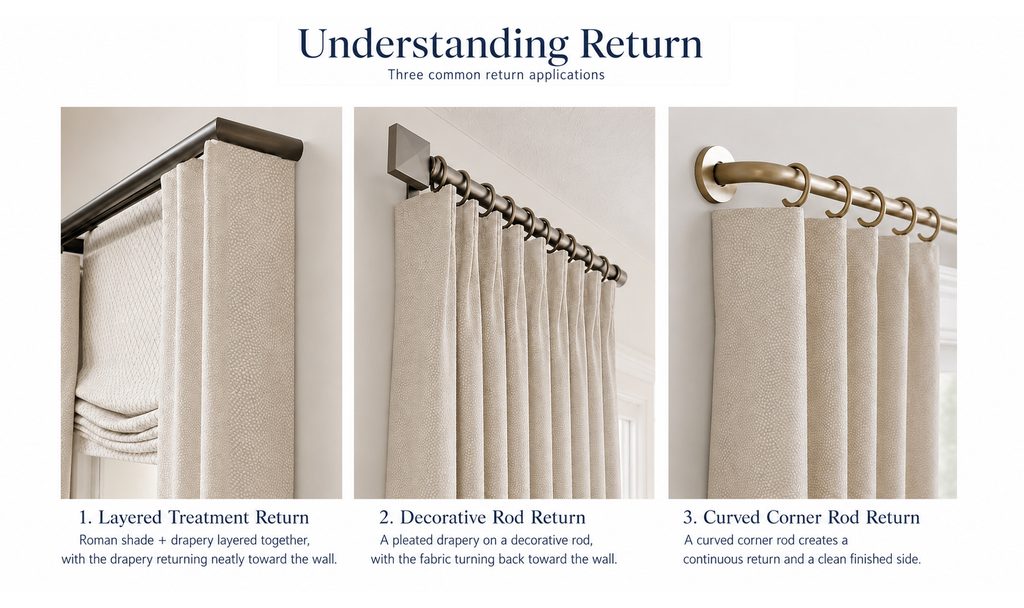
It describes the portion of the drapery that continues from the front plane and turns back toward the wall, rod end, or mounting point.
This is why return can be difficult to explain in a flat front-view drawing. It is really a spatial relationship that appears once the treatment is installed.
Different hardware systems create returns in different ways.
A layered treatment may use a concealed or secondary track to bring the drapery back toward the wall. A decorative rod can create a return at the end of the rod. A curved corner rod allows the hardware itself to turn continuously toward the wall.
In each case, the goal is similar: to create a more finished side condition and, when needed, reduce side light gaps or exposed hardware.
Overlap: Where Two Panels Close at the Center
If return happens at the outer side of a treatment, overlap happens at the center.
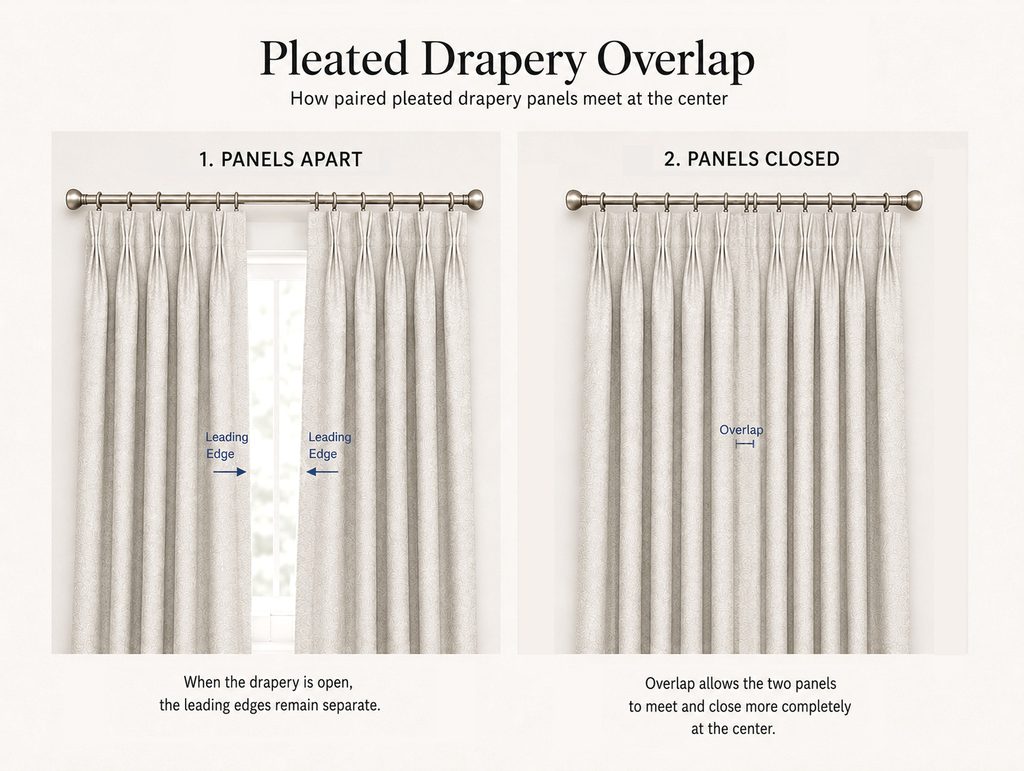
When the draperies are open, the two leading edges are separated.
When the panels close, the leading edges can extend past the center line and cross one another slightly.
That crossing portion is the overlap.
It is not the entire center area. It is the actual section where one leading edge covers the other.
A small amount of overlap can make a meaningful difference. It helps the center close more completely, reduces visible gaps, and creates a cleaner transition between the two panels.
This is especially useful when privacy or stronger light control is important.
Lining: The Structure Behind the Face Fabric
Lining is less visible from the front, but it can have a significant effect on how a drapery performs and feels.
Lining is the fabric layer placed behind the face fabric.
Depending on the project, it can improve the appearance of the back of the treatment, provide privacy, reduce light penetration, protect the face fabric, and add support to the overall drape.
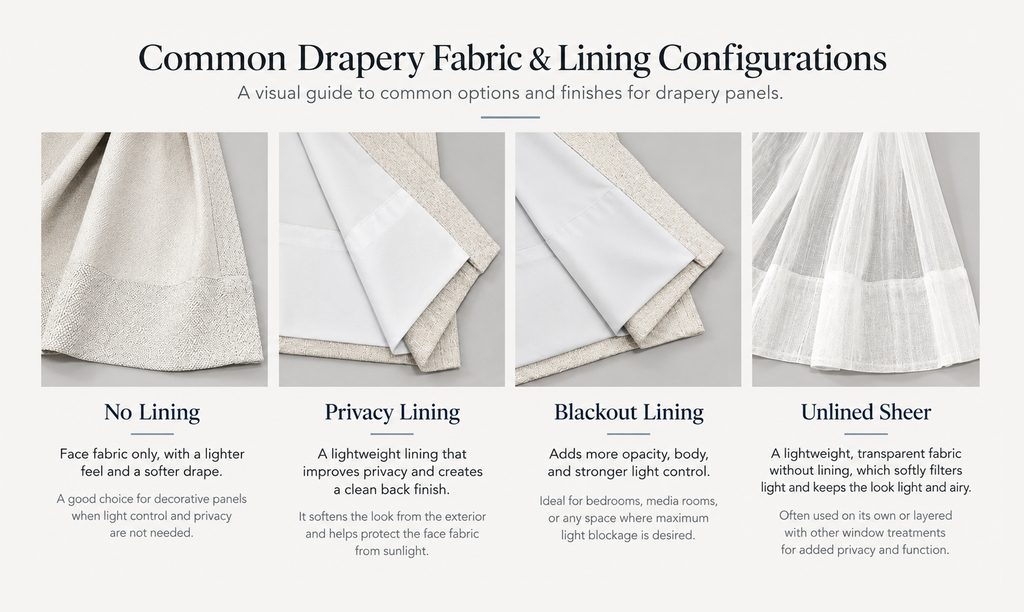
Not every treatment uses the same lining configuration.
Some panels are left unlined.
A privacy lining adds coverage while still allowing a softer level of light through.
A blackout lining is used when stronger light control is needed.
Sheer drapery is typically left unlined so that its lightness and translucency remain part of the design.
Rather than thinking of lining as one standard construction, it is more useful to see it as a choice based on the face fabric, the room, and the performance the treatment needs to provide.
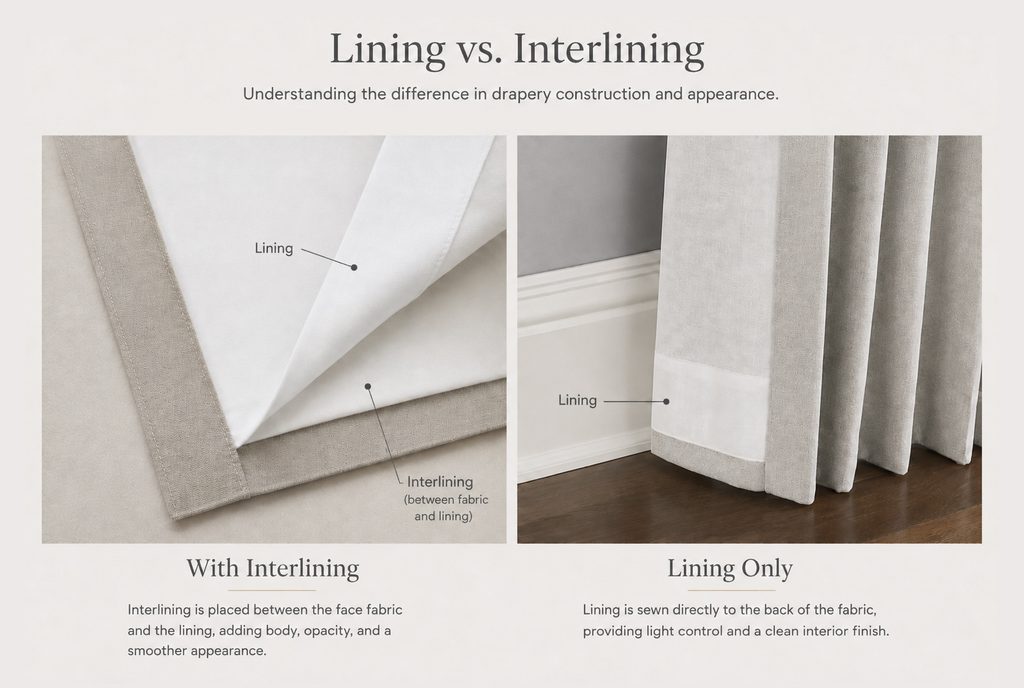
Lining and Interlining Are Not the Same Layer
Lining and interlining are often discussed together, but they occupy different positions in the construction.
Lining is the finished layer at the back of the drapery.
Interlining sits between the face fabric and the lining.
A three-layer construction can be understood as:
Face Fabric → Interlining → Lining
A standard lined drapery without interlining is:
Face Fabric → Lining
Adding interlining gives the panel more thickness and body. It can also soften the way certain fabrics hang and create a fuller, more substantial finished appearance.
It is not necessary for every project, but when additional body, insulation, or richness is desired, interlining can noticeably change the character of the drapery.
Looking at the Terms as a System
Once these terms are placed back into their actual positions, they become much easier to organize.
Some describe where something is:
- Heading
- Leading Edge
- Side Edge
Some describe how the panel is constructed:
- Pleat
- Side Hem
- Bottom Hem
- Lining
- Interlining
And some describe what happens after installation or when the drapery closes:
- Return
- Overlap
This is often more useful than memorizing individual definitions.
In real projects, the question is usually not simply “What does this term mean?”
It is more often:
Does this term describe a location, a fabrication detail, or an installed condition?
Once that is clear, the rest of the terminology becomes much easier to follow.
Final Thoughts
A drapery panel can look simple at first glance, but every part—from the heading and edges to the return, overlap, lining, and interlining—has a specific role in how the treatment is built, installed, and finished.
I wanted to gather these frequently used terms into one visual reference because they come up again and again in design and workroom conversations.
If this overview helps make the structure of a drapery panel a little easier to read and discuss, then it has done what I hoped it would do.
Comments are closed.