Valances and cornices are often used together with Roman shades, blinds, shades, or drapery to create a layered window treatment.
The value of layering is not simply that it makes a window look more decorative. Different layers usually serve different purposes: the top treatment finishes and frames the window, the functional layer manages light and privacy, and the soft layer adds fullness, softness, and atmosphere.
So the more useful question is not:
How many layers should be used?
but rather:
Why is each layer there, and do the layers work together clearly and naturally?
1. Common Layering Combinations
Some of the most common combinations include:
- Valance + Roman Shade
- Cornice + Drapery
- Valance + Blind or Shade

Valance + Roman Shade
The Roman shade usually provides the main function, including privacy, light control, and daily operation.
The valance finishes the top of the window, helps conceal hardware, and adds a decorative layer.
This combination can remain very simple, or become more decorative through fabric, trim, and valance shape.
Cornice + Drapery
A cornice can conceal rods, tracks, or other hardware while creating a strong upper boundary.
Drapery adds softness, fullness, vertical movement, and side framing.
One element is more structured, while the other is softer. Together, they can create a more complete window composition.
Valance + Blind or Shade
Valances can also be paired with roller shades, cellular shades, woven shades, or blinds.
The lower treatment provides most of the function, while the valance helps finish the top and visually integrate a functional product into the room.
2. Understanding the Role of Each Layer
A layered treatment can usually be understood through three basic roles:
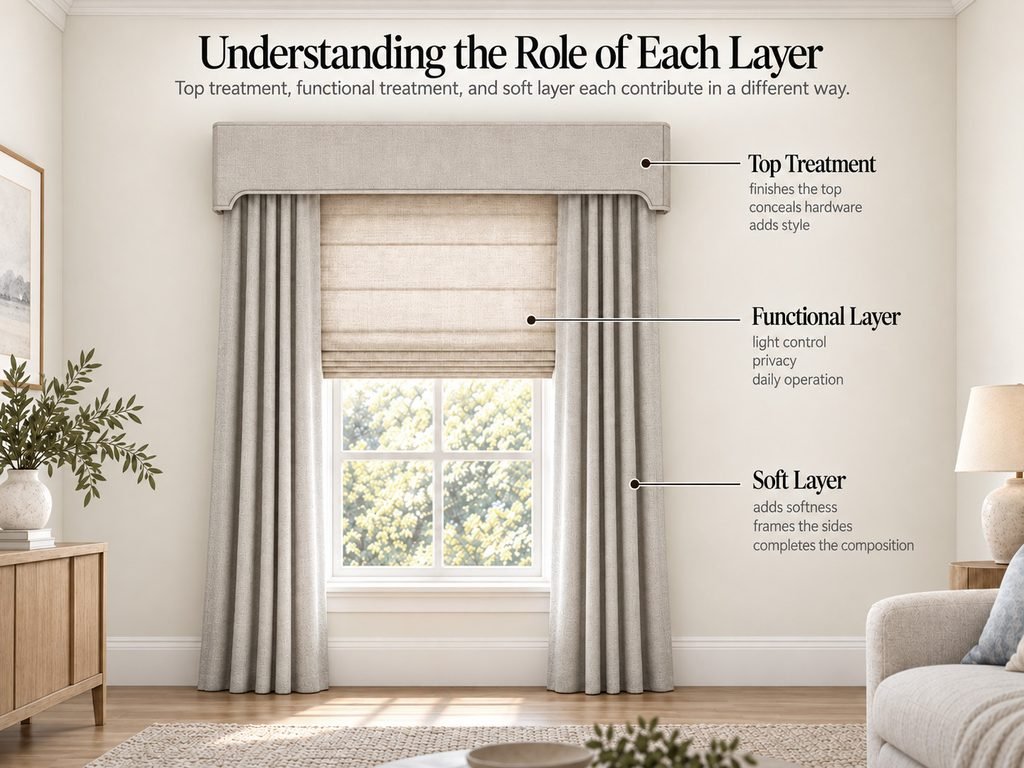
Top Treatment
This usually refers to a valance or cornice.
Its role may include:
- finishing the top
- concealing hardware
- framing the window
- establishing the visual style
Functional Layer
This may include a Roman shade, roller shade, cellular shade, woven shade, blind, or another operable treatment.
Its primary role is usually:
- light control
- privacy
- glare reduction
- daily operation
Because this layer is often used most frequently, operating clearance and ease of use should be protected first.
Soft Layer
When drapery is added, it often becomes the soft layer.
Drapery can contribute:
- softness
- fullness
- side framing
- vertical emphasis
- decorative weight
It does not always need to provide the main light-control function, but it can still change the overall feeling of the window dramatically.
3. Visual Hierarchy and Material Relationships
If every layer is equally strong, the composition can quickly become visually crowded.
More successful layering usually has a clear hierarchy.
For example:
- the top treatment may be the visual focus while the shade remains quiet,
- the Roman or woven shade may carry the texture while the valance simply finishes the top,
- or the drapery may become the main visual element while the cornice stays restrained.
In other words:
one layer can lead while the others support it.
The materials do not need to match exactly.
Different layers can still feel connected through:
- similar color families
- tone-on-tone relationships
- repeated trim colors
- coordinated textures
- subtle pattern relationships
The goal is not sameness, but visual connection.
4. Layering in Real Spaces
Concept diagrams help explain structure, but the effect of layering becomes easier to understand when it is seen in a finished interior.

Shaped Valance + Roman Shade
The Roman shade continues to provide function, while the shaped valance adds outline, trim, and a decorative finish.
This can work well when a space needs more character but does not require full-length drapery.
Decorative Top Treatment + Drapery + Roman Shade
A three-layer composition has a stronger visual presence.
The Roman shade provides function, the drapery adds softness and framing, and the top treatment completes the upper portion of the window.
This type of combination can work well when the window is intended to become a stronger feature in the room.
Box Cornice + Roman Shades + Side Drapery
This combination feels more structured.
The cornice creates a clear upper boundary, the Roman shades provide function, and the side drapery softens the composition.
Cornice + Roller Shade + Side Drapery
A roller shade is primarily functional, but when it is combined with a cornice and side drapery, the window begins to read as a more complete interior treatment rather than as a single functional shade.
This is one of the useful qualities of layering:
it can turn a purely functional treatment into a more integrated design element.
5. Planning, Clearance, and When Less Is More
Layering is not only a decorative decision.
It also involves:
- mounting depth
- projection
- hardware position
- operating clearance
- stacking space
- side returns
- access for maintenance
If the upper structure is too shallow, a Roman shade or blind below may not have enough room to operate.
If hardware systems interfere with one another, even a visually successful design will not work well.
At the same time, not every window needs multiple layers.
Too much layering can create:
- visual clutter
- excessive weight
- reduced daylight
- higher cost
- more complicated installation
A useful principle is:
Every layer should have a reason to be there.
Final Thoughts
Layering valances and cornices with drapery, Roman shades, and blinds is not simply about placing several products on the same window.
Good layering creates a clear relationship between decoration, function, and structure.
When each layer has a defined purpose and the materials, proportions, and visual hierarchy work together, the result feels natural and complete.
A successful layered treatment should not make us think:
“There are many layers here.”
It should simply feel as though:
the decorative and functional parts of the window belong together.
Related Articles
- Valance Proportion & Planning
https://windowtreatmentjournal.com/valance-proportion-planning/ - Understanding Valances: Styles, Structure & Mounting
https://windowtreatmentjournal.com/understanding-valances-styles-structure-mounting/ - Board-Mounted Valances: Structure & Attachment
https://windowtreatmentjournal.com/board-mounted-valances-structure-attachment/ - Roman Shade Styles – Visual Reference Guide
https://windowtreatmentjournal.com/roman-shade-styles-visual-reference-guide/ - Drapery Design – A Visual Guide
https://windowtreatmentjournal.com/drapery-design-visual-guide/