Roman shades are relatively simple to measure, but small differences in window construction can affect how the finished shade fits, operates, and looks.
Before measuring, first decide whether the shade will be installed as an inside mount or an outside mount. The measuring method is different for each, and details such as window depth, trim, handles, and uneven openings should be checked before placing an order.
1. Inside Mount Roman Shades
An inside mount is installed within the window opening, creating a clean and integrated appearance.
Because the shade must fit inside the opening, accurate measurements are especially important.
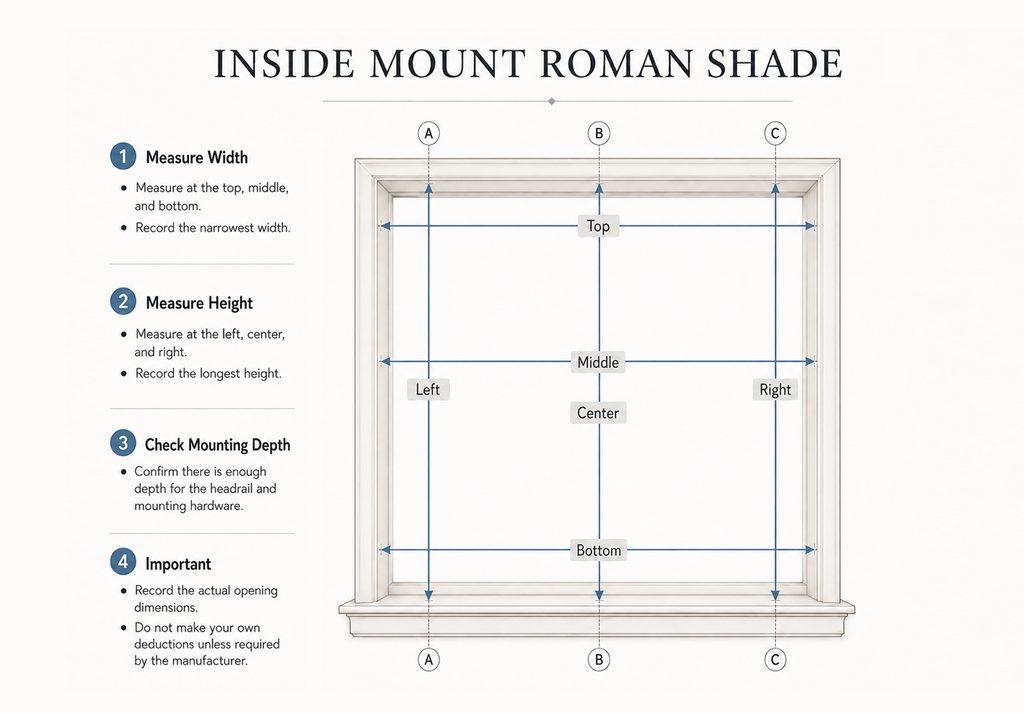
Measure the Width
Measure the inside width of the window opening in three places:
- at the top
- at the middle
- at the bottom
Record all three measurements and use the narrowest width as the reference measurement.
Window openings are not always perfectly parallel, so measuring only one location may not reveal slight variations.
Measure the Height
Measure the inside height in three places:
- left
- center
- right
Record the longest height.
Taking several measurements helps identify irregularities in the opening and provides a more complete picture of the available space.
Do Not Make Automatic Deductions
For an inside mount, it is generally best to record the actual opening dimensions rather than making your own deductions.
Manufacturers may apply their own allowances depending on the headrail, operating system, hardware, and construction method.
Unless specifically instructed otherwise, provide the actual opening measurements and follow the manufacturer’s ordering requirements.
2. Outside Mount Roman Shades
An outside mount is installed beyond the window opening, either on the trim or on the wall above and around the window.
Unlike an inside mount, the goal is not simply to measure the opening. Instead, determine the finished area you want the shade to cover.
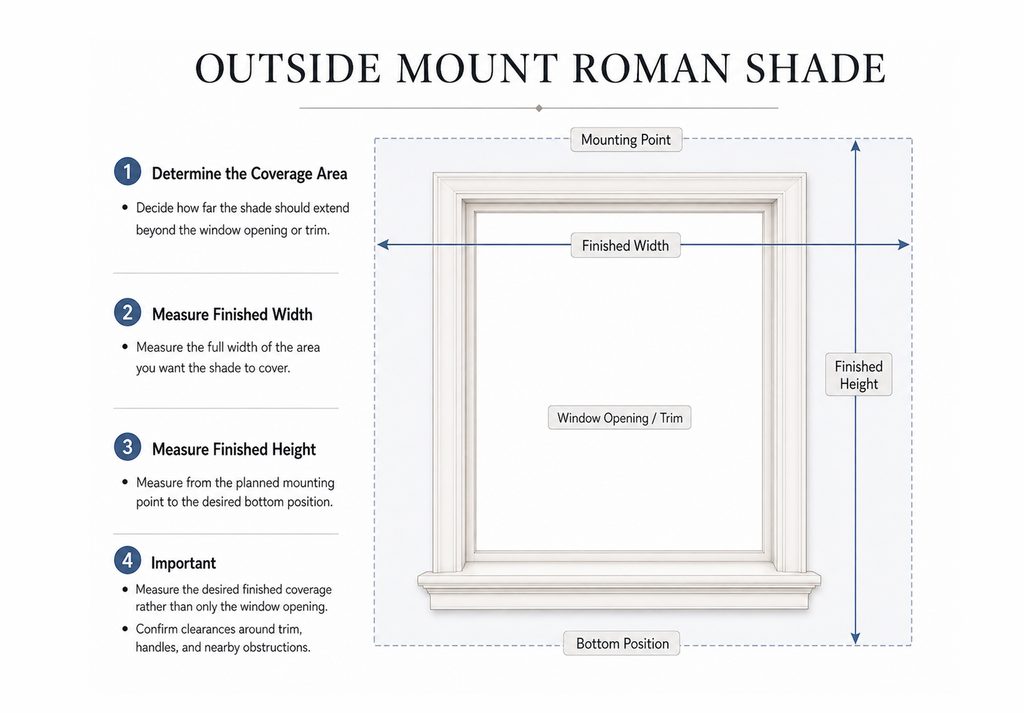
Determine the Finished Width
Decide how far the shade should extend beyond the window opening or trim.
Additional side coverage may help:
- reduce light gaps
- improve privacy
- visually enlarge the window
- create better proportions
Measure the full desired finished width rather than only the window opening.
Determine the Finished Height
Choose the planned mounting point first.
Then measure from that point down to the desired finished bottom position.
The mounting height may depend on the window trim, available wall space, the desired stack position, and the overall visual proportion of the treatment.
3. Check the Window Conditions
Before ordering a Roman shade, it is useful to look beyond width and height alone.
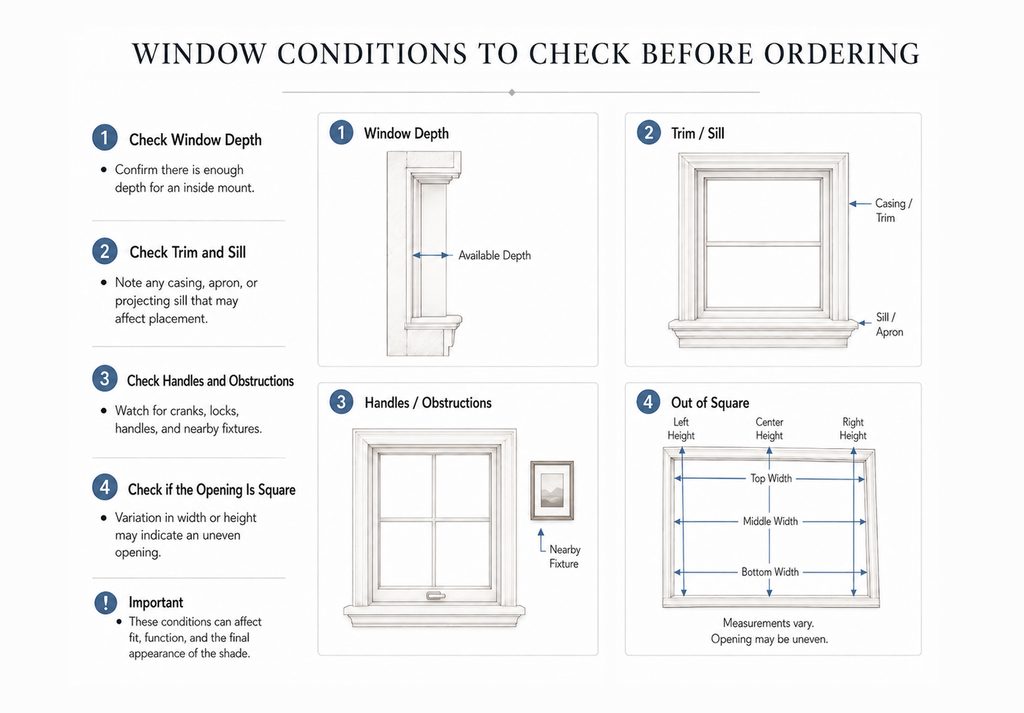
Window Depth
For an inside mount, confirm that the window recess has enough usable depth for the headrail and mounting hardware.
A shallow opening may require a different mounting solution or an outside mount.
Trim and Sill
Check whether the window has:
- casing or trim
- a projecting sill
- an apron
- decorative moulding
These elements may influence where the shade can be mounted and how far it should extend.
Handles and Other Obstructions
Window locks, cranks, handles, nearby fixtures, and other projections can interfere with the shade or hardware.
These conditions should be identified before finalizing the mounting position.
Check Whether the Opening Is Square
If the top, middle, and bottom widths vary noticeably, or the left, center, and right heights are different, the opening may not be perfectly square.
Roman shades tend to make these irregularities more visible because the shade follows the geometry of the opening closely.
Significant variation should be reviewed before ordering rather than assuming the finished shade will correct the architectural condition.
Before Placing the Order
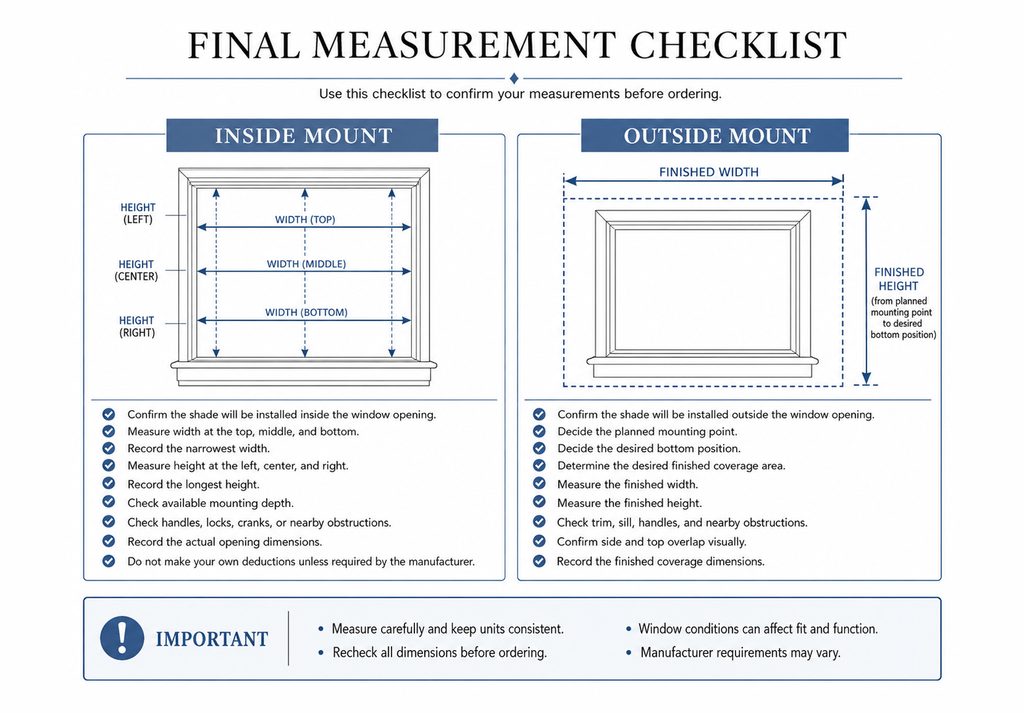
Before submitting your measurements, confirm:
- inside mount or outside mount has been selected
- all width measurements have been recorded
- all height measurements have been recorded
- mounting depth has been checked where required
- trim, sill, handles, and other obstructions have been noted
- the desired finished coverage has been confirmed
- all measurements use the same unit
- manufacturer-specific deductions or allowances have been verified
Final Thoughts
Measuring for Roman shades is straightforward when the installation method is clear.
For an inside mount, the priority is understanding the actual window opening and available mounting space.
For an outside mount, the priority is defining the finished coverage and mounting position.
Careful measuring, together with a quick review of the surrounding window conditions, helps ensure that the finished Roman shade fits the opening, operates correctly, and looks intentional within the space.
Comments are closed.