
When we look at a Roman shade, we usually notice the front first: the folds, the fabric, the pattern placement, and the way the shade stacks when raised.
Once the shade is installed, however, the side view matters too.
Some Roman shades sit fully inside the window opening, with the headrail almost completely concealed. Others are technically inside-mounted but still project beyond the face of the window because the recess is not deep enough. With an outside mount, the side of the headrail is naturally more exposed.
This is where a return can make a noticeable difference.
In this context, a return is not simply extra width added to the shade. It is the finished portion that turns from the front toward the side, helping conceal the headrail, mounting board, brackets, or other visible components.
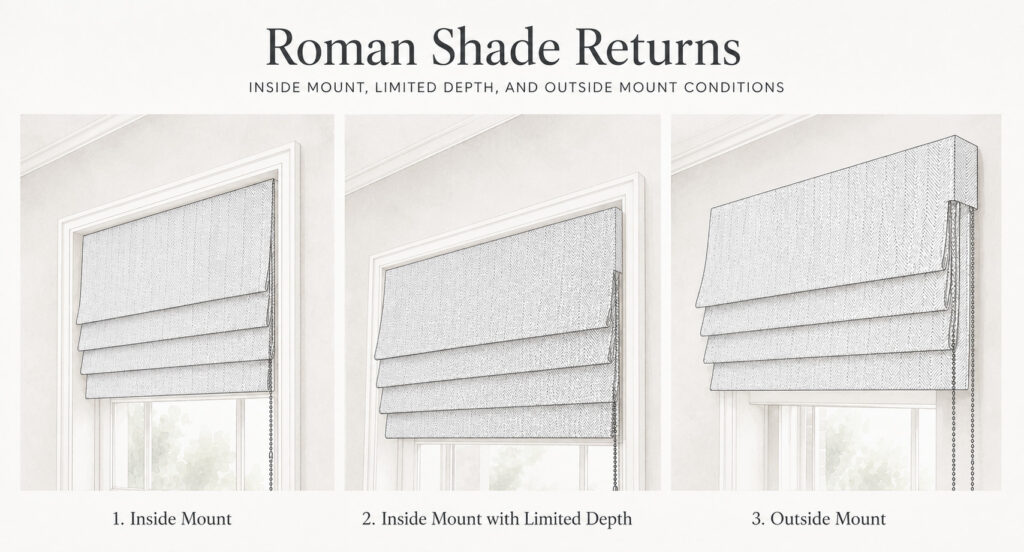
Inside Mount, Limited Depth, and Outside Mount
When the window recess is deep enough, an inside-mounted Roman shade can sit fully within the opening. The headrail remains visually contained by the window frame, so an additional return is usually unnecessary.
A different condition occurs when the recess only meets the minimum mounting depth.
The shade can still be installed inside the opening, but the headrail may project slightly beyond the window frame. From the front, this may not be especially noticeable. From an angle, however, the exposed side of the system can make the installation feel less resolved.
In that situation, a side return can help complete the top of the shade.
With an outside mount, the headrail sits in front of the wall or window casing, so its depth is naturally more visible. Returns are therefore more commonly used to conceal the side of the system and create a cleaner transition back toward the wall.
Whether a return is needed depends on more than the mount type alone. The actual recess depth, headrail projection, mounting hardware, and viewing angle all play a part.
Waterfall Roman Shades: Two Construction Methods
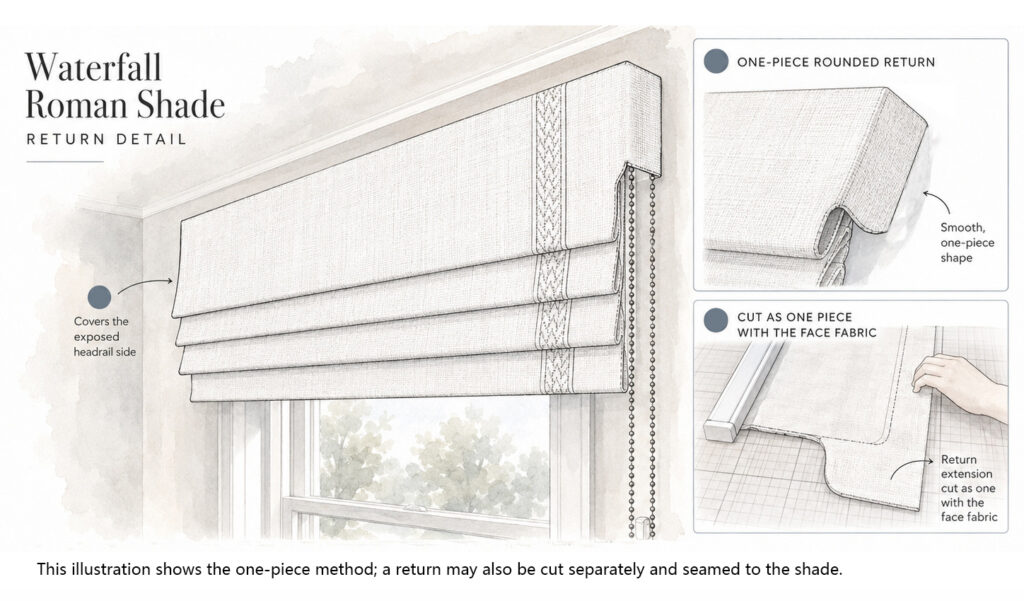
For a waterfall Roman shade, the return can be made in two different ways.
The first method is to cut the return as part of the main shade fabric.
Instead of adding a separate side piece later, the return is planned into the original cut. The face of the shade and the side return remain connected as one continuous piece of fabric.
This creates a clean transition with no visible side seam. It can look especially refined on a waterfall shade, where the soft layered folds already create a continuous visual rhythm.
It is also the more demanding method.
The return depth, corner shape, and left-to-right symmetry all need to be controlled accurately during cutting. Once the fabric is wrapped around the side of the headrail or mounting board, the front of the shade must remain square and undistorted.
The second method is to cut the return separately and seam it to the main shade fabric.
This approach offers more flexibility in cutting and can make fabric usage easier, especially when the available width is limited or when the return depth needs to be adjusted independently.
The seam, however, becomes part of the construction and should be placed and finished carefully so that the side still looks intentional.
With either method, the lower edge of the return may be shaped in different ways.
A rounded return feels softer and often works well with the flowing folds of a waterfall shade. A square return creates a cleaner, more tailored outline.
The choice is partly visual, but it also needs to suit the depth and construction of the headrail beneath it.
Returns Formed by an Extended Valance
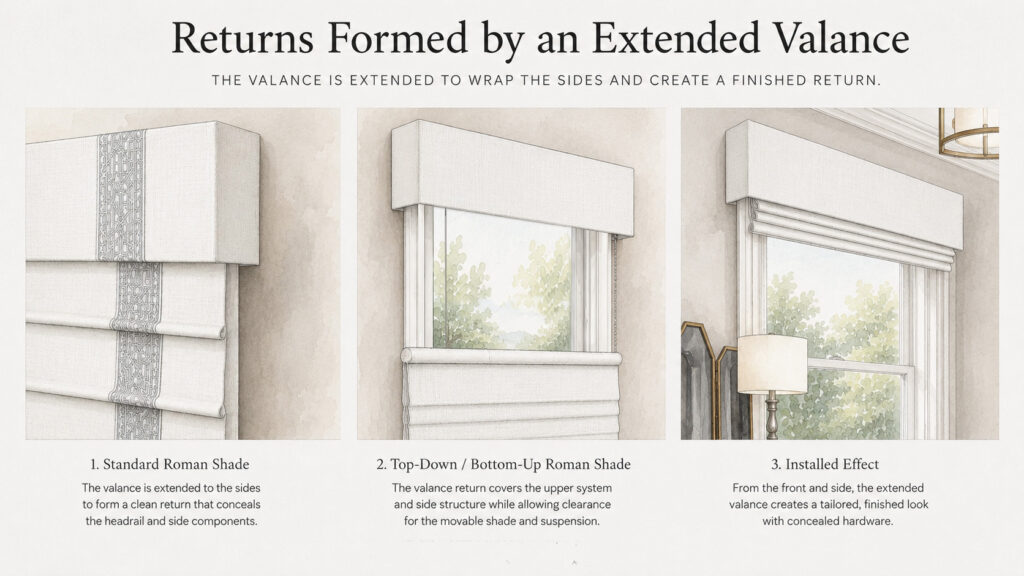
Some Roman shades include a separate valance across the top.
In this case, the valance itself can be widened so that it continues around the sides of the headrail. The return is then formed by the valance rather than by the moving shade body.
The shade can raise and lower normally underneath, while the valance provides a more finished top profile and conceals the side of the headrail, brackets, or mounting structure.
This method works for standard Roman shades, but it can be particularly useful for a top-down/bottom-up Roman shade.
A top-down/bottom-up system usually has more visible structure at the top, including suspension components and additional operating hardware. An extended valance can help conceal these elements from the side.
At the same time, the return must leave enough clearance for the upper section of the shade to move freely. It should hide the mechanism without interfering with the cords, suspension points, or moving fabric.
Soft Returns for Relaxed Roman Shades
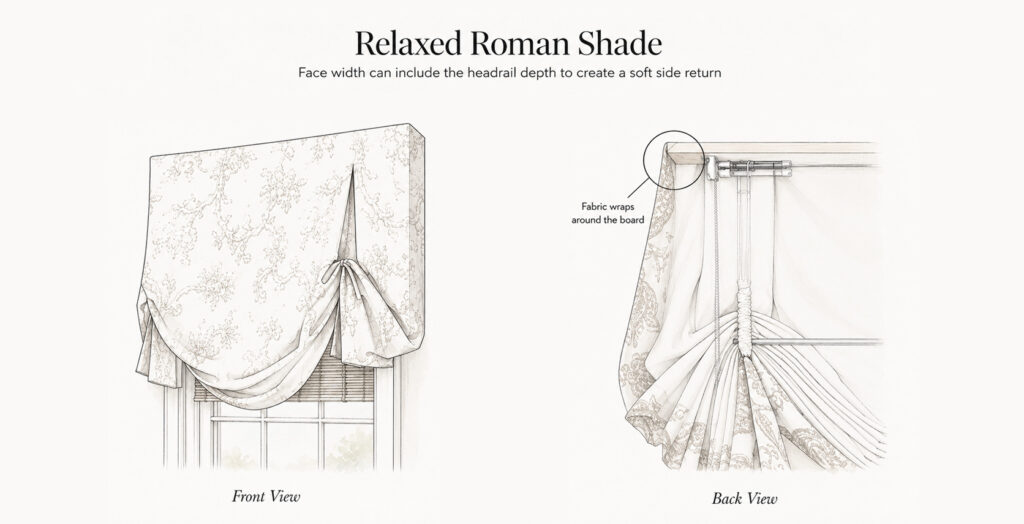
A relaxed Roman shade often benefits from a softer approach.
Rather than adding a rigid-looking side piece, the shade width can be extended to include the depth of the wooden board or headrail.
The fabric then continues from the face, wraps around the side, and is secured toward the back of the board.
From the front, the shade retains its soft, relaxed silhouette. From the reverse side, the construction is easier to understand: the fabric body itself turns around the board and covers its depth.
This type of return feels visually connected to the overall form of the shade. It avoids introducing a hard side element beside a design that is meant to look loose and softly draped.
The fabric allowance still needs to be planned carefully. Too little fabric may leave part of the board exposed, while too much can create bulk or distort the front of the shade.
Detachable Returns
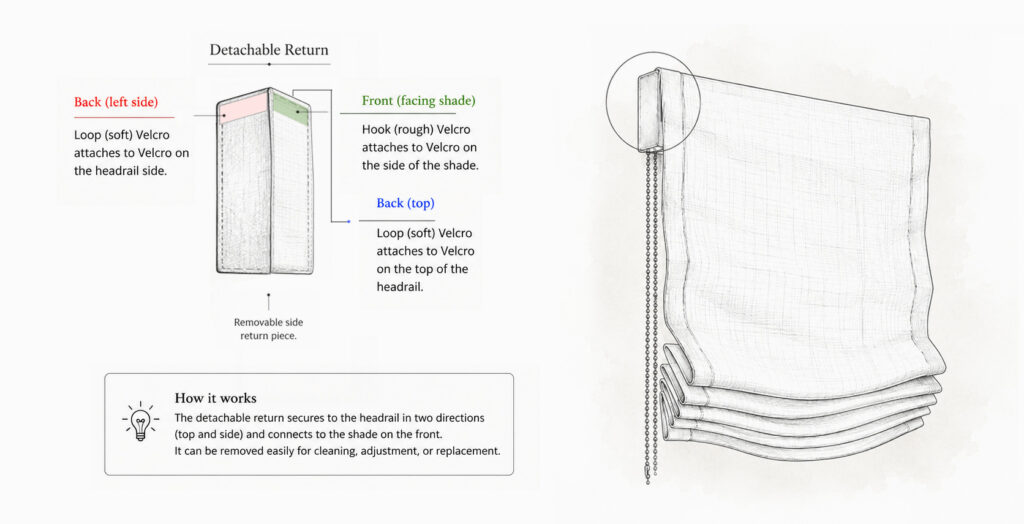
A return can also be made as a separate, removable component.
In this construction, it is neither cut as part of the shade body nor permanently sewn to it. The return is made independently and attached to the side of the headrail or mounting board.
This type of return can be shaped to suit the shade design, then removed later for adjustment, replacement, or repair.
A detachable return can be useful when the top system is complex, when the fabric is not well suited to an integrated return, or when easier access to the headrail is important.
Because it is a separate piece, the connection must be secure and visually clean. Once installed, it should not shift, flare outward, or leave an obvious gap between the return and the face of the shade.
Return Depth Is Not a Fixed Measurement
There is no single standard depth that works for every Roman shade return.
The correct dimension depends on the actual installation, including:
- the depth of the headrail or wooden board;
- the projection of the mounting brackets;
- whether the shade is inside- or outside-mounted;
- the available recess depth;
- how much of the side structure needs to be concealed;
- and the clearance required for operating components.
In some projects, the return only needs to cover the side of the headrail. In others, it must also conceal brackets, mounting plates, or additional hardware.
A return that is too shallow may still leave part of the system exposed. One that is unnecessarily deep can look heavy and may interfere with the operation of the shade.
The depth should therefore be determined from the actual product and installation condition, rather than taken from a fixed rule.
A Small Detail with a Clear Purpose
Not every Roman shade needs a return.
When the headrail sits fully within a deep window recess, the side condition may already feel complete. When the system projects beyond the opening, or when the shade is outside-mounted, a return can make the installation look more considered.
It may be cut as part of the shade, added as a separate sewn piece, formed by an extended valance, wrapped softly around a board, or made as a detachable component.
None of these methods is automatically better than the others.
The most appropriate solution depends on the Roman shade style, the headrail construction, the installation depth, and how the shade will be viewed in the room.
The front of a Roman shade creates the first impression. The return is one of the details that determines whether the side view feels equally finished.
Related Notes
Understanding Roman Shades: A Complete Guide to Styles, Construction, Operation, and Details
A broader guide to Roman shade construction, operation, appearance, and fabrication details, providing context for how smaller elements such as returns fit into the complete treatment.
How to Measure for Roman Shades
A practical guide to inside and outside mount measurements, including width, height, mounting depth, trim, obstructions, and other site conditions that influence the finished Roman shade.
Fabric Seams in Roman Shades: Why Planning Matters on a Flat Surface
A closer look at another small but important fabrication detail—how seam placement, fabric width, symmetry, and cutting decisions affect the finished appearance of a Roman shade.