Roman shades can look remarkably different even when they share the same basic function.
Some have a clean, structured face defined by horizontal folds or battens. Others rely on softer construction, allowing the fabric to curve, drape, or gather naturally. More decorative styles use pleats, swags, and fullness to create a stronger visual presence, while specialty shapes respond directly to unusual window architecture.
A Note on This Guide
This visual guide grew out of my own study notes and ongoing work with Roman shades.
I reviewed how a range of window treatment brands, workrooms, and other industry references describe and present different Roman shade styles, then organized the examples into a structure that makes sense to me based on what I have learned so far.
Terminology and classifications can vary across the industry, so this guide is not intended as a universal standard or a definitive taxonomy. It is simply a working visual reference—a way to document, compare, and better understand the different constructions and appearances I have encountered.
As I continue to learn, work with new systems, and come across other interpretations, this reference may continue to evolve.
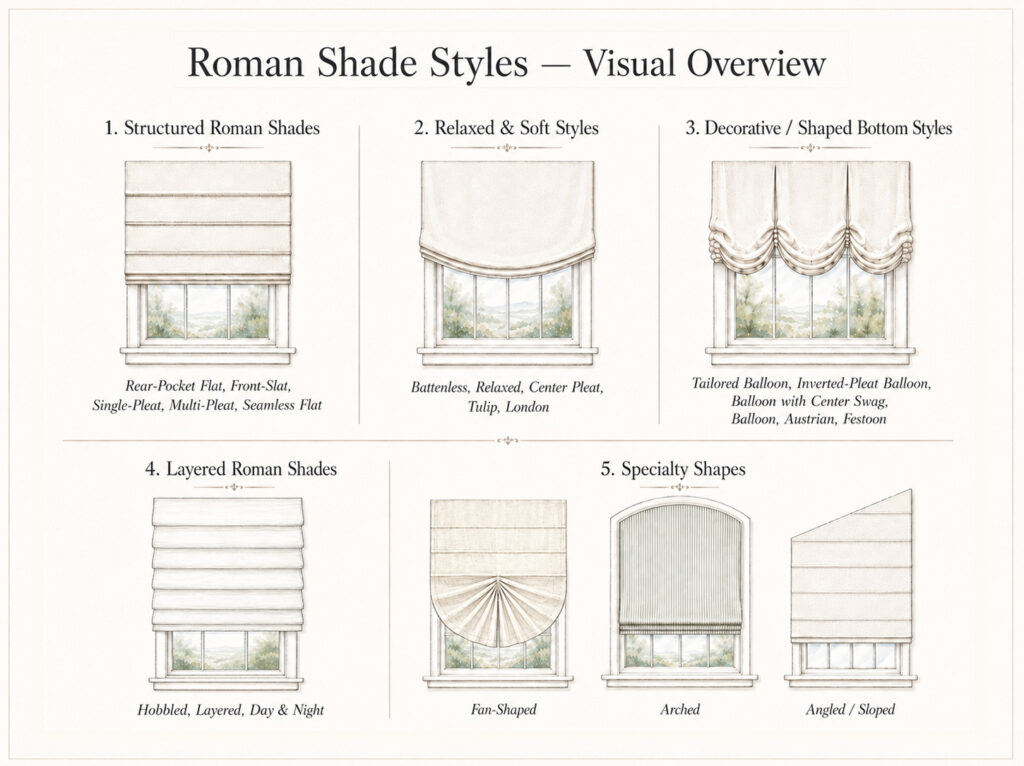
This guide focuses primarily on visual appearance—how different Roman shade constructions change the way the fabric looks on the window.
The terminology used for Roman shades can vary between workrooms, manufacturers, and designers. The styles shown here are organized by their most recognizable visual and construction characteristics.
Structured Roman Shades
Structured Roman shades use horizontal construction details to create a controlled, tailored appearance. Small differences in where battens, pockets, or pleats are placed can noticeably change the face of the shade.
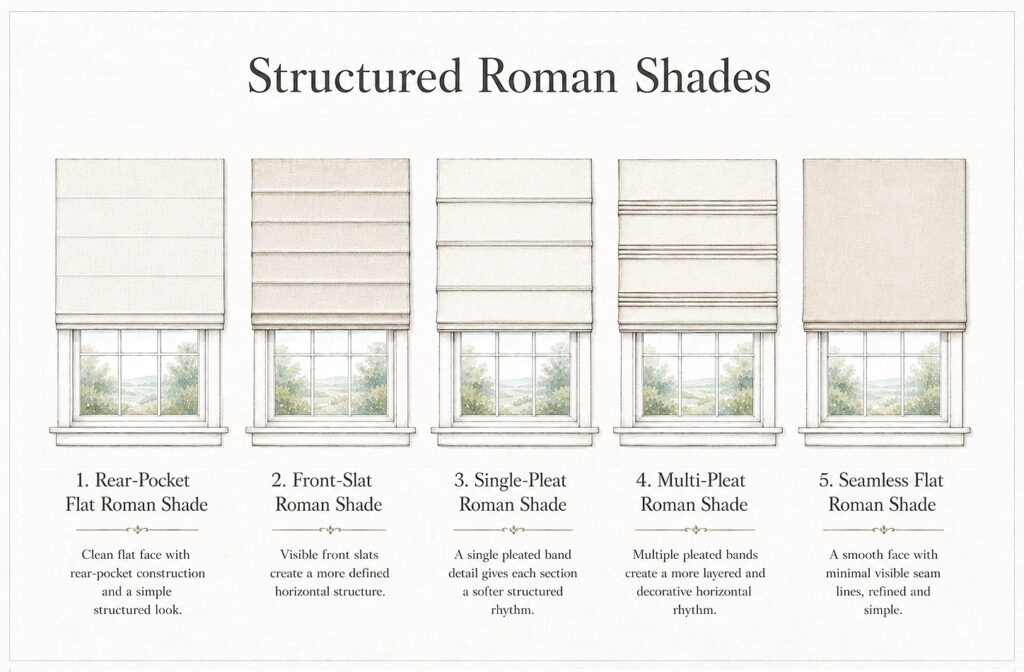
Rear-Pocket Flat Roman Shade
A rear-pocket construction keeps the supporting structure primarily on the back of the shade, leaving the front relatively flat and clean.
The subtle horizontal divisions give the shade structure without adding much decoration to the face.
Front-Slat Roman Shade
In this variation, horizontal slats are more visually defined from the front.
The repeated lines create a stronger architectural rhythm and make the construction itself part of the design.
Single-Pleat Roman Shade
A single pleated band is formed within each section of the shade.
Compared with a simple flat Roman shade, the added fold creates a softer but still structured horizontal rhythm.
Multi-Pleat Roman Shade
Multiple pleated bands are used within each section, creating a more detailed horizontal pattern.
The additional folds give the surface greater texture and decorative definition.
Seamless Flat Roman Shade
A seamless flat Roman shade minimizes visible stitching and horizontal seam lines on the face.
The result is one of the cleanest expressions of a structured Roman shade, particularly effective when the fabric itself is intended to remain visually uninterrupted.
Relaxed & Soft Roman Shades
Soft Roman shades rely less on rigid horizontal support and more on the natural behavior of the fabric.
As the amount and placement of fullness changes, the lower edge can move from almost flat to gently curved, deeply relaxed, or highly shaped.
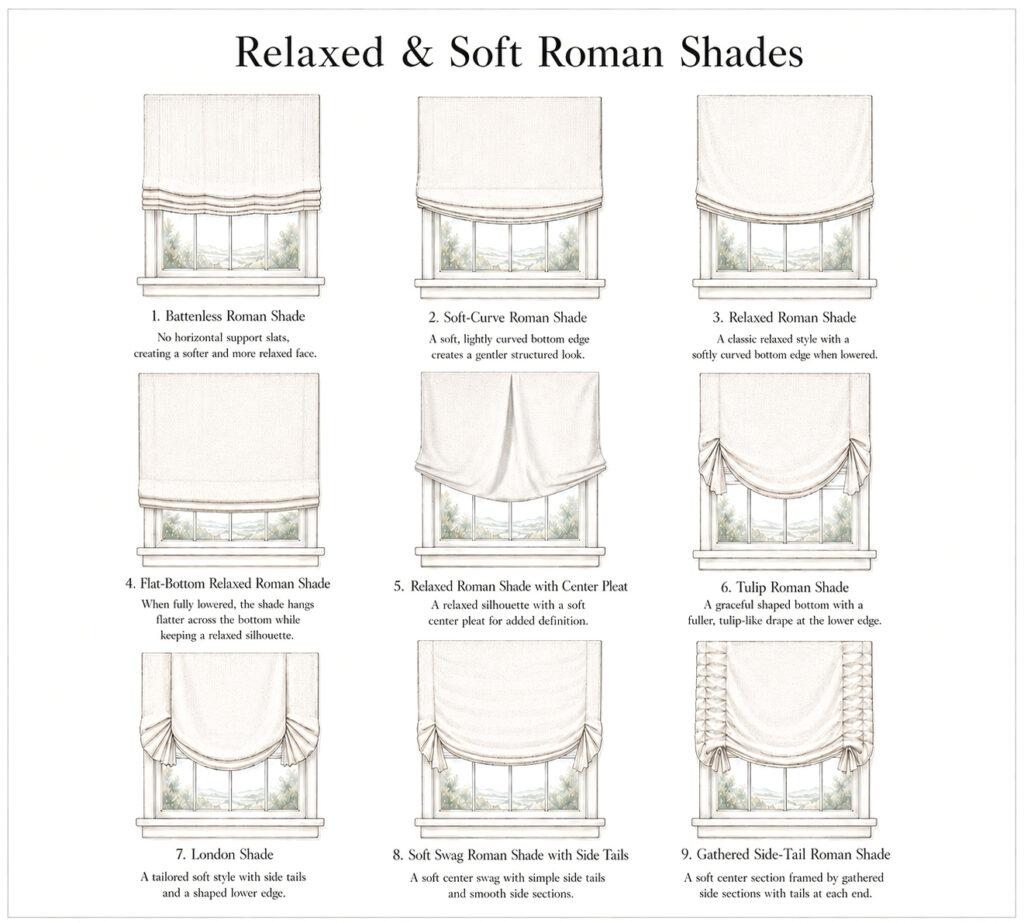
Battenless Roman Shade
A battenless Roman shade is constructed without horizontal support battens.
Because the fabric is not held into rigid horizontal sections, the folds tend to appear softer and more natural when the shade is raised.
Soft-Curve Roman Shade
This style introduces a light curve along the lower edge while maintaining a relatively controlled face.
It sits visually between a structured flat shade and a more pronounced relaxed Roman shade.
Relaxed Roman Shade
The classic relaxed Roman shade forms a gentle natural curve along the bottom.
Rather than finishing with a perfectly straight lower edge, the center drops softly, giving the shade a less formal appearance.
Flat-Bottom Relaxed Roman Shade
This variation retains the softer character of a relaxed shade but is constructed so that the bottom becomes flatter when fully lowered.
It provides a useful alternative when a relaxed appearance is wanted without a permanently pronounced center drop.
Relaxed Roman Shade with Center Pleat
A center pleat introduces additional fabric and definition into the middle of the lower edge.
The result is still relaxed, but with a more deliberate center detail.
Tulip Roman Shade
The Tulip Roman Shade creates a shaped lower edge with fuller side details and a soft center curve.
Its silhouette is more decorative than a standard relaxed shade while still relying on soft fabric movement.
London Shade
A London Shade combines a soft center section with more structured side details.
The side pleats or tails frame the center swag and give the shade a tailored but decorative character.
Soft Swag Roman Shade with Side Tails
This style forms a soft central swag while allowing the side sections to fall into simple tails.
Compared with a London Shade, the side areas remain smoother and less heavily pleated.
Gathered Side-Tail Roman Shade
Here, the soft center section is framed by narrower gathered areas toward each side.
The gathered sections introduce more texture and fullness, while the tails give the lower edge additional decorative movement.
Decorative / Shaped Bottom Styles
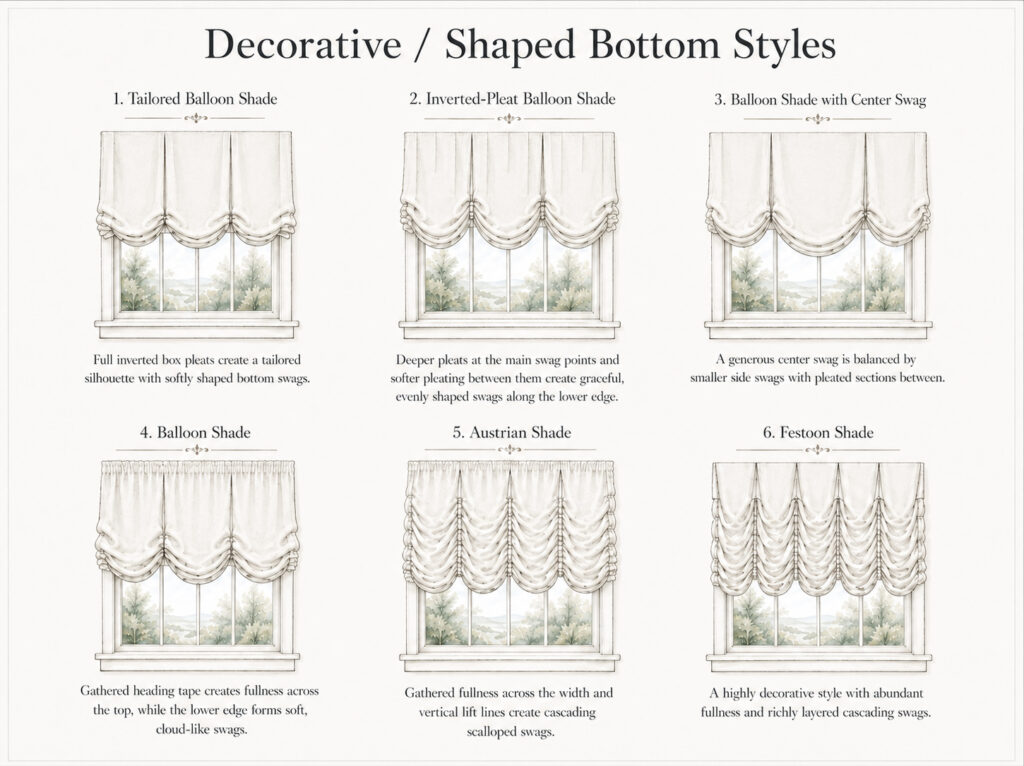
Decorative Roman shades place greater emphasis on fullness, pleating, and the shape of the lower edge.
These styles often use additional fabric and more complex construction to create swags, scallops, and dimensional silhouettes.
Tailored Balloon Shade
Full inverted box pleats create a more tailored structure through the body of the shade.
The pleats control the fullness while allowing softly shaped swags to form along the bottom.
Inverted-Pleat Balloon Shade
In this style, the pleating varies across the width.
Deeper pleats occur at the main swag points, while softer, shallower pleating between them helps create graceful and evenly shaped lower swags.
Balloon Shade with Center Swag
A generous center swag becomes the visual focus of the shade.
Smaller side swags and pleated transition sections balance the larger center section and give the bottom a more composed silhouette.
Balloon Shade
A Balloon Shade uses substantial fullness to create soft, cloud-like swags along the lower edge.
Gathered heading tape provides fullness across the top, distinguishing it from balloon variations that rely more heavily on individually constructed pleats.
Austrian Shade
An Austrian Shade combines fullness across the width with vertical lift lines.
As the shade is raised, the fabric gathers into repeated cascading scalloped swags, creating a soft and highly dimensional surface.
Festoon Shade
Festoon shades take this decorative approach even further.
Abundant fullness and densely layered cascading swags create a rich, highly ornamental appearance.
Dimensional & Layered Roman Shades
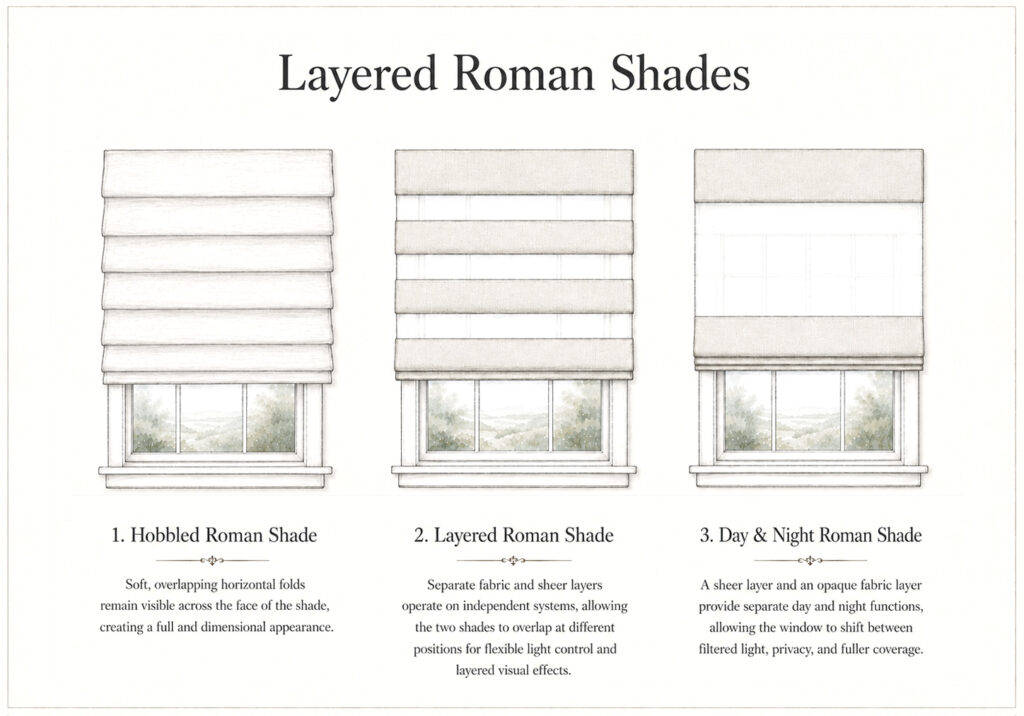
Some Roman shades create their visual character through dimensional folds or through the interaction of more than one fabric layer.
These styles can introduce both visual depth and additional ways to manage light and privacy.
Hobbled Roman Shade
A Hobbled Roman Shade maintains soft, overlapping horizontal folds across the face of the shade.
Unlike a flat Roman shade, the folds remain visible even when the shade is lowered, creating greater depth and fullness.
Layered Roman Shade
This style combines a fabric layer and a sheer layer on separate operating systems.
Because the two shades can move independently, they can overlap at different positions to create changing patterns of fabric and sheer while providing flexible control over light and privacy.
Day & Night Roman Shade
A Day & Night Roman Shade also combines a sheer layer with a more opaque fabric layer.
The two layers serve different purposes: the sheer supports filtered daylight and privacy during the day, while the opaque layer provides greater coverage when needed.
Specialty Shapes
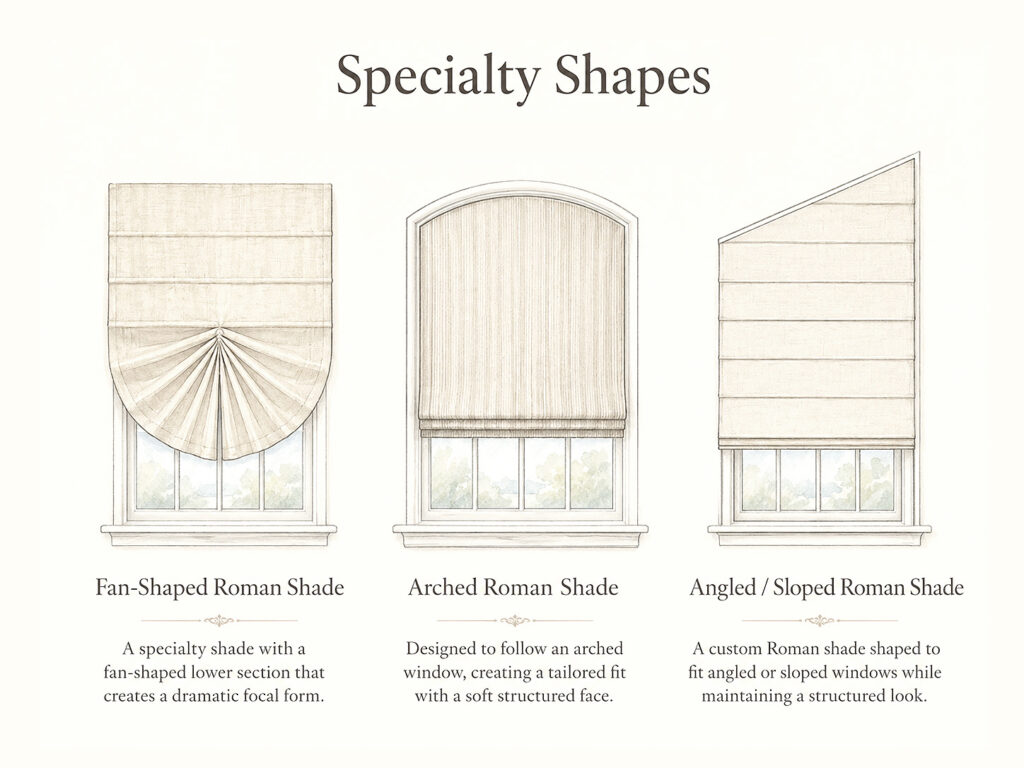
Roman shades are not limited to rectangular windows.
With appropriate patterning, structure, and operating methods, they can also be adapted to distinctive architectural shapes.
Fan-Shaped Roman Shade
A fan-shaped Roman shade develops a radial lower section that opens visually from a central point.
Its construction creates a distinctive geometric form that is very different from the horizontal rhythm of a conventional Roman shade.
Arched Roman Shade
An arched Roman shade follows the curved architecture of an arched window.
Careful shaping allows the treatment to fit the opening while maintaining a controlled, softly structured face.
Angled / Sloped Roman Shade
Angled Roman shades are custom-shaped to follow windows with sloped or asymmetrical upper edges.
The construction adapts the horizontal structure of a Roman shade to the architecture of the window rather than forcing the window into a standard rectangular treatment.
Choosing by Appearance, Not Just by Name
Roman shade terminology is useful, but the name alone rarely tells the whole story.
Two shades described by similar terms may look quite different depending on the location of the battens, the amount of fullness, the depth of the pleats, the fabric weight, or the way the lower edge is constructed.
In practice, I find it useful to begin with the desired visual result:
- Should the face look flat or dimensional?
- Should the folds appear structured or soft?
- Should the lower edge remain straight, form a gentle curve, or develop pronounced swags?
- Should the fabric itself remain the focus, or should the construction become part of the visual expression?
Looking at Roman shades this way makes style selection less about choosing a name from a list and more about understanding how construction shapes appearance.
Final Thoughts
Roman shades are often treated as a single window-treatment category, but visually they can range from extremely minimal to highly decorative.
A small construction change—a front slat instead of a rear pocket, one pleat instead of several, a flat lower edge instead of a relaxed curve—can change the character of the entire shade.
Comparing these differences has helped me think more clearly about how construction, fabric, and window architecture work together—and how each decision shapes the final appearance of a Roman shade.
Related Reading
Comments are closed.