
Valances can take many forms, from flat and tailored constructions to soft swags, gathered treatments, and more sculptural draped designs.
Unlike some window treatment categories, valance terminology is not always consistent across manufacturers, workrooms, designers, and retailers. Similar visual forms may appear under different names, while the same general term may describe slightly different constructions.
For that reason, this article is not intended to create a strict classification system.
Instead, it is designed as a visual reference—a place to quickly compare different valance expressions through shape, structure, proportion, pleating, gathering, and drape.
The goal is simple: when developing a window treatment concept, these illustrations can help identify a direction without having to search across multiple collections or manufacturers.
Structured and Tailored Valance Forms
Some valances rely primarily on controlled construction rather than loose draping.
Flat panels, Roman-inspired forms, pleated returns, shaped lower edges, tailored arches, and repeated box pleats all create a more defined architectural outline.
Within this group, relatively small changes in pleat placement, layering, bottom shape, or tie position can noticeably change the overall character of the treatment.
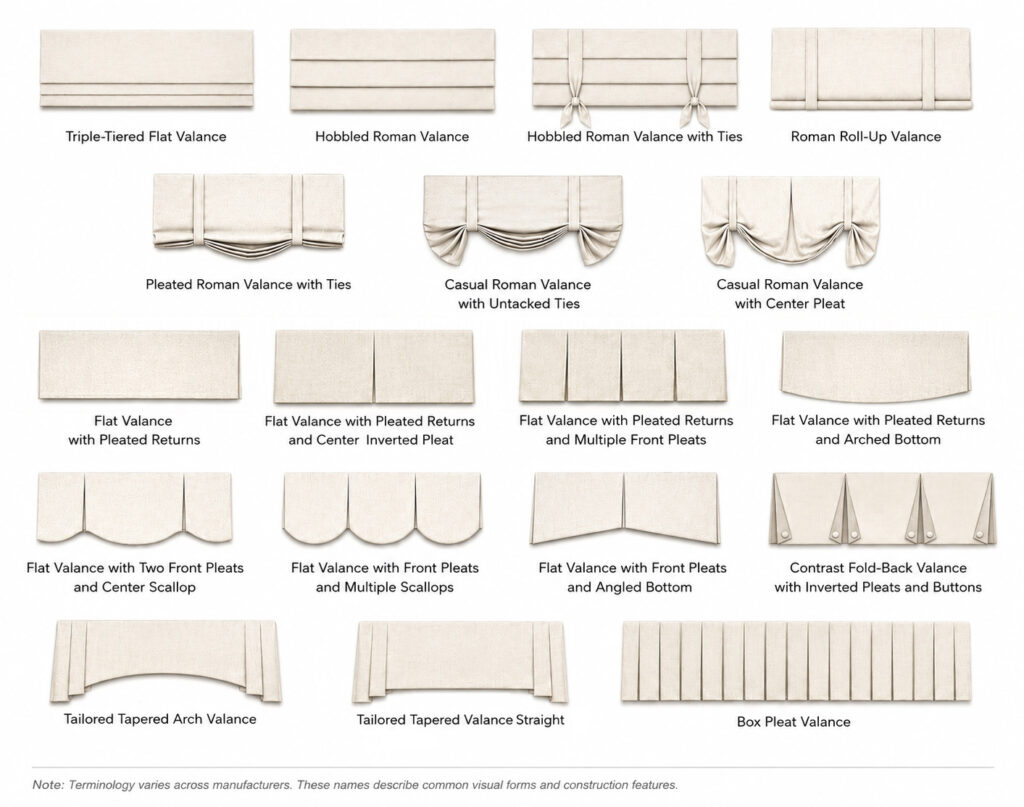
These forms are especially useful when the design calls for a clear horizontal line, controlled fullness, or a more tailored relationship with the window and surrounding architecture.
Scalloped, Kerchief, and Swag Variations
Valance design becomes softer as flat forms begin to incorporate kerchief corners, scalloped edges, swags, horns, bells, and cascades.
Some treatments remain largely structured but introduce a softer lower silhouette, while others depend more heavily on drape and fabric movement.
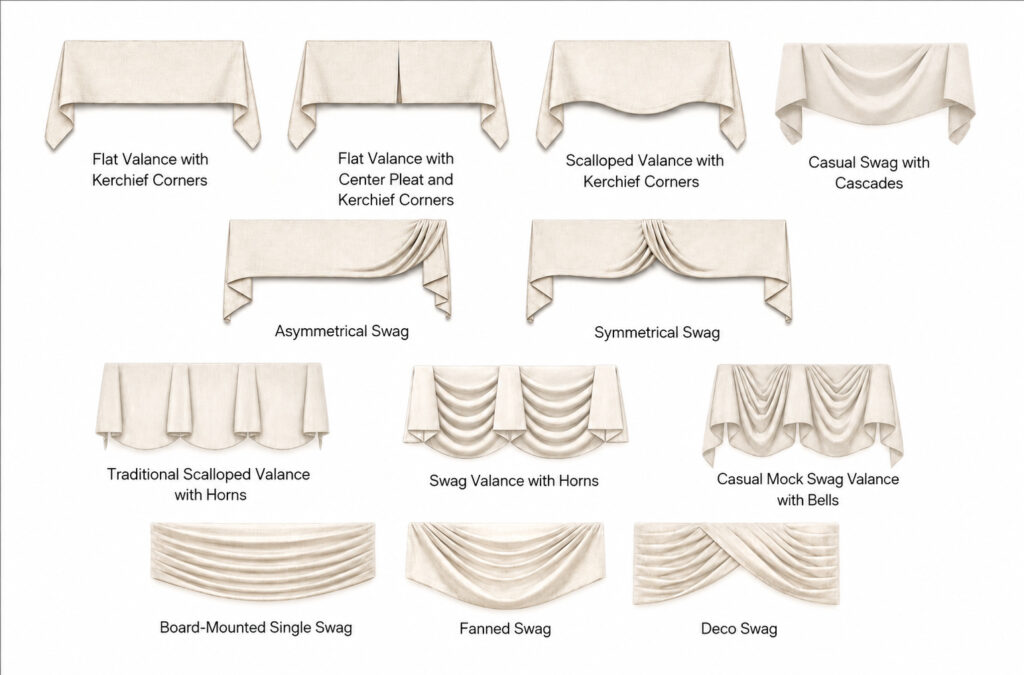
This group shows how a valance can move gradually from tailored to decorative without necessarily becoming highly formal.
The visual effect often depends on the balance between the flat body of the valance and the softer fabric elements introduced around the edges, center, or lower profile.
Pleated and Balloon Valances
Pleating offers another way to shape fullness and rhythm.
Repeated pleats create a controlled vertical pattern, while balloon constructions shift the emphasis toward rounded volume and a softer lower edge.
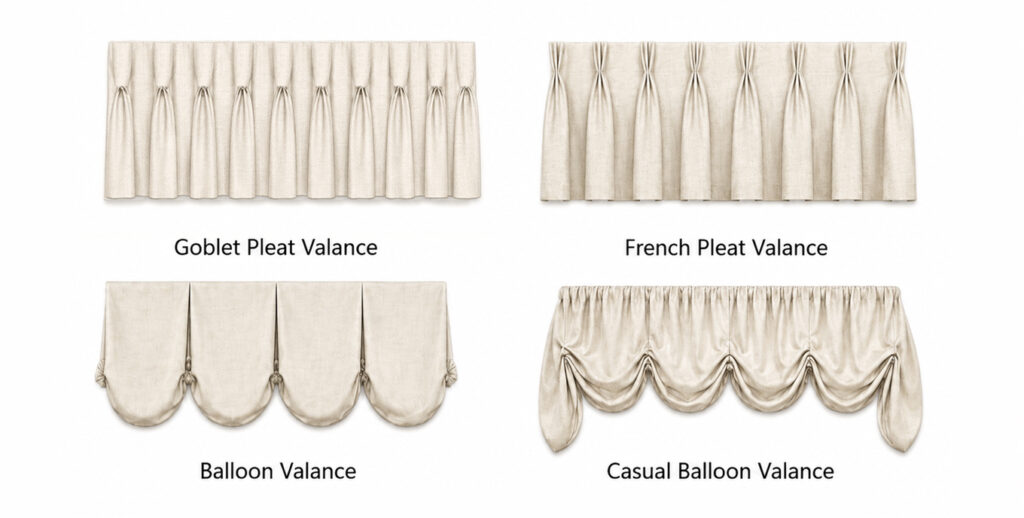
Although these treatments can look quite different, both demonstrate how fullness can be intentionally organized rather than simply gathered.
The amount of structure, spacing, and fabric volume strongly influences whether the final result feels tailored, traditional, relaxed, or decorative.
Shirred and Rod-Mounted Styles
Not all valance character comes from the lower edge.
The way the fabric connects to the rod or support can become an important part of the design itself.
Shirring, rings, tabs, ties, grommets, and rod pockets each create a different rhythm across the top of the treatment.
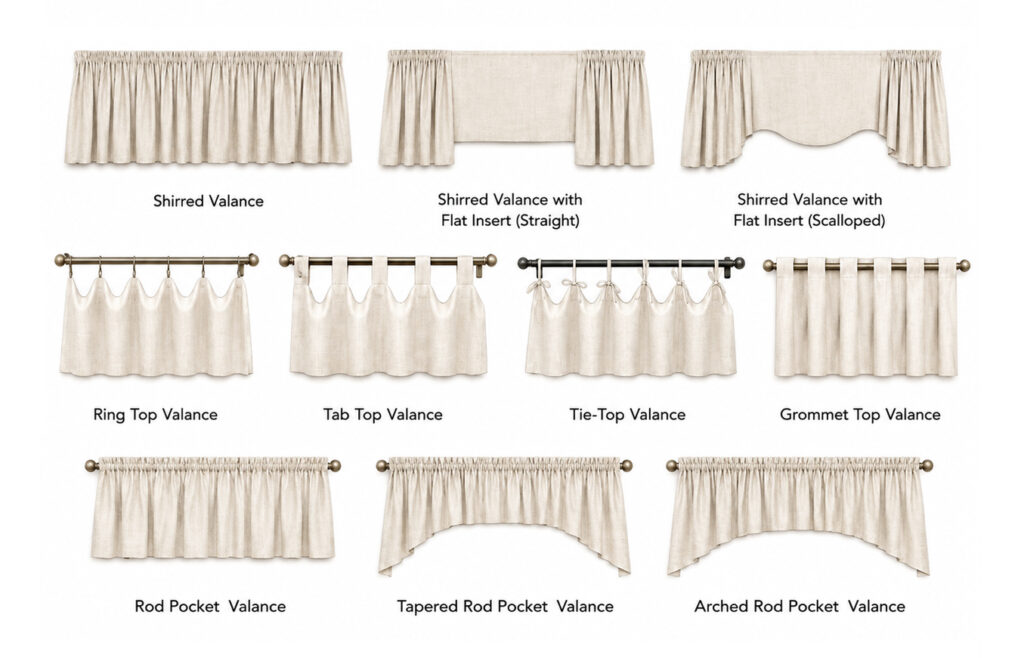
Rod-mounted styles often feel more casual and direct because the hanging method remains visible.
They can work especially well when the hardware is intended to become part of the overall composition rather than being concealed behind the fabric.
Festoon Arrangements and Overlap
Festoon treatments are highly adaptable because their appearance changes through repetition, overlap, direction, and cascade placement.
A single festoon can become a much larger composition when repeated across a wider board or layered in different sequences.
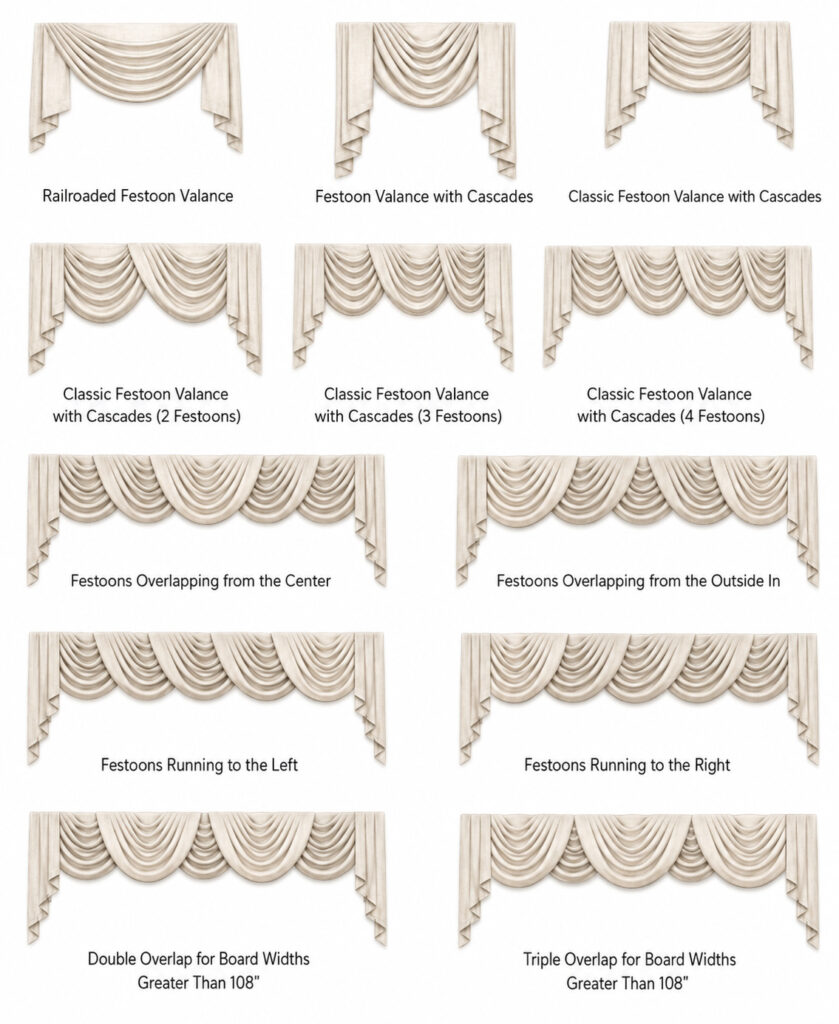
The basic draped form may remain similar, but the visual rhythm changes considerably depending on how individual festoons overlap and where that overlap begins.
This makes festoon design less about one isolated shape and more about how multiple shapes are arranged across the width of the treatment.
Pole, Throw, and Scarf Swags
Pole and throw swags represent some of the most freely draped valance expressions.
Here, the character of the design depends heavily on fabric behavior, support points, spacing, symmetry, and the way the material is allowed to fall.
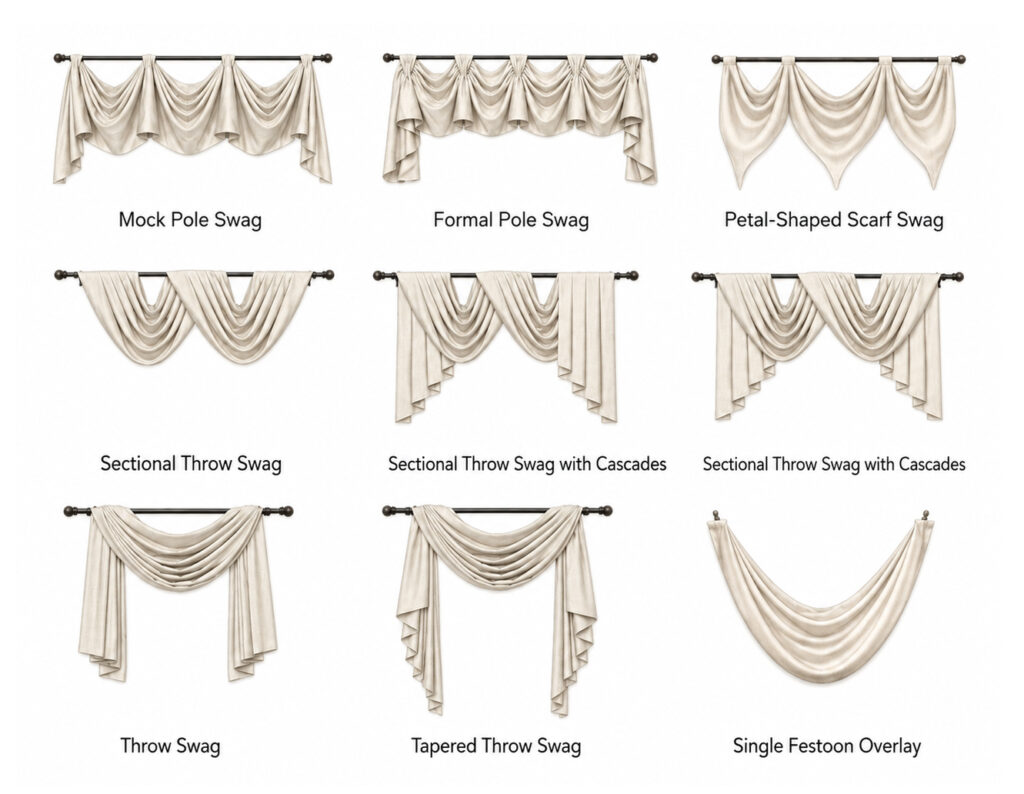
These treatments can range from highly controlled formal arrangements to much looser scarf-like compositions.
Even when the underlying idea is simple, small changes in placement can significantly affect the apparent depth, balance, and movement of the finished treatment.
Using This Reference During the Design Process
A valance should rarely be selected by name alone.
The same general form can look very different depending on:
- fabric weight and drape;
- pattern scale;
- fullness;
- lining and interlining;
- mounting method;
- board or rod width;
- window proportion;
- surrounding drapery or shade layers;
- the degree of tailoring or softness required by the room.
For this reason, it is often more useful to begin by identifying the desired visual language.
Should the treatment feel flat or dimensional?
Tailored or relaxed?
Architectural or decorative?
Symmetrical or intentionally asymmetrical?
Quiet or expressive?
Once that direction becomes clear, construction details can then be developed around the selected form.
A Note on Terminology
Valance terminology varies widely across the window treatment industry.
Many of the names used in this reference reflect common visual descriptions, construction characteristics, or terminology found across different manufacturers and workrooms.
They should therefore be read as practical reference language rather than as a universal naming standard.
In design practice, the most important thing is not always the label itself, but a clear understanding of the shape, structure, proportion, and fabric behavior being requested.
That shared visual understanding is often what allows a concept to move successfully from inspiration to fabrication.
Related Reading
If you would like to explore related top treatments and window treatment design ideas, these guides may also be useful:
- Cornice Shapes: A Visual Reference for Window Treatment Design — A comparison of common cornice shapes, surface details, and structural expressions.
- Drapery Length, Coverage, and Layering: A Visual Guide — A visual guide to drapery proportion, coverage, opening direction, and layered treatment combinations.
- Understanding Drapery Heading Styles — A reference to common drapery headings and the different visual rhythms they create.
- Understanding Roman Shade Styles — A guide to the appearance, structure, and design differences among common Roman shade styles.
Comments are closed.