
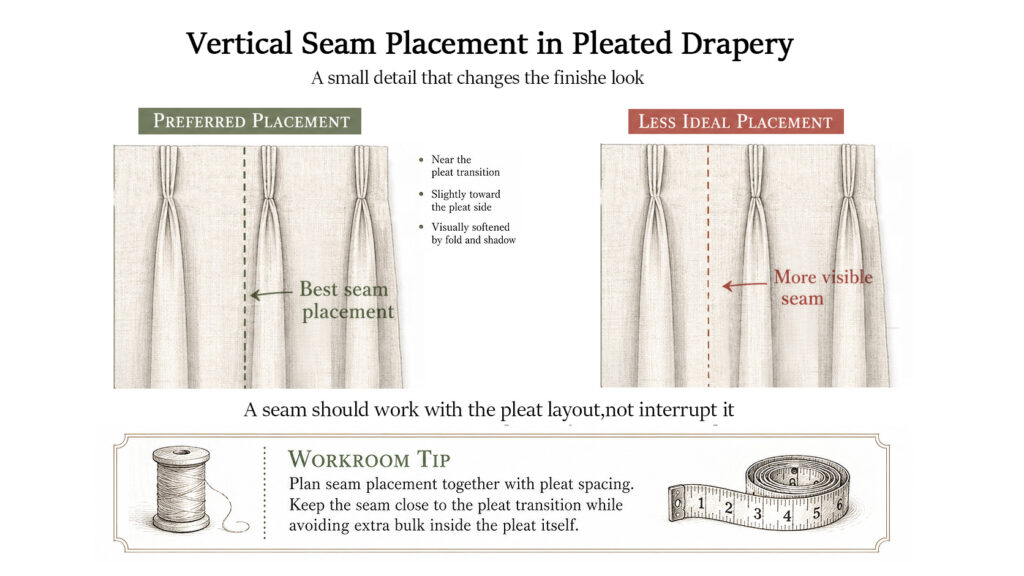
In custom drapery making, the placement of a vertical seam may seem like a small construction detail. In reality, it can have a direct impact on how the finished drapery looks after installation.
When the finished width of a drapery panel is wider than the fabric width, vertical seams are often unavoidable. The important question is not simply whether a seam is needed, but where that seam should be placed. A well-planned seam can be visually softened by the pleats, shadows, and natural movement of the fabric. A poorly placed seam, however, may fall in the most visible flat area of the panel and affect the overall finished appearance.
For pleated draperies such as pinch pleat, Euro pleat, or goblet pleat styles, a vertical seam is usually not best placed in the center of the flat space between two pleats. This flat area is often the most visible part of the drapery face. If the seam falls directly in this area, it may become more noticeable, especially under certain lighting conditions or with fabrics that have texture, sheen, or heavier linings.
A more thoughtful approach is to place the vertical seam near the transition between the flat space and the pleat, slightly toward the pleat side. In this position, the seam can be visually softened by the fold line, shadow, and dimension created by the pleat. Simply put, the seam should work with the pleat structure rather than sit openly on the flat face of the panel.
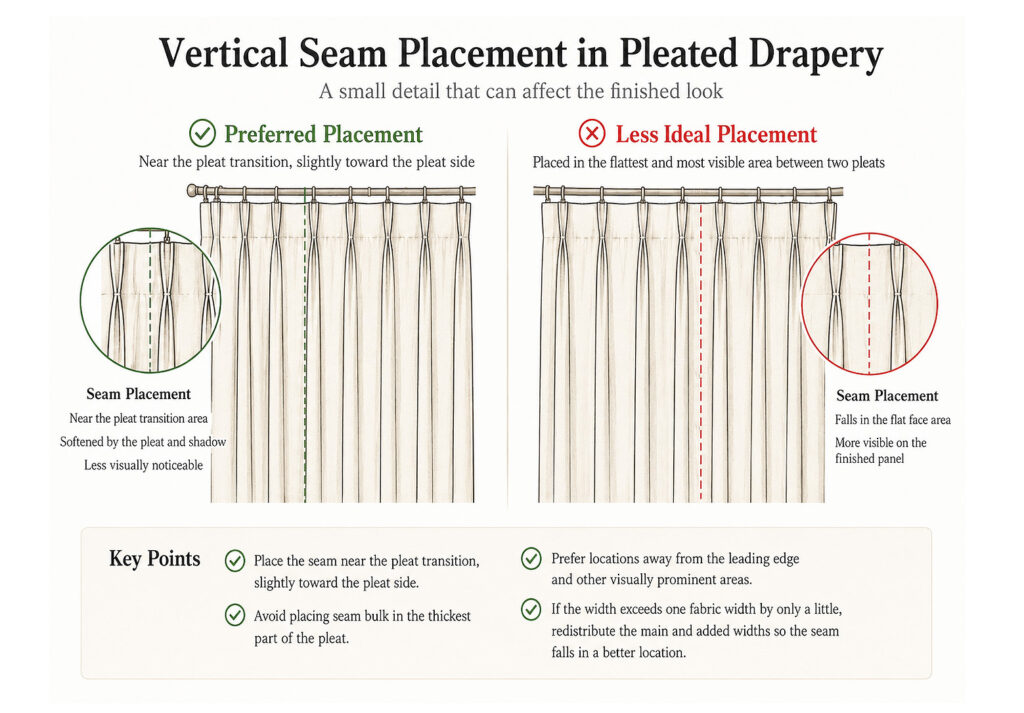
However, this does not mean the seam should always be buried deep inside the pleat itself. With heavier fabrics, blackout lining, interlining, or multiple layers, placing the seam allowance directly inside the thickest part of the pleat can create extra bulk and affect how the pleat forms. The better standard is to keep the seam close to the pleat transition while avoiding unnecessary thickness inside the pleat structure.
A seam may fall near different pleat transition areas, but the preferred location is usually one that stays away from the leading edge and the most visible part of the panel. On a pair of functional draperies, the first pleat near the center closure may still be visually prominent, so it is not always the best place for a seam. The exact pleat number is less important than whether the seam falls in a visually quiet location.
Another common situation occurs when the finished panel is only slightly wider than one fabric width, perhaps by about 4–8 inches. In this case, it is usually not ideal to simply add a narrow strip of fabric just to make up the missing width. If the added piece is too narrow, the seam may naturally fall near the leading edge, side edge, or another highly visible area.
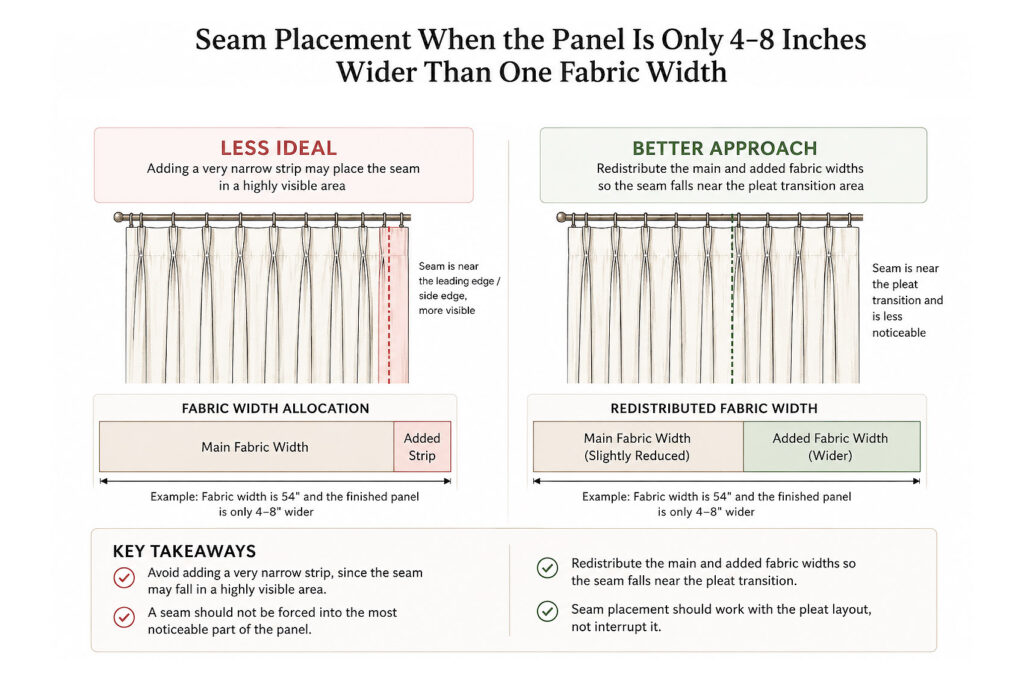
A more professional solution is to redistribute the main fabric width and the added fabric width. The main width may be reduced slightly, and the added section may be made wider, so the seam can move to a better location near a pleat transition. The goal is not only to make the panel wide enough, but to make the seam work with the final pleat layout.
This is why seam placement should not be decided after cutting as a last-minute adjustment. It should be planned together with the pleat spacing, pleat count, fabric width, and finished panel width. In custom drapery work, seam placement and pleat layout are part of the same construction logic.
For patterned fabrics, stripes, jacquards, or fabrics with a strong texture, seam placement becomes even more important. The seam must also be considered together with pattern matching and the visual rhythm of the fabric. A poorly placed seam can interrupt the design, even when the sewing itself is clean.
Vertical seam placement may be a small detail, but it reveals the judgment of a professional workroom. Good seaming is not just about joining fabric widths together. It is about allowing the seam to become quiet, natural, and visually secondary in the finished drapery.
Workroom Note:
Vertical seams should be planned near the pleat transition area, slightly toward the pleat side, while avoiding extra bulk inside the thickest part of the pleat. Seam placement should be planned together with pleat spacing, not handled as an afterthought. When a panel is only slightly wider than one fabric width, the main and added fabric widths should be redistributed to keep the seam away from the leading edge or other highly visible areas.
Related Notes
Understanding Drapery Heading Styles: How Different Headings Shape Custom Drapery
A closer look at how pleat structure, fullness, and heading construction shape the finished drapery—important considerations when planning where vertical seams should fall.
Understanding Drapery Anatomy: A Visual Guide to Key Parts and Construction Terms
A visual guide to the main parts of a custom drapery panel, including headings, leading edges, side hems, returns, overlaps, lining, and other construction details.
Understanding Drapery Fullness: Fabric Ratio, Pleat Style, and Finished Appearance
A practical look at how fabric ratio, pleat style, folds, and fullness work together to influence the structure and finished appearance of custom drapery.
Understanding Fabric Types for Window Treatments: Fiber, Weave, and Surface
A foundation for understanding fabric construction and characteristics—useful when considering fabric width, pattern, handling, and fabrication decisions in custom window treatments.