When choosing drapery, people often focus first on fabric color, pattern, texture, hardware, and pleat style. But one of the most important factors behind the final look is often less visible at the beginning: drapery fullness.
Fullness affects how a curtain hangs, folds, moves, stacks, filters light, and feels within a room. The same fabric can look very different depending on how much fabric is used across the finished width.
Lower fullness creates a flatter, cleaner, and more economical appearance. Higher fullness creates richer folds, softer volume, and a more custom-made feeling.
But more fullness is not always better.
A well-made drapery is not simply about using more fabric. It is about finding the right balance between fabric type, pleat style, window size, track or rod width, stackback space, light control, budget, and the overall design intent.
In professional drapery fabrication, fullness is not only a number. It is a design and workroom decision that affects proportion, movement, function, and the finished appearance of the room.
What Is Drapery Fullness?
Drapery fullness refers to the relationship between the amount of fabric used and the finished width the drapery needs to cover.
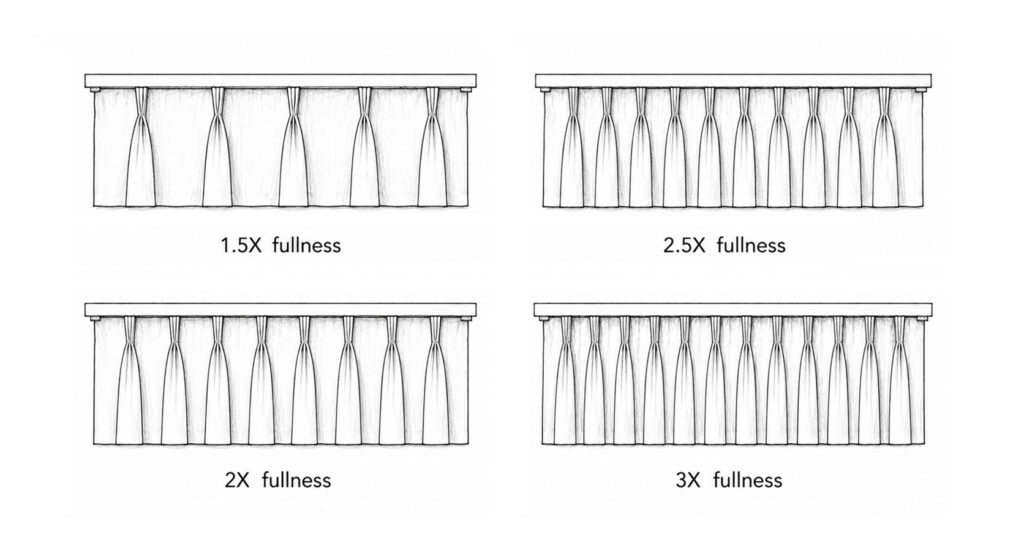
For example, if a window or track needs to cover 100 inches, and the drapery is made with about 200 inches of fabric width, the curtain has approximately 2x fullness.
If 250 inches of fabric are used to cover the same 100-inch width, the drapery has approximately 2.5x fullness.
At first, fullness may seem like a simple fabric ratio. In real fabrication, however, the final result is more complex.
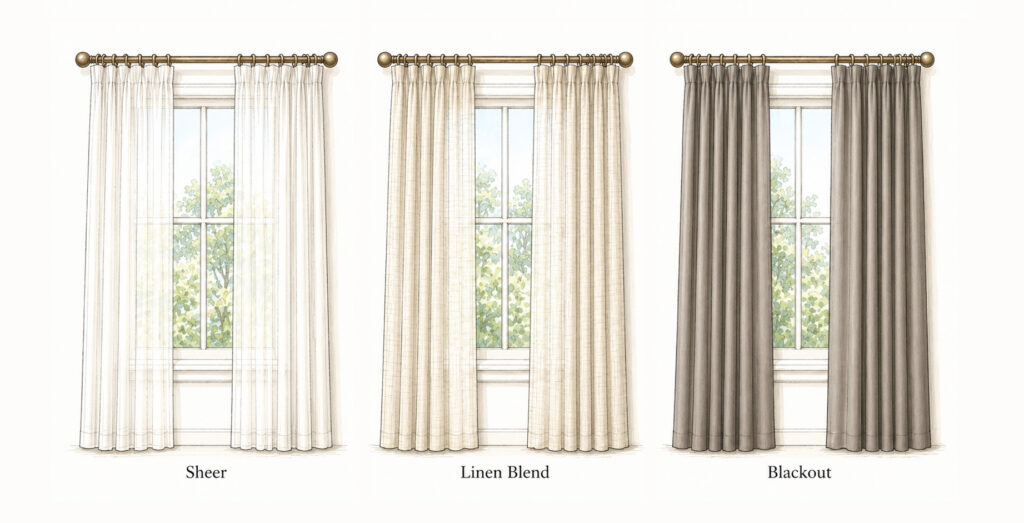
The same 2x fullness can look very different on a lightweight sheer, a medium-weight linen blend, a heavy blackout fabric, or a structured decorative textile. It can also change depending on the pleat style, lining, hardware, and installation method.
For this reason, fullness should not be understood only as “how much fabric is used.” It is one of the key design factors that shapes the final volume, rhythm, softness, and function of a drapery.
Why Fullness Matters
Fullness is a quiet but important detail in drapery design.
It may not attract attention as quickly as a fabric pattern or decorative trim, but it strongly affects whether a finished curtain feels flat and ordinary, or soft, balanced, and custom-made.
Fullness influences the visual weight of the drapery when closed, the rhythm of the folds, the way the fabric falls, the amount of light filtration, the level of privacy, and the stackback when the curtain is open.
If the fullness is too low, the drapery may appear flat, thin, or under-scaled for the room.
If the fullness is too high, the drapery may look richer, but it will also require more fabric, more labor, more weight, more stackback space, and a higher budget.
In this sense, fullness connects design with fabrication.
It is both an aesthetic decision and a technical one.
Fullness Is Not the Same for Every Drapery Style
Many people talk about drapery fullness in simple terms such as 2x, 2.5x, or 3x. These numbers are useful for general communication, but they do not apply to every drapery style in the same way.
Different heading styles create folds differently, so they require different fullness considerations.
Traditional pleated styles such as pinch pleat, French pleat, or Euro pleat usually need enough fabric to form stable pleats and soft return between the folds.
Ripple fold drapery and wave curtains work differently. Their wave effect is not created by traditional fixed pleats. Instead, it depends on the relationship between tape spacing, carrier spacing, and the track system. For this reason, ripple fold or wave curtain fullness should not be understood in exactly the same way as traditional 2x or 2.5x pleated drapery.
Grommet drapery, rod pocket drapery, and flat panel drapery may use lower fullness and still create a casual, simple, or more relaxed effect.
Sheer curtains often benefit from higher fullness because lightweight fabrics are more transparent. Extra fabric volume can add softness, depth, and a more graceful light-filtering effect.
Heavy fabrics, velvet, blackout fabric, or drapery with thick lining need more careful consideration. Since these fabrics already have weight and body, too much fullness can create excessive bulk, difficult movement, and large stackback.
There is no single fullness standard that works for every drapery style.
A professional fullness decision depends on the drapery style, fabric quality, fabrication method, and the needs of the space.
Common Drapery Fullness Ratios
In design and fabrication, the following fullness ratios are often used as general reference points. They are not strict rules, but they help designers and clients understand how different fabric volumes affect the finished look.
| Fullness | Visual Effect | Suitable For | Note |
|---|---|---|---|
| 1.5x | Cleaner, flatter, less fabric volume | Casual panels, budget-sensitive projects, decorative panels | May look under-scaled or less finished |
| 2x | Balanced, natural, commonly used | Many residential draperies and medium-weight fabrics | A safe and practical starting point |
| 2.5x | Softer, fuller, more custom-looking | Formal rooms, designer projects, sheers | Requires more fabric and more stackback |
| 3x | Very full, layered, and rich | Lightweight sheers or decorative high-end treatments | Not suitable for all heavy fabrics |
These ratios should always be adjusted according to the fabric weight, drape, pleat style, lining, window size, hardware width, stackback space, and desired appearance.
A 2.5x sheer curtain may look soft and elegant.
The same 2.5x fullness in a heavy blackout fabric may feel bulky and difficult to manage.
When choosing fullness, the number is only the beginning. The fabric and construction method matter just as much.
Workroom Note
Higher fullness does not automatically mean a better result.
For soft and lightweight fabrics, additional fullness can create more depth, movement, and softness.
For stiff or heavy fabrics, too much fullness may create bulk, excessive stackback, difficult operation, or a heavier visual appearance.Good fullness allows the fabric to express its natural drape and texture. It should not force the fabric into more volume than it can comfortably support.
Fabric Type Changes the Fullness Effect
Fullness should never be selected separately from the fabric.
Lightweight sheers often need more fullness to create a soft, layered, and finished appearance. If the fullness is too low, the sheer may look thin when closed and may not soften the light effectively.
Medium-weight linens, cotton blends, and decorative fabrics often work well around 2x to 2.5x fullness. This range usually creates natural folds without making the drapery feel too heavy, which is why it is common in many residential and designer projects.
Heavy fabrics, velvet, blackout fabrics, or draperies with blackout lining require more caution. These materials already have body and weight. If the fullness is too high, the curtain may become bulky and may require more stackback space when opened.
The fabric hand also matters.
A soft, fluid fabric may fall beautifully with higher fullness. A stiff fabric may not create soft folds even with additional fabric volume. Instead, it may form sharper, more structured folds.
For this reason, the right fullness depends not only on the ratio, but also on whether the fabric itself can support the desired fold and volume.
Fullness and Stackback
Many people consider how the drapery will look when closed, but forget to consider how it will look and function when open.
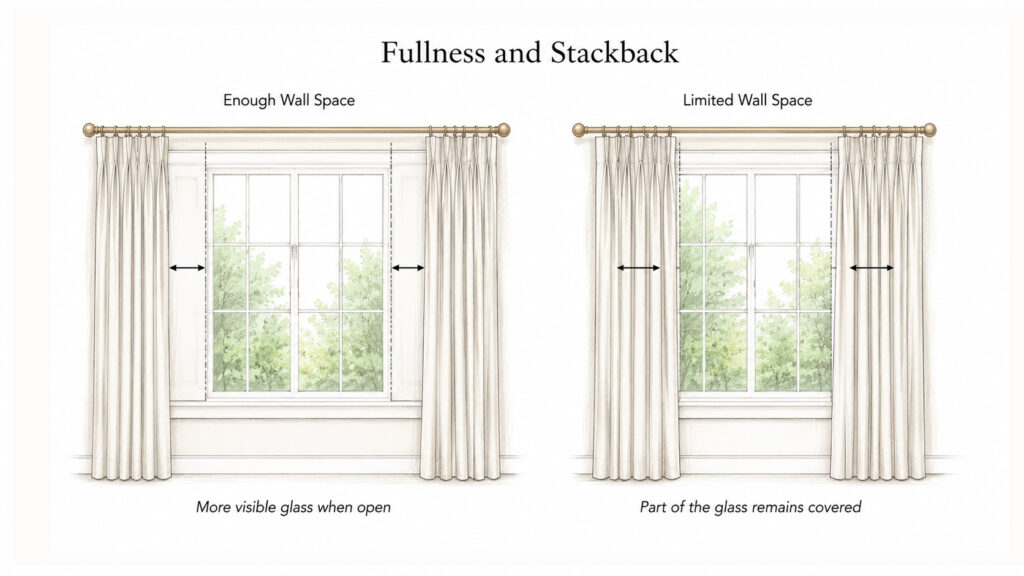
The higher the fullness, the more fabric is used. The more fabric is used, the more space the drapery usually needs when it is pulled open. This is called stackback.
Stackback affects daylight, view, and how much glass remains visible when the curtain is open.
If there is enough wall space beside the window, fuller drapery can stack outside the glass area and still allow good natural light into the room.
But if the wall space is limited, or if the track or rod is installed only within the window frame, high fullness may cause the open drapery to cover part of the glass.
For large windows, sliding doors, hotel rooms, living room windows, and spaces where daylight is important, stackback should be considered early in the design process.
Fullness, hardware width, parking space, and wall space should be planned together.
A professional drapery solution should look good when closed and work well when open.
Fullness and Budget
Fullness also affects the project budget.
Higher fullness usually means more fabric, more lining, more labor, more weight, and potentially higher shipping and installation costs.
However, budget control should not simply mean reducing fullness.
If fullness is too low, the drapery may save fabric but look flat, incomplete, or out of proportion with the room. This can be especially noticeable on large windows, tall spaces, formal living rooms, and designer projects.
A better approach is to balance budget and final appearance.
The goal is not to use the least fabric possible. The goal is to use enough fabric to achieve the intended look without unnecessary excess.
Good budget control means making the right fullness decision without compromising the finished effect.
How to Choose the Right Drapery Fullness
Before choosing fullness, it is helpful to confirm several key details:
- Is the drapery mainly decorative or functional?
- Is the fabric lightweight, soft, medium-weight, heavy, or stiff?
- Will the drapery include lining or blackout lining?
- What pleat style or heading style will be used?
- How wide and tall is the window?
- What is the track or rod installation width?
- Is there enough stackback space beside the window?
- Does the project need to maximize daylight and view?
- Should the room feel clean, casual, formal, soft, or luxurious?
- Does the budget allow for higher fabric consumption?
These questions may seem detailed, but they directly affect whether the finished drapery feels natural, functional, and well proportioned.
In many projects, fullness is not determined by a fixed formula. It is determined by the design intent and the fabrication conditions together.
Sometimes 2x fullness is enough.
Sometimes 2.5x creates a softer and more complete result.
Sometimes 3x is appropriate only for lightweight sheers or highly decorative treatments.
Sometimes reducing fullness can actually make a heavy fabric look cleaner and more modern.
The right fullness is not the highest fullness.
It is the fullness that best suits the fabric, the window, and the space.
Final Thoughts
Drapery fullness may look like a simple fabric ratio, but it connects design, fabrication, function, and feeling.
It affects how full the drapery looks when closed and how much space it needs when open.
It affects how the fabric falls, how light enters the room, and how finished the final treatment feels.
In professional drapery design, fullness should not be understood only as “how many times the fabric width.” It is a design decision that balances fabric, pleat style, space, function, and budget.
A beautiful drapery does not always use the most fabric.
It uses the right amount of fabric, in the right way, for the right space.
Related Notes
Understanding Drapery Heading Styles: How Different Headings Shape Custom Drapery
A closer look at how pleated, wave, and rod-based headings create different structures, folds, and finished appearances—and why fullness should be considered together with heading style.
Understanding Drapery Stack Back: Planning Space Beyond the Window
A practical study of how fabric volume, heading style, lining, hardware, and available wall space affect the amount of room drapery needs when open.
How Fabric Texture Changes the Look of Window Treatments
A visual study of how fabric weight, softness, texture, and drape influence folds, volume, and the overall character of a finished window treatment.
Understanding Drapery Lining: Lining, Blackout Lining, and Interlining
A guide to how lining, blackout lining, and interlining affect the weight, body, light control, construction, and finished behavior of custom drapery.