

In custom drapery, the final result is rarely shaped by one single design element. More often, it is the combination of many small decisions that determines whether a finished window treatment feels balanced, refined, and appropriate for the space.
The same fabric, the same window, and the same general style can lead to very different outcomes. One drapery may hang naturally, with calm pleats, clean edges, and a well-proportioned silhouette. Another may be technically complete, but still feel slightly unfinished in its fullness, fall, closure, or overall presentation.
These differences often come from details that are not immediately obvious: how the finished width is planned, how the pleats are spaced, which lining is selected, how the edges are finished, how the fabric behaves, and how the drapery is dressed after installation.
In high-quality custom drapery, details are not decorative extras. They are part of the structure of the finished work. They determine whether a panel is simply made, or whether it truly supports the design intent of the room.
Measurements Are About More Than Numbers
Drapery measurements are not only about the width and height of a window.
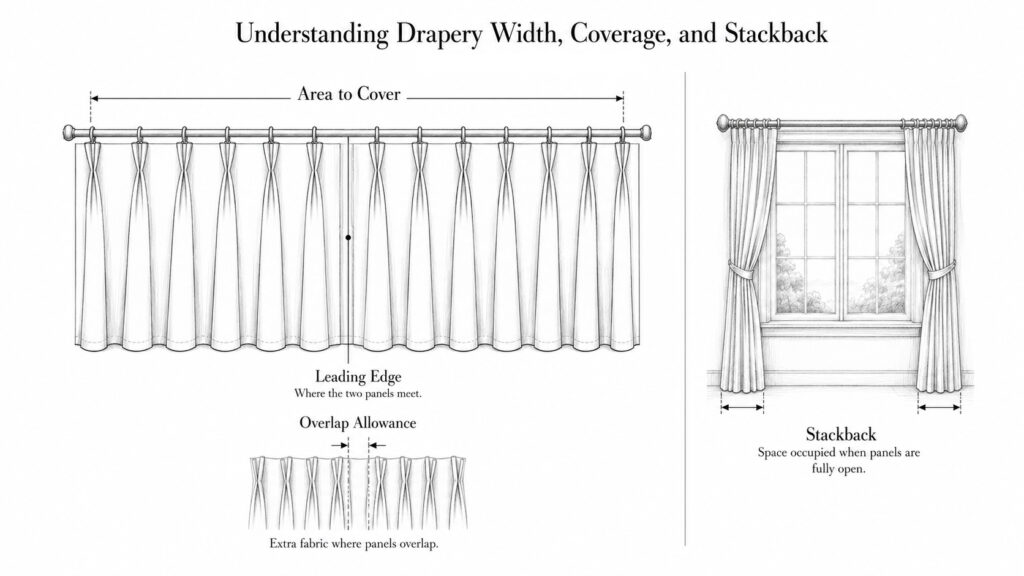
In a custom project, the finished dimensions need to consider the area to cover, how the panels will open and close, where the stackback will sit, whether returns are needed, and how the leading edges will meet when the drapery is closed.
These details affect both function and appearance.
A return can help create a more complete side view and reduce light gaps along the edge. A well-planned leading edge affects how two panels meet at the center. Stackback influences how much glass remains visible when the drapery is open.
Good measurements are not simply accurate numbers. They are the translation of design intent, installation conditions, and everyday use into a finished size that works in the room.
Pleat Spacing Creates Visual Rhythm
Fullness is often one of the first things people discuss when planning drapery. A panel may be made with two times fullness, two-and-a-half times fullness, or another specification. But fullness alone does not define the final look.
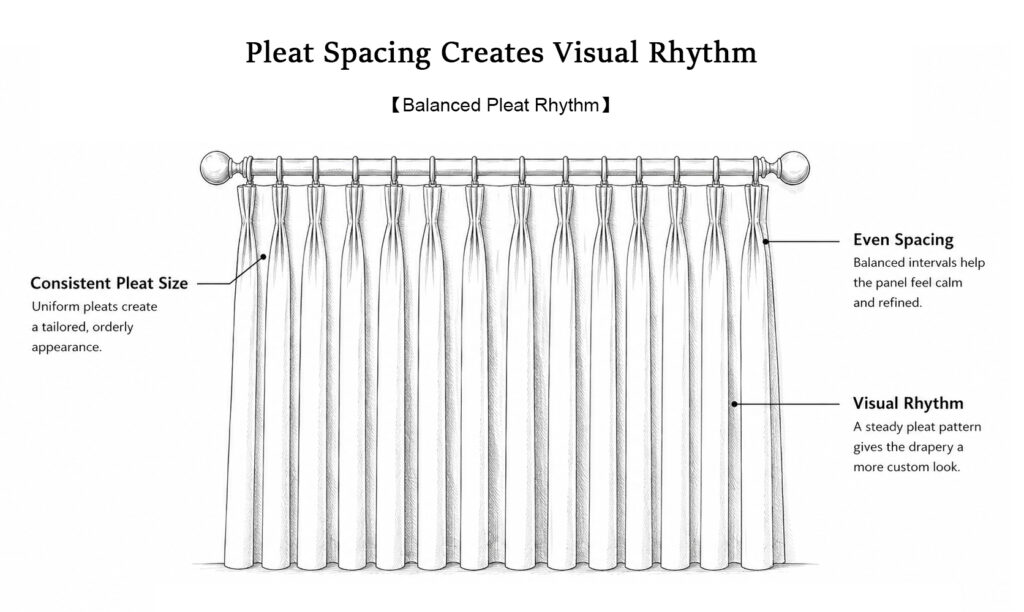
The size of each pleat, the spacing between pleats, and the way those pleats are distributed across the finished panel all influence the visual rhythm of the drapery.
Well-planned pleats create a quiet sense of order. Whether the panels are closed, partially open, or stacked to the side, the pleats should feel continuous and balanced.
This becomes especially important when a room has multiple windows of different sizes. A consistent pleat logic helps the entire space feel more unified. In many cases, thoughtful spacing and proportion contribute more to a refined result than fullness alone.
Lining Affects Function, Weight, and Fall
Lining is often discussed in terms of light control, but its role is broader than that.
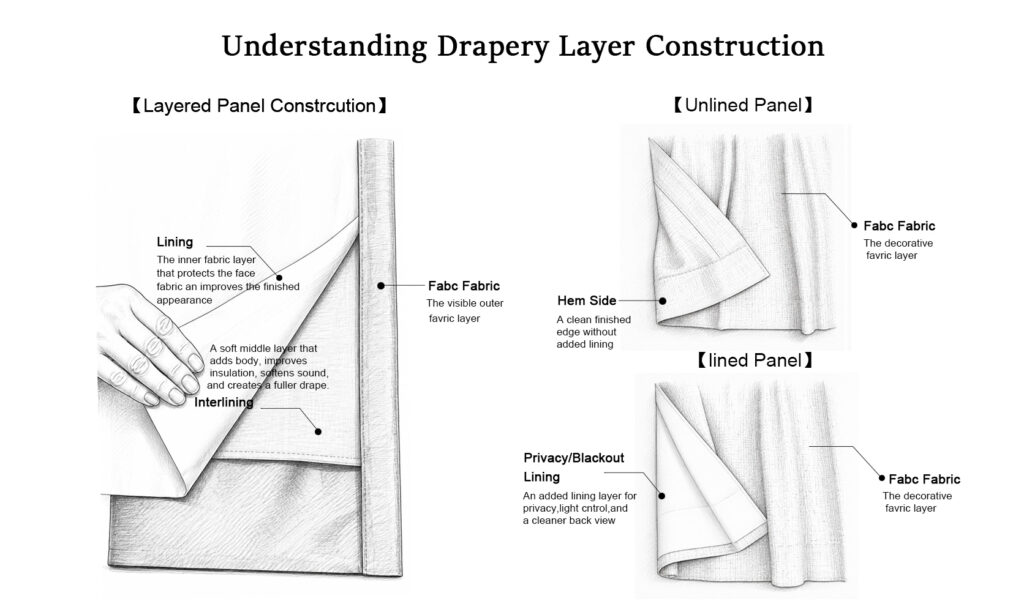
In custom drapery, lining, blackout lining, and interlining can affect privacy, fabric protection, insulation, sound absorption, body, weight, and the way the drapery falls.
A standard lining can give the back of the drapery a cleaner appearance and help protect the face fabric from sunlight. Blackout lining is often used in bedrooms, media rooms, or spaces where privacy and light control are important. Interlining can add softness, depth, and a more substantial hand. It may also be selected for projects where thermal comfort, insulation, or a quieter room feel is desired.
However, more structure is not always better. A lightweight fabric can lose its natural softness if paired with a lining that is too heavy. A heavier fabric can become bulky if the construction is not considered carefully.
The right lining choice depends on the fabric, the room, the performance needs, and the desired visual effect.
Edges Influence the Finished Quality
The edges of a drapery are easy to overlook, but they play an important role in the finished appearance.
Side hems, bottom hems, leading edges, returns, and weighted hems all affect how stable, clean, and complete a panel feels from the front, the side, and the back.
A well-finished side edge helps the panel hang more naturally and reduces twisting or rolling. A stable bottom hem gives the drapery a cleaner line near the floor. For sheers and lighter fabrics, a weighted hem can help the lower edge fall with more control.
The leading edge also matters. It affects how the drapery closes, how the center line appears, and whether the front edge has enough support when hung from rings, pins, or other hardware.
Many of these details are small on their own, but together they shape the sense of quality in the finished window.
Fabric Judgment Is an Essential Part of Custom Work
Fabric is not a fully standardized material.
Linen has natural texture and ease. Sheer fabric is light and translucent, but also more sensitive to edge finishing and light. Velvet has direction, depth, and changes in reflection. Embroidered fabrics, stripes, plaids, and large-scale patterns require attention to placement, balance, and cutting.
Different fabrics cannot always be handled in the same way.
Some materials support fuller pleats. Others work better with a lighter structure. Some need lining or interlining to give them stability, while others need to preserve their original softness and movement.
This kind of judgment is difficult to replace with a single formula. A strong custom result comes from understanding both the standard construction method and the specific character of the fabric.
Final Dressing Completes the Drapery
A drapery is not fully finished the moment sewing is complete.
Steaming, dressing, fold training, and final inspection all affect how the drapery enters the room. The pleats need to fall naturally. The bottom line should be clean. The panels should feel balanced. The stackback should look intentional when the drapery is open.
Some fabrics need steaming to release marks from production or transport. Some styles benefit from fold training so the pleats begin to fall in the intended direction. These final steps are not extra decoration. They help the earlier construction details become visible in the finished space.
Conclusion
Good custom drapery often looks simple once it is installed.
It falls naturally, holds its proportion, closes cleanly, and works with the room rather than drawing attention to itself. But that quiet result depends on many decisions made before the panel ever reaches the window.
Measurements, pleat planning, lining, edge finishing, fabric judgment, and final dressing all contribute to the finished quality.
That is the value of detail in custom drapery: it turns a design idea into a finished window treatment that feels stable, refined, and appropriate for the space.
Related Notes
Understanding Drapery Leading Edges and Side Edges
A closer look at the construction and function of drapery edges, including side edges, leading edges, returns, and how these details affect the finished panel.
Understanding Drapery Lining, Blackout Lining & Interlining
A practical guide to lining, blackout lining, and interlining, and how each option influences light control, structure, weight, and the finished drape.
Drapery Pin Setting Guide
A closer look at how drapery pin position relates to the actual hanging point, hardware, and the finished height and appearance of the treatment.
Drapery Anatomy Guide
A visual reference to the main parts of custom drapery and how individual construction details come together in the finished treatment.