
Valance and cornice proportions may seem like a simple matter of dimensions, but in practice they are rarely solved by one fixed formula.
The same valance height can look completely different on two windows of different sizes.
The same cornice width may also need to change depending on whether it sits above a Roman shade, blind, drapery, or no secondary treatment at all.
For that reason, I find it more useful to think about three dimensions together:
- height
- width and side coverage
- depth and operating clearance
These dimensions are not independent. Together, they determine whether the finished treatment feels visually balanced and functionally appropriate.
1. Height Proportion
Valance height has a strong influence on how the window is perceived.
If the valance is too shallow, it may feel visually weak and may not frame the window effectively.
If the height is well balanced, it can relate naturally to the window, wall space, ceiling height, and the treatment below.
If the valance becomes too tall, it may make the window feel shorter or smaller and can add too much visual weight at the top.

There is no single height that works for every project.
The proportion usually depends on:
- window height
- room scale
- ceiling height
- treatment below
- valance style
- overall visual weight
A height that feels balanced on a tall window may feel heavy on a smaller one.
Valance height is therefore better understood as a relative proportion rather than a fixed dimension.
2. Width and Side Coverage
The width of a valance or cornice also changes the visual proportion of the window.
If the width stays very close to the Roman shade or window opening below, the composition may feel compact and contained.
A slightly wider treatment can create a stronger framing effect and visually connect the top treatment to the window more clearly.
If the valance extends too far beyond the window, however, the top treatment can begin to feel disconnected from the opening below.

When considering width, I usually look at:
- the relationship to the window frame
- the relationship to the Roman shade, blind, or other treatment below
- whether the side coverage feels balanced
- the amount of wall space on each side
- whether hardware needs to be concealed
- whether the whole composition feels visually connected
There is no universal rule for how far a valance should extend beyond the window.
Some projects work well close to the window width, while others benefit from a modest extension.
The more useful question is whether the width feels proportionate to the complete treatment.
3. Depth and Operating Clearance
Depth, or projection from the wall, affects more than visual volume.
It also determines whether the treatment below has enough space to operate properly.
If the projection is too shallow, a Roman shade, blind, or piece of hardware below may feel crowded or may not have enough clearance.
If the depth is well planned, the cornice or valance can provide the necessary operating space while still feeling visually light.
If the projection becomes too deep, the top treatment may begin to feel bulky and visually heavy.
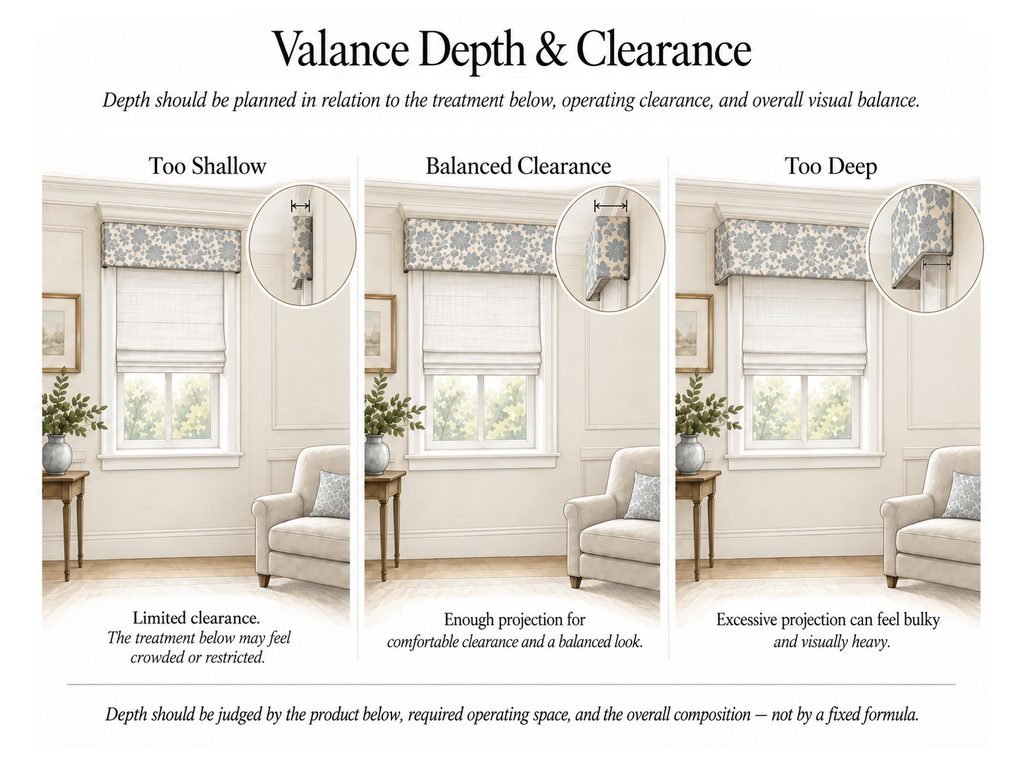
The goal is not to find one standard depth.
Instead, the depth should be planned in relation to:
- the treatment below
- the amount of hardware space required
- the operating clearance needed for a Roman shade or blind
- the thickness of the board or cornice structure
- the side returns
- the visual relationship between projection and valance height
In this sense, depth is first a functional issue and then a visual one.
4. Height, Width, and Depth Should Be Read Together
Although height, width, and depth can be discussed separately, they should always be evaluated as part of one composition.
A taller valance combined with a deep projection will create more visual mass.
A very wide cornice with very little height may feel overly horizontal.
On a smaller window, increasing height, width, and depth at the same time can easily allow the top treatment to overpower the window itself.
I find it useful to think of the three dimensions this way:
height controls visual weight
width controls framing and side coverage
depth controls clearance and physical volume
The final result depends on how these three relationships work together.
5. Proportion Depends on What Is Below
A valance rarely exists completely on its own.
It may be paired with:
- a Roman shade
- a roller shade
- a cellular shade
- a blind
- drapery
- or no secondary treatment at all
Each combination changes the way proportion should be judged.
For example, with an inside-mounted Roman shade below, the valance or cornice may need to balance framing with operating clearance.
With full-length drapery below, width, depth, and height may need to relate more closely to fullness, hardware position, and the overall layered composition.
This is one reason I prefer not to reduce valance proportion to a fixed percentage.
The treatment below can change the visual and functional relationship completely.
6. Planning Before Fabrication
Once a valance or cornice moves into fabrication, dimensional changes become more difficult and more costly.
Before fabrication begins, it is useful to confirm:
- finished height
- finished width
- projection depth
- wall and trim conditions
- mounting location
- treatment below
- required operating clearance
- side returns
- hardware position
If these conditions are not considered early, problems may appear later:
- the treatment may feel too heavy
- the width may feel too narrow
- the projection may be too deep
- the side returns may interfere with the treatment below
- the composition may feel visually unbalanced
- operating clearance may be insufficient
Proportion planning is therefore both a design decision and a structural one.
Final Thoughts
There is no single set of proportions that works for every valance or cornice.
A treatment that is shallow, tall, wide, or deep is not automatically wrong.
What matters is how those dimensions relate to:
window size + room scale + treatment below + mounting conditions + operating clearance
For me, a well-proportioned valance does not necessarily draw attention to how carefully its dimensions were calculated.
The better result is usually one in which the valance, window, wall, and treatment below feel naturally connected as one composition.
Related Articles
- Understanding Valances: Styles, Structure & Mounting
https://windowtreatmentjournal.com/understanding-valances-styles-structure-mounting/ - Board-Mounted Valances: Structure & Attachment
https://windowtreatmentjournal.com/board-mounted-valances-structure-attachment/ - Exploring Valance Styles – Visual Reference
https://windowtreatmentjournal.com/exploring-valance-styles-visual-reference/ - Cornice Shapes – Visual Reference
https://windowtreatmentjournal.com/cornice-shapes-visual-reference/ - Roman Shade Styles – Visual Reference Guide
https://windowtreatmentjournal.com/roman-shade-styles-visual-reference-guide/