
A fabric may look beautiful on its own, but that does not mean it will behave equally well in every window treatment.
Drapery and Roman shades ask different things from fabric.
Drapery depends heavily on drape, softness, fullness, and the way folds develop vertically. Roman shades, by contrast, depend more on surface stability, fold formation, bulk, and how the fabric behaves as it raises and lowers.
For that reason, I find it more useful to look at how a fabric behaves than to judge it only by its fiber name or weight.
1. Drapery and Roman Shades Ask Different Things from Fabric
For drapery, fabric generally needs to form vertical folds in a controlled and visually pleasing way.
Soft fabrics with good drape often create more fluid folds, while firmer fabrics may produce a more tailored and structured appearance.
Roman shades behave differently.
When lowered, the fabric is presented as a relatively flat surface. It needs enough stability to hold a clean face, while still being flexible enough to form orderly folds when raised.
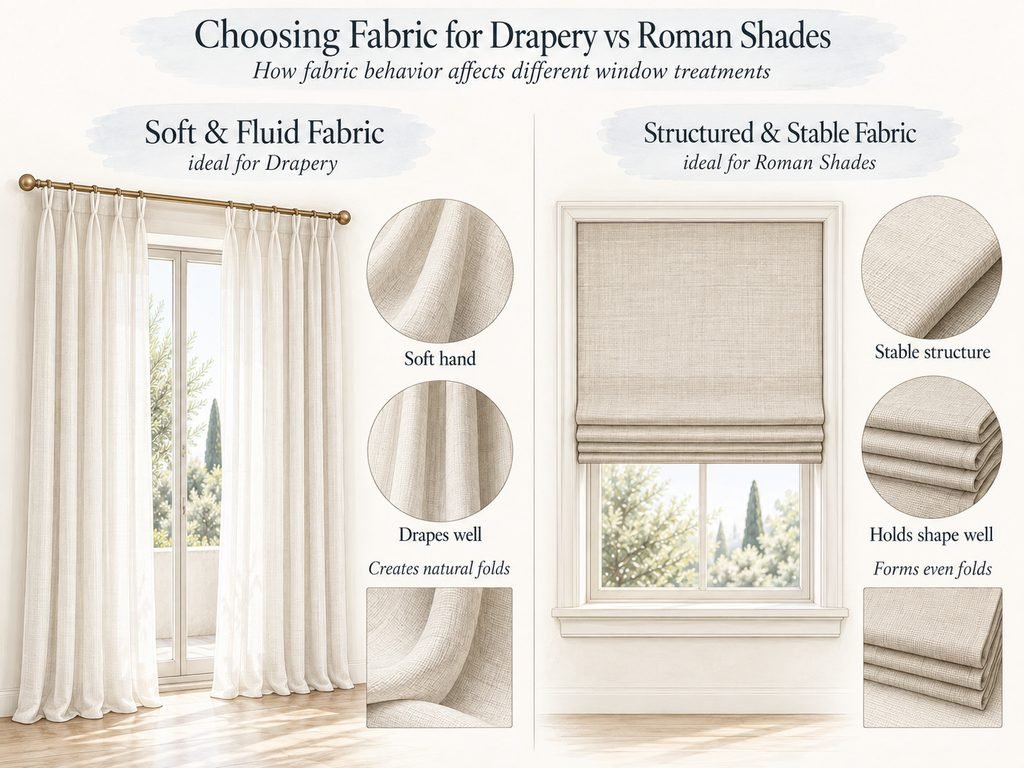
This does not mean:
- drapery must always use soft fabric
- Roman shades must always use firm fabric
A better way to think about it is that each treatment reveals different fabric characteristics.
A fabric that looks beautifully fluid as drapery may behave very differently when asked to fold repeatedly into a Roman shade.
2. Fabric Weight Matters — But Only as a Starting Point
Fabric weight certainly affects how a treatment behaves, but weight alone is not enough to determine suitability.
Sheer / Lightweight
Lightweight fabrics often create a soft, airy, and flowing appearance in drapery.
In Roman shades, they can also create a light and relaxed look, but some fabrics may need lining or additional support to achieve a more controlled result.
Medium-Weight
Medium-weight fabrics often offer a useful balance between drape and body.
In drapery, they may form folds without feeling overly heavy or overly limp.
For Roman shades, they can work well when the fabric is stable enough to hold a clean surface while remaining flexible enough to fold.
Heavier-Weight
Heavier fabrics may give drapery more substance and visual weight.
However, heavier does not automatically mean better for Roman shades.
If a fabric is too heavy, too stiff, or too bulky, the raised shade may create a thick stack, and the folds may become harder to control.
Textured / Structured Fabrics
Textured or more structured fabrics can give drapery a tailored or architectural quality.
They may also work well in Roman shades, but only if the fabric remains stable without becoming excessively stiff or bulky.
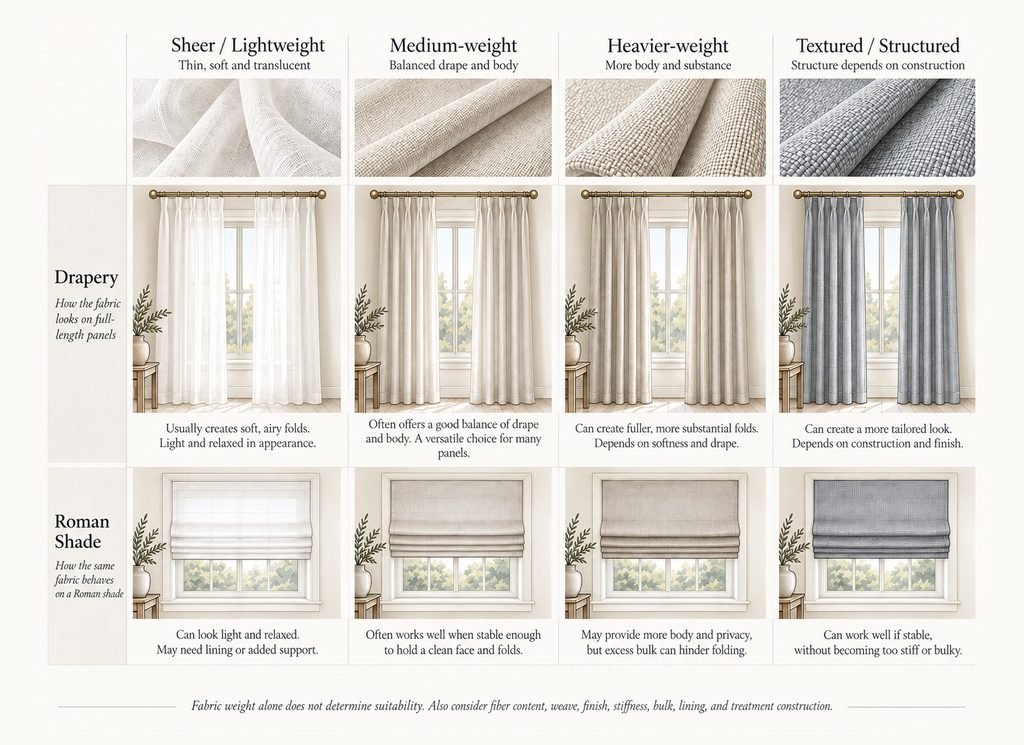
The progression from light to heavy is useful to understand, but it should always be treated as a tendency rather than a fixed rule.
3. Weight Alone Does Not Determine Suitability
Two fabrics with similar weight can behave completely differently.
Other factors often have an equal or greater influence on performance, including:
- Fiber Content
- Weave & Construction
- Finish & Treatment
- Stiffness & Hand
- Bulk & Thickness
- Lining & Interlining

These factors interact with one another, which is why fabric selection is rarely determined by a single specification.
4. Fiber Content
Fiber content can influence:
- drape
- stiffness
- wrinkle behavior
- recovery
- durability
Linen, cotton, polyester, and blended fabrics can all behave differently even when their weights are similar.
This is why I would not decide whether a fabric is suitable for drapery or a Roman shade based only on the fiber name.
What matters more is how the finished fabric actually behaves.
5. Weave & Construction
Weave and fabric construction have a direct effect on stability.
A looser weave may feel softer and more fluid, but it may also be less stable.
A tighter weave often provides more structure and dimensional control.
Plain weave, twill, jacquard, and other constructions can influence:
- surface texture
- drape
- thickness
- stability
- fold behavior
Two fabrics made from the same fiber can therefore perform very differently simply because their constructions are different.
6. Finish & Treatment
Finishing treatments are easy to overlook, but they can significantly change fabric behavior.
Pre-shrinking, coatings, wrinkle-resistant finishes, stain protection, water resistance, and other treatments may affect:
- hand
- stiffness
- drape
- recovery
- surface behavior
A fabric that feels soft in its unfinished state may become noticeably firmer after treatment.
Likewise, a performance fabric may be durable without necessarily being suitable for every drapery or Roman shade application.
“Performance” does not automatically mean “appropriate for all treatments.”
7. Stiffness & Hand
Hand is one of the most important fabric characteristics, but it can also be difficult to describe with numbers alone.
Two fabrics of similar weight may feel very different:
- one may be soft
- one may have moderate body
- one may feel quite stiff
For drapery, a softer hand often helps create more natural folds.
However, a slightly firmer fabric may be useful when a more tailored or structured appearance is desired.
Roman shades usually require a balance.
The fabric needs enough body to hold a clean face, but enough flexibility to fold properly.
If it is too soft, it may need lining or additional support.
If it is too stiff, fold formation may become less natural.
8. Bulk and Thickness
Thickness and weight are not the same thing.
Some fabrics are not especially heavy but still feel bulky because of their construction.
In drapery, this added volume may create richness and fullness.
In Roman shades, however, all of that fabric has to stack at the top when the shade is raised.
If the fabric is too bulky, the stack can become thick and visually heavy.
For Roman shades, I would therefore look not only at how much the fabric weighs, but also at how much volume it creates when folded.
9. Lining and Interlining Can Change the Fabric Completely
The face fabric is only part of the final construction.
Lining and interlining can change the finished treatment significantly.
They may affect:
- light control
- privacy
- body
- drape
- fold structure
- insulation
- overall thickness
A lightweight face fabric may become much more suitable for a Roman shade once lining is added.
Likewise, a drapery fabric with good natural drape may become fuller and more substantial when combined with interlining.
For that reason, it is often better to evaluate the face fabric and lining system together rather than as separate decisions.
10. Choosing by Behavior, Not by Label
Instead of asking:
“Can this fabric be used for a Roman shade?”
I find it more useful to ask:
- Does it stay reasonably flat when lowered?
- Does it fold naturally?
- Will the raised stack become too bulky?
- Does it create the drape I want when hung?
- Will lining change the way it behaves?
- Does the weave or finish affect stability?
- Does the finished result suit the design intent?
Suitability is rarely determined by one label.
It is usually the result of several material characteristics working together.
Final Thoughts
Drapery and Roman shades do not have one fixed list of “correct” fabrics.
Many fabrics can work across different treatment types, but they may behave very differently in each one.
Lighter, softer fabrics often create more natural drape.
More stable fabrics with some body may help a Roman shade hold a cleaner surface.
But these are tendencies, not rules.
The final decision is better made by considering:
fiber content + weave + finish + stiffness + bulk + lining + treatment construction
For me, fabric selection is less about placing a fabric into a category and more about understanding how it actually moves, hangs, folds, and recovers.
That is also why physical samples, hanging tests, and real fold tests are often more useful than specifications alone.
Related Articles
- Pattern Scale in Window Treatments
https://windowtreatmentjournal.com/pattern-scale-window-treatments/ - Pattern Repeat, Placement & Matching in Window Treatments
https://windowtreatmentjournal.com/pattern-repeat-placement-matching-window-treatments/ - Drapery Lining, Blackout & Interlining Guide
https://windowtreatmentjournal.com/drapery-lining-blackout-interlining-guide/ - Roman Shade Styles – Visual Reference Guide
https://windowtreatmentjournal.com/roman-shade-styles-visual-reference-guide/ - Drapery Design – A Visual Guide
https://windowtreatmentjournal.com/drapery-design-visual-guide/