
Planning fabric width and pleat distribution is an important part of custom pinch pleat drapery fabrication.
While the basic calculation involves coverage width, fullness, and pleat quantity, the treatment of leading edges, overlap ends, and returns can vary depending on the hardware system and workroom method.
This calculator provides a practical starting point for planning Double Pinch Pleat and Triple Pinch Pleat drapery, with adjustable settings to accommodate different fabrication approaches.
Pinch Pleat Drapery Calculator
Advanced settings & definitions
A hardware- and workroom-dependent planning tool. In this version, the opening-end flat is allocated from the panel’s calculated face width for this calculation. Select the other option if your shop adds that flat beyond the coverage.
Results (per panel unless noted)
Nominal spacing is a reference-point estimate, not the measured visible flat gap. Cutting width excludes pattern matching and seam allowances. Confirm the mark-out on a sample.
Calculation breakdown
Enter the coverage width, number of panels, pleat style, fullness ratio, and pleat quantity. Additional edge settings can be adjusted according to the selected hardware and fabrication method.
The calculator provides estimates for finished width, flat fabric width, pleat take-up, and nominal pleat spacing.
The results are intended for planning and should be reviewed before final cutting.
Understanding the Input Dimensions
Coverage Width
Coverage Width refers to the face width of the rod or track that the drapery is intended to cover.
For a pair of panels, the calculator divides the total coverage equally between the two panels.
Depending on the hardware system and workroom method, flat edge sections may be included in or added beyond the stated coverage width.
Pleat Style and Fullness
Double Pinch Pleat and Triple Pinch Pleat use similar width-planning principles, although their finished pleat construction differs.
As general planning references:
- Double Pinch Pleat: approximately 2.0× fullness
- Triple Pinch Pleat: approximately 2.5× fullness
These are adjustable reference values rather than fixed fabrication standards.
The calculator estimates overall pleat take-up but does not determine the individual folds within each finished pinch pleat.
Leading Edge and Overlap End
The leading edge is the operating edge of a drapery panel.
When the hardware requires center overlap, this edge may be constructed as an overlap end.
The flat section at the opening edge is included only once in the fabric calculation, whether it is configured as a standard leading edge or an overlap end.
Side Edge and Return
The outer edge of a panel may be finished as a flat side edge or configured with a return toward the wall.
Returns are commonly measured separately from the rod or track face width. Their dimensions depend on the hardware projection and installation method.
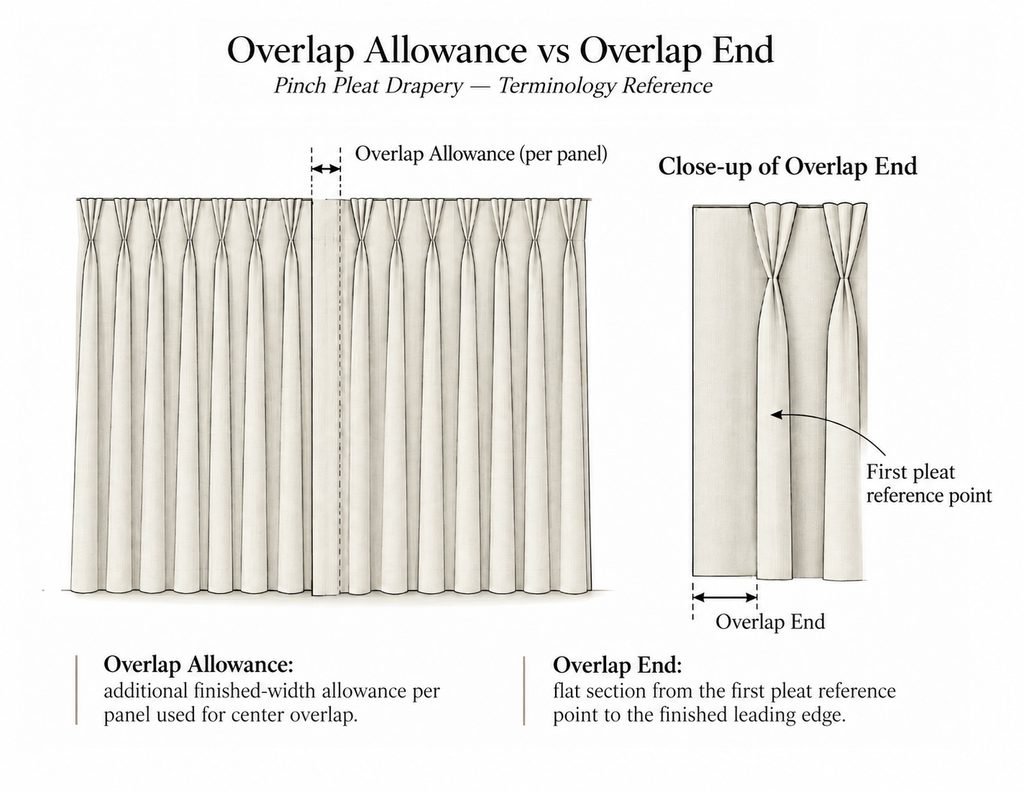
Understanding Overlap End and Overlap Allowance
The terms Overlap End and Overlap Allowance are not used consistently across all workrooms and hardware manufacturers. For clarity, this calculator uses the following definitions.
Overlap End refers to the flat section from the first pleat reference point to the finished leading edge of a panel designed for center overlap.
Overlap Allowance refers to the additional finished-width allowance allocated to each panel for the center-overlap arrangement.
These are different dimensions and should not automatically be added together as separate flat fabric sections.
For example, a panel may have a 3½″ overlap end and a 2½″ overlap allowance. The first describes the edge construction; the second describes an additional width allocation required by the selected hardware arrangement.
The overlap allowance is not necessarily equal to the visible overlap after installation.
Understanding the Calculation Results
The calculator provides several planning values:
Finished Width
The estimated width of the finished drapery panel, including applicable edge extensions and overlap allowances.
Flat Fabric Width
The estimated flat fabric width required before pleating, based on the selected fullness and edge allowances.
Pleat Take-up
The calculated amount of fabric allocated to each pleat.
Pleat Spacing
The nominal distance between pleat reference points based on the selected pleat count.
This reference spacing should not be confused with the visible flat space between finished pleats. Actual results depend on the pleat construction and fabric characteristics.
Practical Workroom Considerations
The calculator is intended for preliminary design and workroom planning rather than final production specifications.
Before cutting, consider fabric width, seam placement, pattern repeat, side hems, fabric thickness, and the requirements of the selected hardware system.
A sample pleat can help confirm the actual pleat take-up, spacing, and finished appearance, particularly when working with unfamiliar fabrics.