
When selecting fabrics for drapery, Roman shades, and other window treatments, designers often begin with familiar characteristics such as fiber content, fabric width, weight, texture, color, and drape.
Occasionally, a fabric supplier may also provide a test report containing information about colorfastness, dimensional stability, flammability, or other performance characteristics.
But what do these tests actually measure? How can the results help us understand a fabric? And does having more test reports necessarily mean better quality?
The answers depend on the fabric, its intended application, and the requirements of a particular project.
Not every decorative fabric comes with a full set of test reports, and the absence of testing documentation does not automatically indicate poor quality.
This guide introduces common fabric tests and standards encountered in U.S. and European textile documentation, with a particular focus on how designers can understand and use this information when reviewing fabrics for window treatments.
1. What Is a Fabric Test Report?
A fabric test report documents how a particular fabric sample performs under specified laboratory conditions.
Depending on the test, it may provide information about:
- Colorfastness to Light: How a fabric’s color responds to controlled light exposure.
- Dimensional Stability: How the fabric’s dimensions change after a specified treatment.
- Seam Slippage: How readily yarns move apart at a seam under applied force.
- Flammability: How the material behaves under a specified flame or fire-propagation test.
These results provide information about individual properties rather than a complete assessment of fabric quality or real-world performance.
Several terms are useful when reading a report:
| Term | Meaning |
|---|---|
| Test Item | The property being evaluated |
| Test Method | The procedure used to measure that property |
| Test Standard | A published standard that may specify methods, classifications, or requirements |
| Test Result | The measured value, rating, or recorded outcome |
| Pass / Fail | A determination based on specified acceptance criteria |
| Certification | Recognition or verification under a defined certification scheme |
A test method does not necessarily establish a passing requirement, and a numerical result does not automatically indicate compliance.
Understanding this distinction is an important first step in interpreting textile testing information.
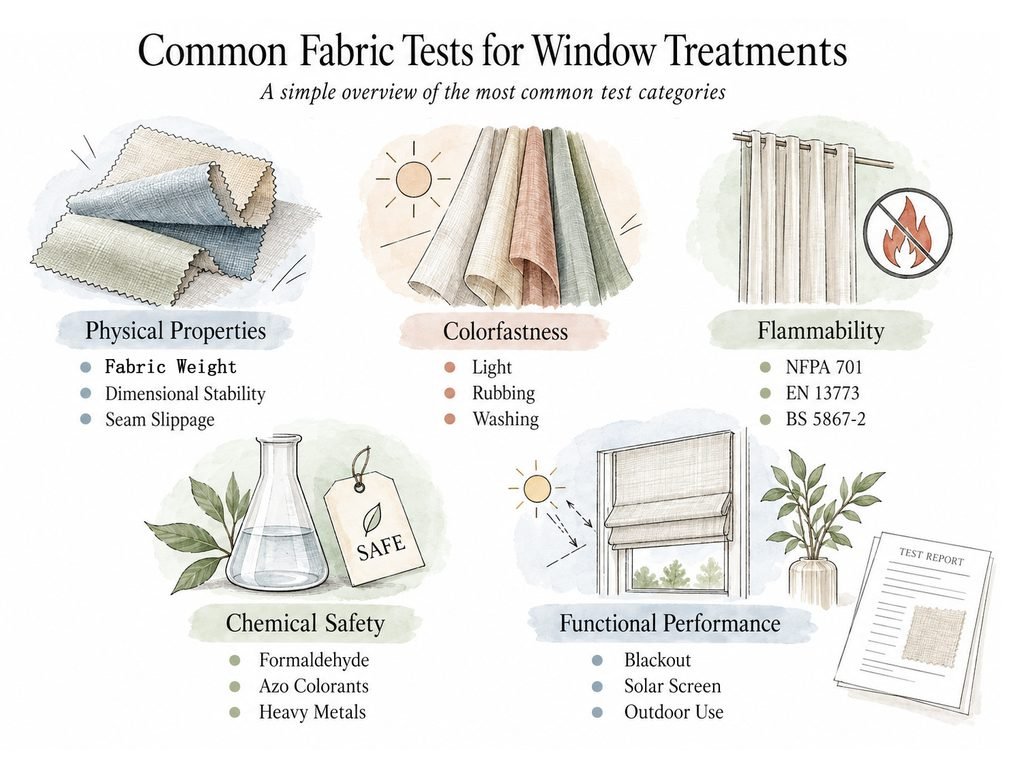
2. Common Fabric Tests
Fabric tests cover a wide range of properties. The following categories provide a useful overview of the information designers may encounter.
They are not intended as a universal testing checklist for every window treatment fabric.
2.1 Physical Properties
Physical testing examines aspects of fabric construction, strength, and dimensional behavior.
| Test Item | What It Evaluates |
|---|---|
| Fabric Weight | Mass per unit area |
| Dimensional Stability | Dimensional changes after specified treatment |
| Tensile / Breaking Strength | Resistance to breaking under tension |
| Tear Strength | Resistance to tearing |
| Seam Slippage | Movement of yarns at a seam under stress |
| Pilling Resistance | Tendency to develop surface pills |
| Abrasion Resistance | Resistance to wear caused by rubbing |
For window treatments, dimensional stability and seam slippage can be particularly useful to understand.
For example, dimensional changes after laundering may affect the finished length of washable drapery. Seam slippage may influence the appearance and stability of seams in certain woven fabrics.
However, these results must be interpreted in relation to the test conditions.
A laundering shrinkage test, for example, does not directly predict every type of dimensional change that might occur while curtains are hanging.
2.2 Colorfastness
Colorfastness describes a textile’s ability to resist color change or color transfer under specified conditions.
Common tests include:
| Test Item | What It Evaluates |
|---|---|
| Colorfastness to Light | Color change caused by controlled light exposure |
| Colorfastness to Rubbing / Crocking | Color transfer during dry or wet rubbing |
| Colorfastness to Washing | Color change and staining after washing |
| Colorfastness to Water | Color change and staining after water exposure |
For fabrics installed near windows, colorfastness to light is often particularly relevant.
A fabric used in a room with strong sunlight may face different exposure conditions from one installed in a relatively shaded space.
Test methods and rating systems vary. For example, ISO 105-B02 evaluates colorfastness to artificial light, while other methods may use different exposure conditions or assessment procedures.
A rating should therefore be interpreted together with its test method.
Laboratory exposure hours should not be interpreted as a direct prediction of how many months or years a fabric will resist fading in an actual room.
2.3 Flammability
Flammability testing evaluates how a material behaves under defined ignition or flame-exposure conditions.
Several standards may appear in U.S., European, and UK window treatment specifications.
| Standard | General Purpose |
|---|---|
| NFPA 701 | Test methods for flame propagation of textiles and films |
| EN 13773 | Classification of burning behavior for curtains and drapes |
| BS 5867-2 | Flammability requirements for fabrics used in curtains, drapes, and window blinds |
These standards differ in their test procedures, classifications, and intended applications. Results obtained under one standard should not automatically be treated as equivalent to results under another.
Whether particular documentation is required depends on the product, installation location, applicable regulations, and project specifications.
Requirements for commercial and public spaces may differ from those for ordinary residential applications.
2.4 Chemical Safety
Chemical testing may evaluate the presence or concentration of certain restricted substances in textile materials.
Examples include:
- Formaldehyde
- Restricted Azo Colorants
- Certain Heavy Metals
- Certain Phthalates
Two names commonly encountered in textile documentation are REACH and OEKO-TEX STANDARD 100.
REACH is a European Union regulatory framework addressing the registration, evaluation, authorisation, and restriction of chemicals.
OEKO-TEX STANDARD 100 is a textile testing and certification system focused on harmful substances.
These serve different purposes. Neither should be interpreted as a complete evaluation of all fabric performance characteristics.
2.5 Functional Performance
Specialized window treatment fabrics may be evaluated for properties related to their intended functions.
| Fabric Type | Possible Performance Information |
|---|---|
| Blackout Fabric | Light transmission and light-blocking performance |
| Solar Screen Fabric | Openness factor, visible light, and solar properties |
| Thermal Fabric | Relevant thermal and solar characteristics |
| Acoustic Fabric | Acoustic performance under specified conditions |
| Outdoor Fabric | Weathering, light resistance, and water-related performance |
The relevance of these tests depends on the particular fabric and its intended application.
For example, the light-blocking performance of a blackout fabric is not necessarily identical to the light control achieved by a fully installed window treatment.
Mounting conditions, side gaps, and construction details can also affect the finished result.
3. Understanding Common Standards and Organizations
Fabric reports and technical sheets often contain abbreviations such as ASTM, AATCC, ISO, or NFPA.
These names do not all represent the same type of organization or requirement.
Some identify standards organizations, others refer to standards, industry guidelines, regulations, or certification systems.
| Abbreviation / Name | Full Name | Main Role |
|---|---|---|
| ACT | Association for Contract Textiles | Industry association providing voluntary performance guidelines for contract textiles |
| ASTM | ASTM International (formerly American Society for Testing and Materials) | Standards organization publishing test methods and product performance specifications |
| AATCC | American Association of Textile Chemists and Colorists | Professional association developing textile test methods |
| ISO | International Organization for Standardization | Organization developing international standards |
| EN | European Standard | Designation for European standards |
| BS | British Standard | Designation for British standards |
| NFPA | National Fire Protection Association | Organization publishing fire safety codes, standards, and related guidance |
| REACH | Registration, Evaluation, Authorisation and Restriction of Chemicals | European Union chemicals regulatory framework |
| OEKO-TEX | A textile testing and certification brand and system, not an English acronym | Includes certification schemes such as OEKO-TEX STANDARD 100 |
For example, ASTM publishes both test methods and performance specifications, including ASTM D3691/D3691M for household curtain and drapery fabrics.
ACT provides voluntary performance guidelines for certain contract textile applications, including drapery. These guidelines refer to established textile testing methods.
AATCC and ISO are also common sources of testing methods used in textile reports.
Recognizing these names helps us understand where technical information originates.
However, the presence of a recognized standard number does not, by itself, establish that a fabric meets every requirement of a particular project.
4. How to Read a Fabric Test Report
Designers do not necessarily need detailed laboratory knowledge to begin understanding a fabric test report.
A practical approach is to review five basic questions.
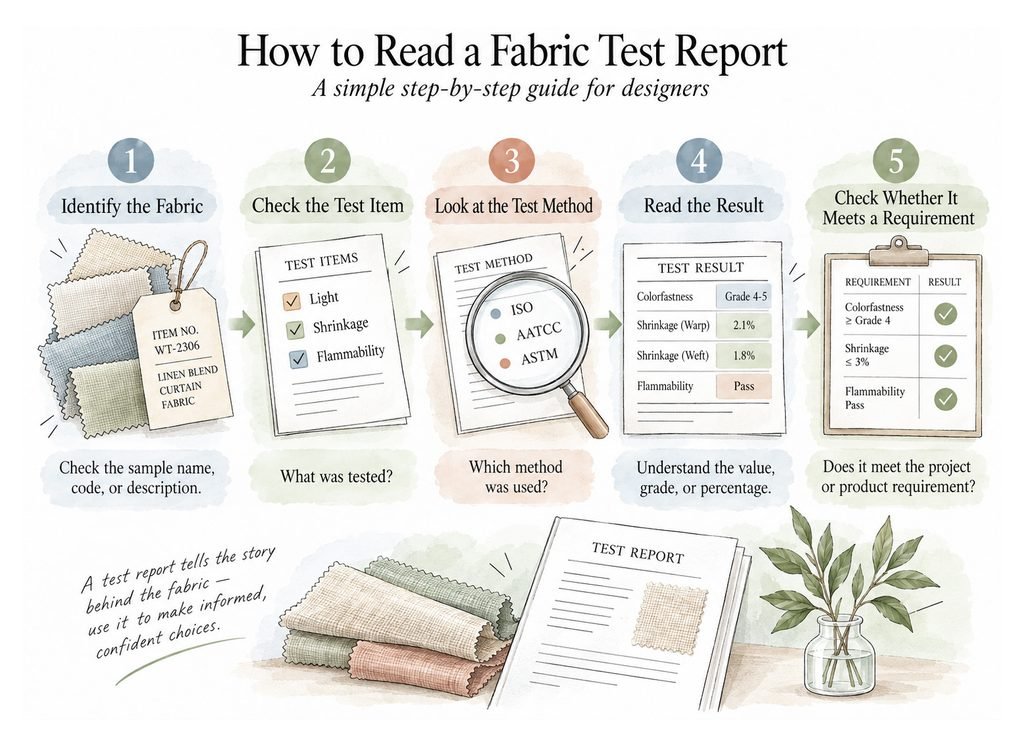
Illustrative example only. Test values and acceptance criteria are provided for demonstration and do not represent actual laboratory results.
1. What Fabric Was Tested?
Begin with the sample identification.
Look for the fabric name, item number, description, and any other details that identify the tested material.
The goal is to determine whether the report corresponds to the fabric being considered.
2. What Was Tested?
Identify the property being evaluated.
Is the report concerned with colorfastness, dimensional stability, seam slippage, flammability, or another characteristic?
Understanding the test item gives the result its basic meaning.
3. Which Test Method Was Used?
Look for the test method and its reference number.
Different methods may involve different conditions, procedures, and rating systems.
Results obtained using different methods are not necessarily directly comparable.
4. What Was the Result?
The report may present results as numerical values, percentages, grades, classifications, or descriptive outcomes.
For example, a dimensional change result may be expressed as a percentage, while certain colorfastness tests use grading scales.
The number alone is rarely enough. Its meaning depends on the test method and evaluation system.
5. Does the Result Meet a Requirement?
Some reports include a Pass or Fail determination. Others provide results without stating whether they meet a particular acceptance criterion.
A test result and a compliance determination are not necessarily the same thing.
If a project requires a specific performance level, the reported result must be evaluated against the applicable requirement.
The report date, sample condition, testing scope, and any limitations should also be considered.
5. Does More Testing Mean Better Fabric?
Not necessarily.
The number of tests performed on a fabric does not provide a direct measure of its overall quality.
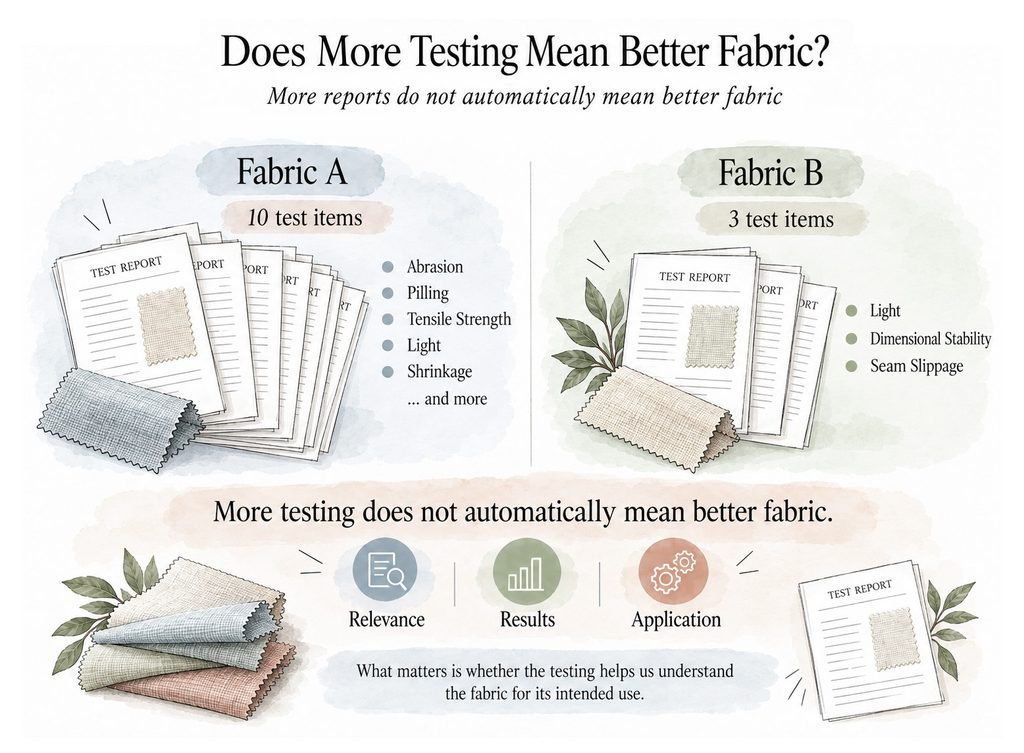
Consider two hypothetical decorative fabrics.
Fabric A has results for ten test items, including abrasion resistance, pilling, tensile strength, and several other properties.
Fabric B has results for only three items: colorfastness to light, dimensional stability, and seam slippage.
If a designer is selecting fabric for residential drapery, the information available for Fabric B may be more directly relevant to certain aspects of the project.
That does not mean Fabric B is necessarily better than Fabric A.
The actual test results, fabric construction, intended application, and other design considerations still matter.
A test report may also document a result that does not meet a specified requirement.
More testing does not automatically mean better fabric. The relevance of the tests, their results, and the intended application are more meaningful than the number of reports alone.
What If No Test Report Is Available?
Many decorative fabrics are selected without a complete set of laboratory test reports.
The absence of testing documentation does not automatically indicate poor fabric quality or make a material unsuitable for every application.
Designers may still evaluate fabrics through samples, supplier information, previous experience, and observations of texture, hand, drape, and construction.
However, these methods cannot replace testing or documentation when specific performance or regulatory requirements must be demonstrated.
When a project requires verified performance, the appropriate evidence should be obtained and reviewed.
6. Helpful Test Information for Drapery and Roman Shade Fabrics
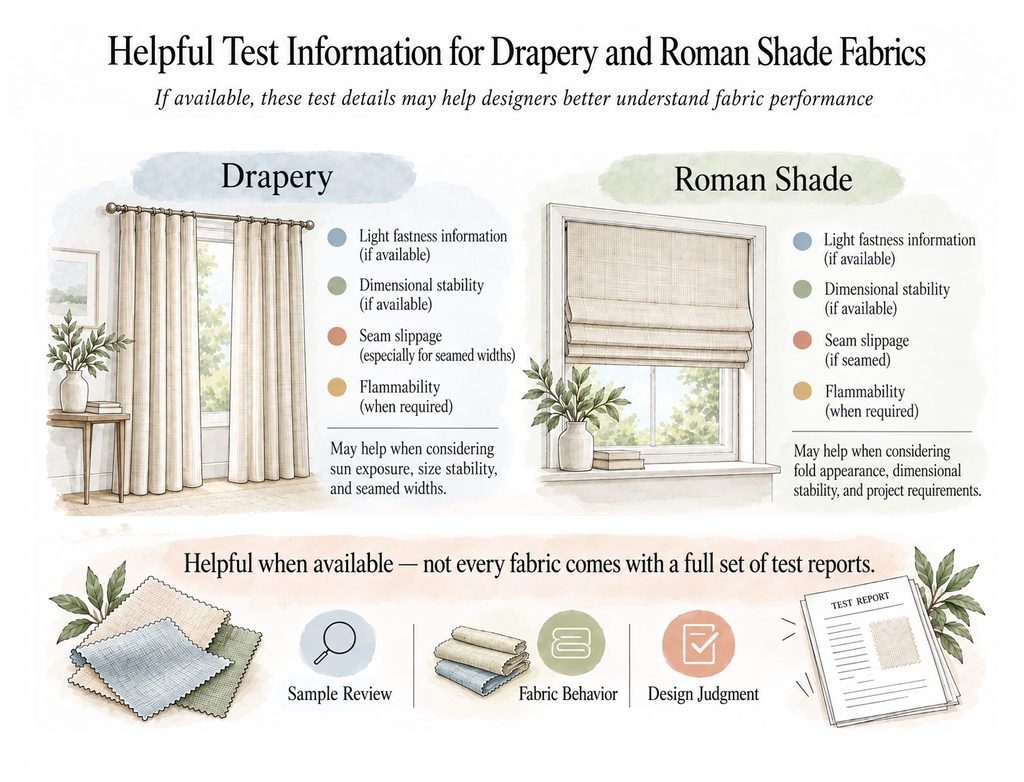
Drapery and Roman shades share many fabric performance considerations. When available, information about colorfastness to light, dimensional stability, and seam slippage may help designers better understand certain material characteristics.
However, the way these properties relate to the finished product can differ.
Drapery
For drapery, seam slippage information may be particularly useful when working with woven fabrics that require joined widths.
Dimensional stability and lightfastness information can also provide useful references, depending on the fabric and its intended use.
Beyond testing, designers still need to consider fabric drape, fullness, lining, and the overall appearance of the finished panels.
Roman Shades
For Roman shades, dimensional stability and lightfastness information may also be useful.
However, fabric stiffness, thickness, folding behavior, and the interaction between the face fabric and lining can have a significant influence on the finished shade.
These characteristics are often better understood through physical samples and fabrication trials than through standard test reports alone.
Additional Project Requirements
For certain commercial or specialized installations, additional documentation, including flammability test results, may be required.
Such requirements depend on the project and applicable regulations rather than being universal requirements for all decorative fabrics.
Test information can support fabric selection when available, but it does not replace sample evaluation and professional design judgment.
7. Final Thoughts
Fabric test reports offer another way to understand specific material properties, but they do not provide a complete definition of fabric quality.
For window treatment designers, learning to read these reports is not about requiring every fabric to have as many test certificates as possible.
It is about recognizing what different tests measure, understanding the information they provide, and considering when that information may be relevant to a particular application.
Visual character, texture, hand, drape, fabrication behavior, and practical project requirements remain essential parts of fabric selection.
Understanding test reports helps us make more informed material decisions without allowing testing data to replace design judgment.
Related Articles
- Basic Fabric Information Form for Window Treatments — A practical form for recording basic fabric specifications and supplier information.
- Pattern Scale in Window Treatments — Exploring how pattern scale influences drapery, Roman shades, and other window treatments.
- Understanding Drapery Lining, Blackout & Interlining — A visual guide to lining options and their roles in drapery construction.