
When selecting fabric for window treatments, color, pattern, texture, and hand often receive the most attention. Yet a fabric’s suitability for a particular application depends on much more than its appearance.
Fiber composition, width, weight, pattern repeat, cleaning requirements, dimensional stability, and performance characteristics can all influence how a fabric is selected, fabricated, and used.
Much of this information can be found in a fabric specification sheet or the technical product information provided by the manufacturer.
Although brands organize their specifications differently, most fabric information addresses several essential questions: What is the fabric made of? What are its dimensions and pattern characteristics? How should it be cleaned? What performance information is available? And what applications is it intended for?
Drawing on product information from decorative fabric brands such as Fabricut, Kravet, Dedar, and Sanderson, this guide explores common specification terms and their relevance to custom window treatments.
1. Understanding a Fabric Specification Sheet
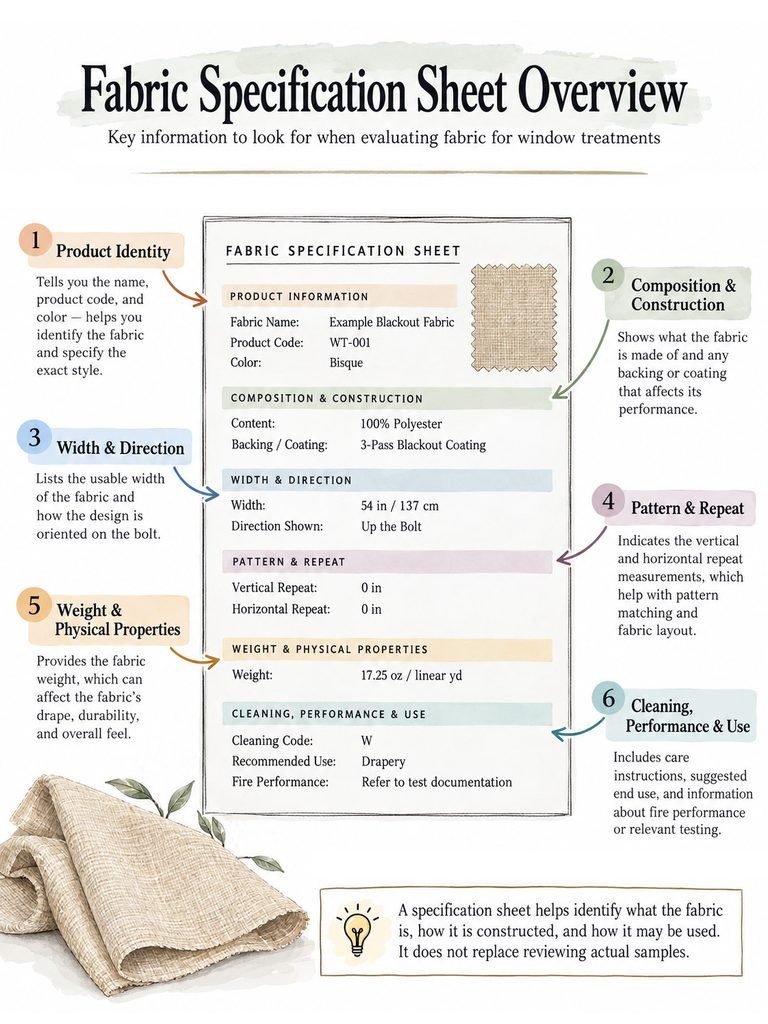
A typical decorative fabric specification sheet may include information such as:
| Specification | Example |
|---|---|
| Fabric Name | Example Blackout Fabric |
| Product Code | WT-001 |
| Color | Bisque |
| Width | 54 in / 137 cm |
| Content | 100% Polyester |
| Weight | 17.25 oz / linear yd |
| Vertical Repeat | 0 in |
| Horizontal Repeat | 0 in |
| Direction Shown | Up the Bolt |
| Backing / Coating | 3-Pass Blackout Coating |
| Cleaning Code | W |
| Recommended Use | Drapery |
| Fire Performance | Refer to test documentation |
This is an illustrative specification assembled for educational purposes, not an official manufacturer’s product sheet. Actual specifications, care requirements, and performance claims should always be verified for the selected fabric.
These details provide a useful starting point, but specifications alone cannot fully describe how a fabric feels, drapes, behaves during fabrication, or performs in a finished treatment.
Reading a specification sheet therefore involves understanding both what the information tells us and what may still need to be confirmed.
2. Fabric Content & Construction
Fiber Content / Composition
Content or Composition identifies the fibers used in a fabric, usually expressed as percentages.
Examples include:
- 100% Polyester
- 55% Linen / 45% Cotton
- 50% Cotton / 35% Viscose / 15% Linen
Fiber content provides an important starting point for understanding a material, but it does not determine every aspect of its performance.
Two fabrics labeled 100% Polyester, for example, may have very different textures, weights, and draping characteristics because of differences in yarn construction, weave, and finishing.
The same applies to blended fabrics. Fiber percentages alone cannot reliably predict softness, shrinkage, or dimensional stability.
Base Fabric & Embroidery Content
For embroidered fabrics and certain layered constructions, manufacturers may list the composition of the base fabric separately from that of the embroidery.
This distinction matters because the embroidery yarns and ground fabric may respond differently to cleaning, moisture, heat, and handling.
Differences between the materials may also influence cutting, seam construction, and dimensional behavior.
Backing, Coating & Finish
These terms often appear in decorative fabric specifications, but they describe different aspects of construction.
Backing refers to an additional material layer or treatment applied to the back of a fabric.
Coating refers to a material applied to a fabric surface to provide characteristics such as light blocking or other functional properties.
Finish refers to processes used to modify the fabric’s appearance, hand, or performance.
For example, the term 3-Pass Blackout generally describes a blackout fabric made using multiple coating applications.
However, a fabric’s listed fiber composition does not necessarily identify the chemical composition of its coating or backing.
When fabrication involves heat, special cleaning requirements, or other processing conditions, the complete material construction may need further review.
3. Fabric Width & Direction
Fabric Width
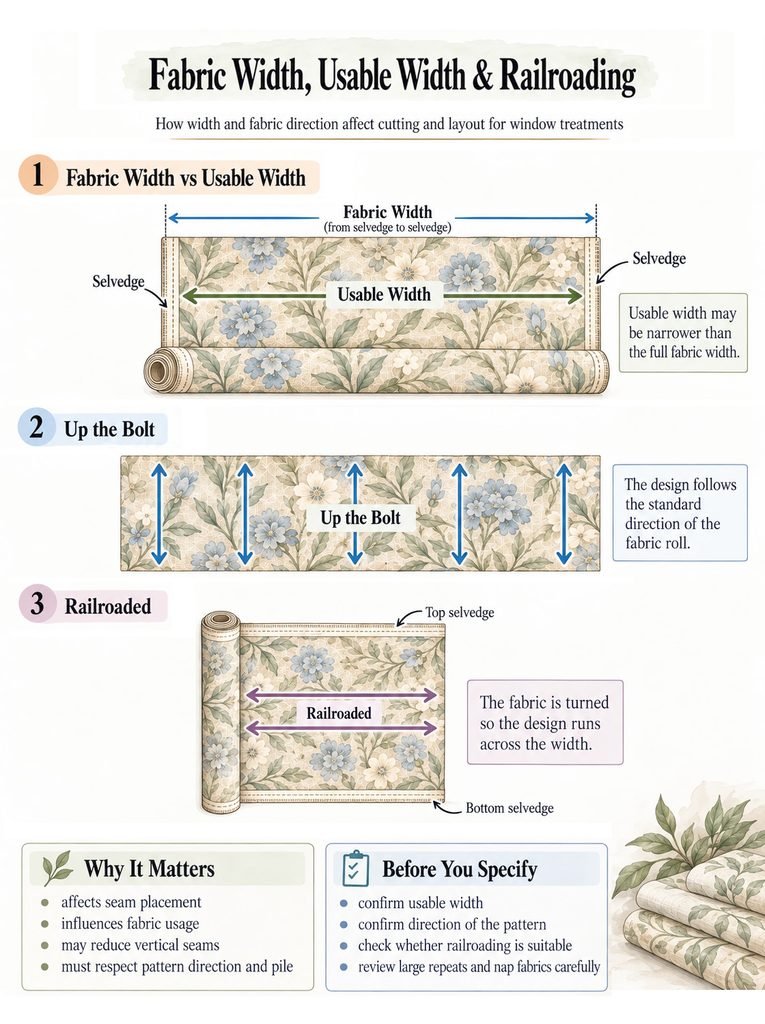
Fabric Width refers to the width of the material measured from one selvage to the other.
Many decorative fabrics are approximately 54 inches (137 cm) wide, although other widths and extra-wide drapery fabrics are also available.
Width affects fabric layout, seam placement, and material requirements.
Usable Width
The nominal fabric width is not always the same as the width available for cutting.
Selvages, unusable edge areas, and other material or fabrication limitations may reduce the actual usable width.
For this reason, Usable Width should be confirmed whenever possible before calculating yardage or planning seams.
Direction Shown / Up the Bolt
Fabric has two principal directions: across its width and along the length of the roll.
When a specification indicates Up the Bolt, it generally describes how the pattern is presented in relation to the fabric roll.
This information helps identify pattern orientation, but it does not by itself establish whether the fabric is suitable for railroading.
Railroaded
Railroading refers to turning the fabric’s orientation 90 degrees relative to its conventional use.
For certain extra-wide fabrics, railroading allows the fabric width to be used as the vertical dimension of a window treatment, potentially reducing vertical seams.
However, not every fabric can be railroaded successfully.
Directional patterns, pile fabrics, directional sheen, and particular construction characteristics may limit whether the fabric can be used in this orientation.
When reviewing specifications, it is important to distinguish between:
- Fabric Width: the nominal width of the material
- Usable Width: the width available for cutting
- Direction Shown: how the pattern is displayed
- Railroaded: whether the fabric is intended or suitable for use in a rotated orientation
These terms are related, but they are not interchangeable.
4. Pattern Repeat & Matching
For patterned fabrics, repeat dimensions and matching requirements are essential considerations in fabric selection and cutting.
Although closely related, Pattern Repeat and Pattern Match describe different aspects of the design.
Pattern Repeat
Pattern Repeat refers to the dimensions over which a pattern repeats according to its established arrangement.
Vertical Repeat is the distance over which the design repeats along the fabric length.
Horizontal Repeat is the distance over which the design repeats across the fabric width.
For example:
- Vertical Repeat: 24 in
- Horizontal Repeat: 18 in
These measurements indicate that the pattern repeats at different intervals in the two directions.
Large repeats can increase the fabric allowance required for pattern matching, although actual yardage depends on panel dimensions, the number of widths, and the matching arrangement.

Pattern Match
Pattern Match describes how a design aligns between adjacent fabric widths according to its original repeat arrangement.
Straight Match
The pattern aligns at the same height across adjacent widths, creating a continuous design.
Offset Match
The pattern requires adjacent widths to be vertically offset according to the original repeat arrangement.
A Half-Drop Match is one common form of offset matching, in which the offset equals half of the vertical repeat.
Importantly, an offset match does not mean that finished drapery panels must hang at different heights.
During cutting and pattern planning, fabric widths may need to be shifted vertically to achieve the correct design alignment. Once cut and fabricated, the finished panels can still have consistent top and bottom levels.
The matching arrangement is generally determined by the fabric’s original pattern construction. It is not simply a choice between straight and offset matching made to reduce fabric consumption.
When available, the manufacturer’s stated pattern-match information should be followed. If it is not provided, the full pattern repeat or an appropriate fabric sample should be reviewed.

5. Fabric Weight & Physical Properties
Fabric Weight
Decorative fabric brands may use different units to describe fabric weight.
| Unit | Meaning |
|---|---|
| GSM / g/m² | Grams per square meter |
| oz/sq yd | Ounces per square yard |
| oz/linear yd | Ounces per linear yard of full-width fabric |
| g/linear m | Grams per linear meter of full-width fabric |
These figures should not be compared directly without considering their units.
Linear weight, in particular, must be considered together with fabric width before it can be converted into weight per unit area.
For window treatments, fabric weight may influence hardware loads and certain fabrication decisions, but weight alone does not determine how a fabric drapes.
Drape, Body & Hand
These terms are frequently used to describe fabric behavior, but they are not interchangeable.
Drape / Drapability
Describes how a fabric hangs, bends, and forms folds under gravity.
Body
A practical term describing a fabric’s sense of fullness, substance, and structural support. It is not a single standardized test measurement.
Hand / Handle
Describes the overall tactile qualities of a fabric, including softness, smoothness, roughness, flexibility, or stiffness.
Two fabrics with similar weights may form very different folds because of differences in their fibers, construction, and finishing.
While technical specifications provide useful information, physical samples remain valuable when evaluating fabric hand and draping characteristics.
Shrinkage & Dimensional Stability
Shrinkage describes the percentage reduction in fabric dimensions under specified conditions.
Dimensional Stability is a broader term describing a fabric’s ability to maintain its dimensions when exposed to conditions such as cleaning, moisture, or other specified treatments.
Fabrics may shrink, stretch, or experience other dimensional changes. Shrinkage and dimensional stability are therefore related concepts, but they do not mean exactly the same thing.
Dimensional changes can be particularly noticeable in custom window treatments.
For example, if a drapery panel measuring 100 inches in finished length experiences 2% lengthwise shrinkage under a particular treatment, its length could decrease by approximately 2 inches.
Such changes may affect the relationship between the drapery and the floor, the folding behavior of Roman shades, seam alignment, or compatibility with lining and interlining materials.
When reviewing specifications, it is useful to distinguish between:
- Warp / Lengthwise Shrinkage: dimensional reduction along the warp or fabric length
- Weft / Widthwise Shrinkage: dimensional reduction across the fabric width
- Dimensional Change: a change in dimensions that may involve shrinkage or extension
- Test Conditions: the cleaning, washing, or other procedures under which dimensional changes were evaluated
Lengthwise and widthwise shrinkage may differ, so a single percentage should not automatically be applied in every direction.
Likewise, fiber content alone cannot establish that a fabric is shrink-proof, even when the material is polyester or has undergone preshrinking treatments.
For custom treatments requiring precise dimensions, relevant dimensional-stability information should be confirmed under conditions appropriate to the intended fabrication, care, and use. Sample testing may also be necessary.
6. Cleaning & Care
Fabric specifications may present care information in different ways.
Two commonly encountered systems are:
- Cleaning Codes: letter-based cleaning instructions
- Care Symbols: graphic textile care symbols
They are not the same labeling system.
Cleaning Codes
American decorative fabric specifications commonly use codes such as:
| Code | General Meaning |
|---|---|
| W | Use specified water-based cleaning methods |
| S | Use specified solvent-based cleaning methods |
| WS / SW | Use approved water-based or solvent-based methods |
| X | Typically vacuum or lightly brush only; do not use water- or solvent-based cleaners |
These codes provide general guidance. The manufacturer’s complete cleaning instructions should always be reviewed.
In particular, W does not mean a fabric can be machine-washed or soaked, and S does not mean that every dry-cleaning process is suitable.
Care Symbols
Some manufacturers use standardized textile care symbols covering:
- Washing
- Bleaching
- Drying
- Ironing
- Professional Textile Care
These symbols may communicate temperature limits, cleaning procedures, and prohibited treatments.
For custom window treatments, it is also important to distinguish between the care requirements of the original fabric and those of the finished product.
For example, a fabric may permit a particular cleaning method, but the addition of blackout lining, interlining, decorative trims, or other construction components may change the care requirements of the finished treatment.
A fabric’s cleaning code should therefore not be interpreted as a guarantee that the completed window treatment can be cleaned in the same way.

7. Performance & Certification
Some fabric specifications also include performance data and certification information.
The relevance of these details may vary between residential, commercial, and hospitality applications.
Lightfastness
Lightfastness describes a material’s resistance to color change under specified light-exposure test conditions.
Because window treatments are frequently exposed to daylight, lightfastness can be an important consideration.
However, laboratory results cannot precisely predict fading under every installation or environmental condition.
Abrasion Resistance
Decorative fabrics may be evaluated using abrasion tests such as Martindale or Wyzenbeek.
Because these methods use different procedures, their numerical results should not be treated as directly equivalent.
Abrasion resistance is particularly relevant to upholstery and other frequently contacted surfaces. For hanging drapery, its importance depends on the intended application.
Flammability
Different countries, markets, and projects may require different textile flammability tests.
For example, NFPA 701 addresses flame-propagation testing for certain textiles and films, including materials used in curtains and draperies.
When reviewing flammability information, it is important to distinguish between:
- A fabric that has passed a specified test
- A fabric that may be treated to meet a particular requirement
- General performance statements provided by the supplier
Passing one test does not automatically establish compliance with every applicable project requirement.
Certifications
Some manufacturers provide certifications related to harmful substances, chemical emissions, or other environmental and performance considerations.
These certifications have different scopes and should not be treated as interchangeable.
Where specific performance requirements apply, the relevant standards and supporting documentation should be reviewed.
8. Recommended Uses & Application Suitability
Fabric specification sheets often include End Uses or Recommended Uses, such as:
- Drapery
- Roman Shades
- Upholstery
- Cushions
- Decorative Applications
These recommendations provide a useful starting point, but they do not mean that every fabric is appropriate for every style or construction within a product category.
A fabric listed for drapery, for example, may still need to be evaluated in relation to heading style, fullness, lining, weight, and drape.
For Roman shades, folding behavior, thickness, dimensional stability, and construction requirements may also influence fabric selection.
Recommended use is a reference for material selection, not a final design decision.
9. From Specifications to Fabric Verification
Once the specifications are understood, certain details may still need to be confirmed before a fabric is selected for a project.
| Item | Purpose |
|---|---|
| Fabric Sample | Review actual color, texture, hand, and drape |
| Usable Width | Confirm the available cutting width |
| Pattern Direction & Match | Verify pattern orientation, seam planning, and matching |
| Care Instructions | Confirm fabric and finished-treatment care requirements |
| Dimensional Stability | Understand dimensional changes under relevant conditions |
| Performance Documentation | Verify applicable test results and certifications |
| Availability & Dye Lot | Confirm supply, production lot, and color consistency |
Not every fabric or project requires the same level of testing or documentation.
The information that needs to be verified depends on the material, construction, and intended application.
If a specification does not provide certain details, they can be recorded as Not Provided or To Be Confirmed rather than assumed from the fabric’s fiber content or product name.
Conclusion
A fabric specification sheet may appear to be a collection of names, numbers, and technical terms, but the information connects material characteristics with design, fabrication, and practical use.
Understanding these specifications provides a more informed basis for comparing fabrics. It also helps distinguish between what technical data can tell us and what still requires physical samples, supporting documentation, or further verification.