
Café curtains are short curtains that cover only part of a window.
Unlike traditional curtains that extend from the top of the window downward, café curtains leave the upper portion open. This allows natural light and part of the outside view to remain visible, while the lower section of the window provides privacy where it is most needed.
They are commonly used in kitchens, breakfast areas, bathrooms, dining spaces, and other rooms where full window coverage may feel unnecessary or too heavy.
Although café curtains are simple in construction, their final look can change considerably depending on the mounting height, heading style, hardware, fabric, and the way they relate to the window itself.
1. What Is a Café Curtain?
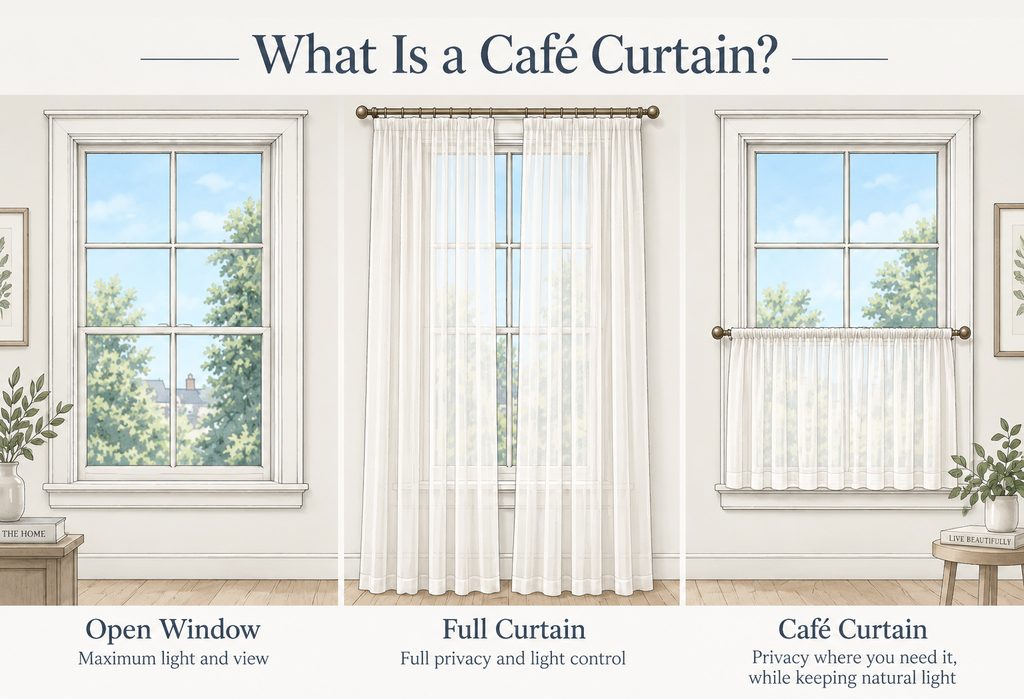
When an open window, a full curtain, and a café curtain are viewed side by side, the difference becomes easy to understand.
An open window provides the most daylight and the clearest view, but very little privacy. A full curtain offers more complete coverage and light control, but it also conceals more of the window.
A café curtain sits somewhere between the two.
It covers the lower portion of the window while leaving the upper area open. This creates privacy at a practical height without completely closing off the window.
For me, this is the main idea behind a café curtain:
It covers the part of the window that needs coverage, rather than covering more than necessary.
That makes it especially useful in spaces where daylight is important but lower-window privacy is still needed.
2. Café Curtain Height & Placement
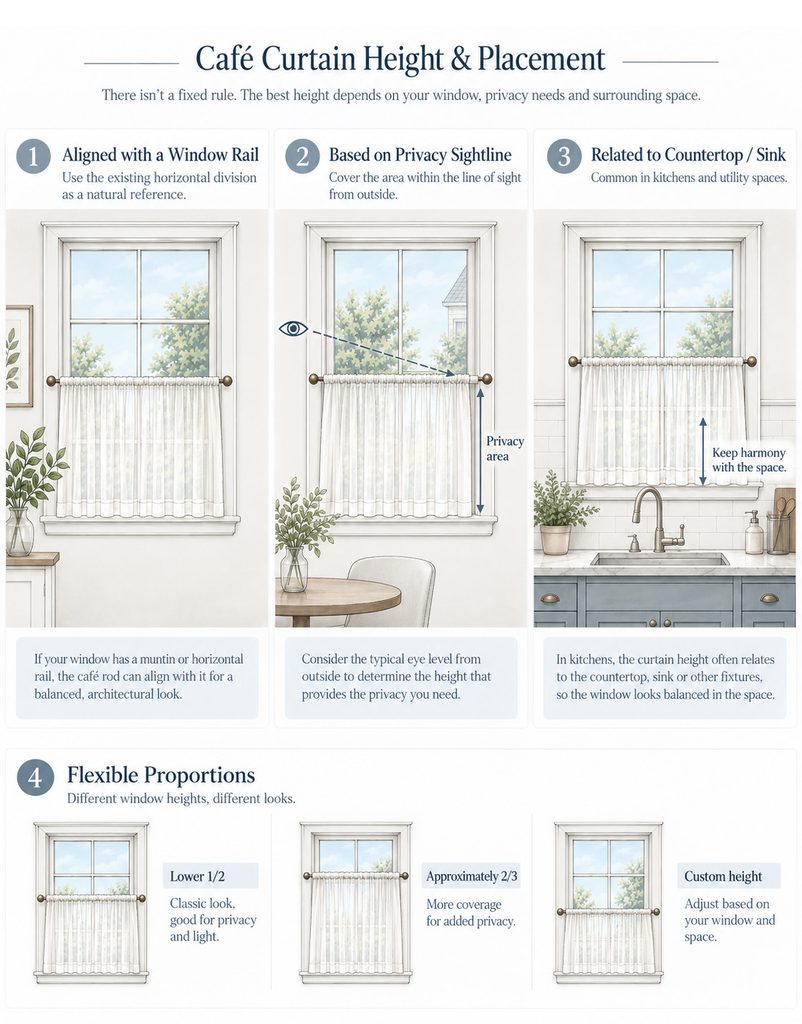
Café curtains are often described as covering the lower half of a window, but I do not think the height needs to follow a strict 50/50 rule.
In practice, it makes more sense to look at the window itself and the surrounding conditions.
Aligning with the Window Structure
If the window has a clear horizontal muntin, rail, or other architectural division, the café rod can often align naturally with that line.
This tends to create a more balanced appearance because the curtain follows the existing proportions of the window rather than stopping at an arbitrary height.
Considering the Privacy Sightline
For street-facing windows, windows close to a walkway, or rooms near neighboring properties, the outside sightline may be more important than the exact proportion of the window.
The curtain should cover the area that actually needs privacy.
On some windows, the lower half may be enough. On others, the curtain may need to sit slightly higher to block the typical line of sight from outside.
Relating the Curtain to Countertops and Sinks
In kitchens, the height of a café curtain often relates to the countertop, sink, sill, and other fixed elements around the window.
A curtain that sits too low can feel disconnected, while one that is too high may make the window feel visually compressed.
The goal is usually to create a comfortable relationship between the window, the surrounding fixtures, and the curtain itself.
Flexible Proportions
A lower-half treatment, approximately two-thirds coverage, or a custom height can all work depending on the window.
These proportions are better understood as visual references rather than fixed rules.
For me, the best café curtain height usually comes from balancing three things:
privacy, natural light, and window proportion.
3. Café Curtain Heading Styles
Because café curtains are relatively small, the heading style can have a noticeable effect on the overall character of the window.
The same short curtain can feel relaxed, tailored, traditional, or decorative simply by changing the way the top is finished.
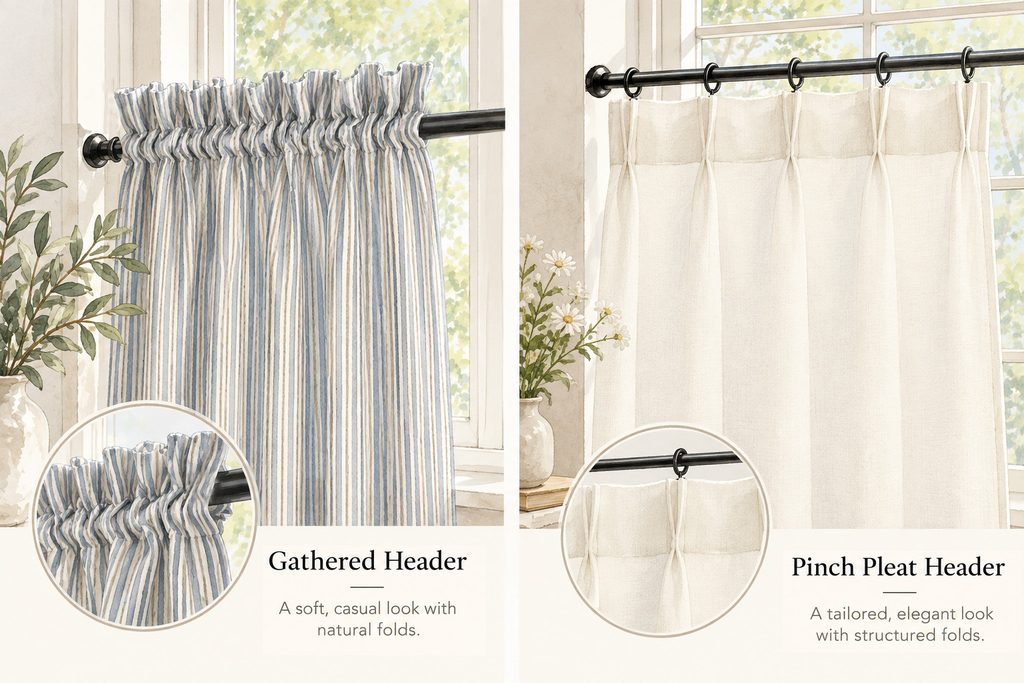
Gathered Header
A gathered header is one of the most natural choices for a café curtain.
The fabric is softly gathered along the rod, creating small, relaxed folds rather than a highly structured pleat.
This works especially well with linen, cotton, stripes, and other lightweight fabrics.
The appeal comes from the softness of the gathering rather than from precise shaping.
Pinch Pleat Header
A pleated heading creates a more tailored and polished appearance.
Compared with a gathered header, the pleats establish a clearer rhythm and stronger vertical lines.
Even on a small café curtain, this added structure can make the treatment feel more refined.
It is a useful option when the window calls for a cleaner or more finished look.
4. Rings, Clip Rings & Tie Tops
Café curtains can also be suspended from the rod using visible hardware or fabric ties.
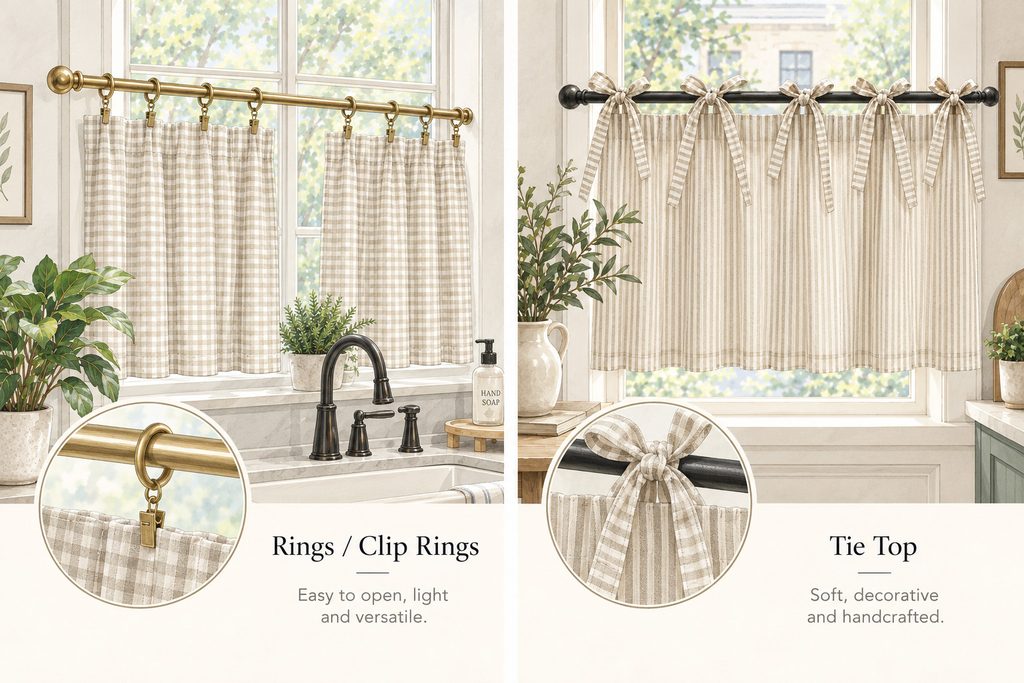
Rings / Clip Rings
Rings and clip rings are flexible and practical.
They create a visible connection between the curtain and the rod, and they also make the curtain easier to open, adjust, or remove.
With clip rings, the top edge of the curtain can remain relatively simple because the clip itself provides the attachment.
This works well with both lightweight linen and decorative patterned fabrics.
Tie Top
Tie tops create a very different effect.
Fabric ties are wrapped or knotted directly around the rod, giving the curtain a more relaxed and handcrafted appearance.
The width, length, and knot of the ties all become part of the design.
This style often works well in cottage, country, and other informal interiors, but the final look depends heavily on the fabric and detailing.
5. Hardware Options
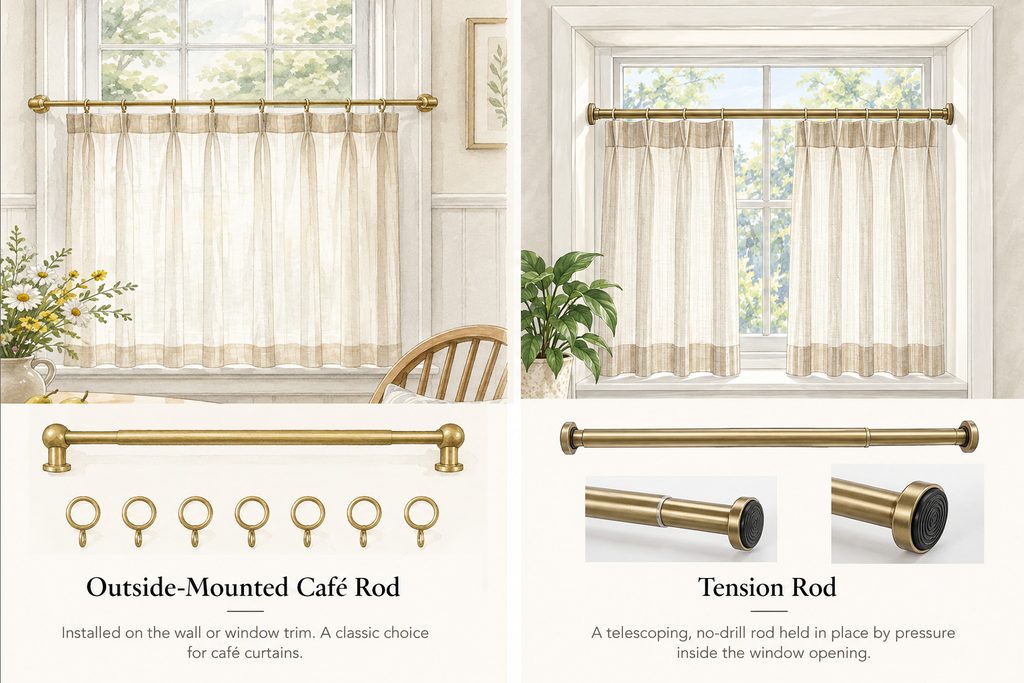
Café curtain hardware can be very simple or quite decorative.
There are many different rods, brackets, rings, clips, and finials available, so this article is not intended to catalog every hardware variation. Instead, it is more useful to look at two common installation approaches.
Fixed Café Rod
A traditional café rod is usually slender and visually light.
It can be mounted to the window trim, frame, or another suitable surrounding surface, and may be used with rings, clips, or a curtain that slides directly onto the rod.
A fixed rod generally offers a stable installation and can also become part of the overall design.
Brass, black, nickel, and other finishes can give the same café curtain a very different character.
Tension Rod
A tension rod is another practical option.
It is typically telescoping and held in place by pressure between the two sides of the window opening, so it does not require drilling or conventional mounting brackets.
For lightweight café curtains, this can be a convenient and visually discreet solution.
Whether a tension rod is appropriate depends on the width of the opening, the surfaces it presses against, and the weight of the curtain.
The hardware shown here represents only a few common approaches. In practice, the final choice will depend on the window construction, fabric weight, installation conditions, and desired appearance.
6. Café Curtains in Different Spaces

One reason café curtains remain so useful is that they adapt easily to many different rooms without making the window feel overly formal.
Kitchen
The kitchen may be the most familiar setting for café curtains.
They work especially well above sinks and countertops, where full-length drapery would usually be impractical.
A short curtain can provide lower-window privacy while still keeping the room bright.
Dining Area or Breakfast Nook
In dining areas and breakfast nooks, café curtains can create a softer and more relaxed atmosphere.
They are less formal than full-length drapery and allow more of the outside view to remain visible, which suits everyday spaces particularly well.
Bathroom
Bathrooms often need privacy while also benefiting from natural light.
This makes café curtains a very practical option.
As long as the curtain height covers the relevant sightline, the upper portion of the window can remain open and bright.
Bay Windows and Window Nooks
Bay windows and built-in window areas are another good setting for café curtains.
Because these windows often have strong architectural character, short curtains can provide privacy without hiding the overall shape of the window.
7. Layering Café Curtains with Other Window Treatments
Café curtains do not have to be used on their own.
One particularly useful combination is:
Café Curtain + Roman Shade
During the day, the Roman shade can remain open while the café curtain provides lower-window privacy.
When more privacy or additional light control is needed, the Roman shade can be lowered.
The two treatments serve different purposes:
- the café curtain maintains everyday privacy while preserving daylight;
- the Roman shade provides fuller coverage when needed.
This layered approach can add both function and visual depth.
That said, layering is not always necessary. If the café curtain already solves the main privacy and light-control needs of the room, there is no reason to add another treatment simply for decoration.
Conclusion
Café curtains are a simple form of window treatment, but their strength comes from the way they use only part of the window.
Instead of covering everything, they focus on the area that actually needs privacy while allowing the rest of the window to remain open to light and view.
Their height, heading style, hardware, fabric, and relationship to the surrounding architecture can all change the final result.
A café curtain may be nothing more than a soft linen panel, or it may include tailored pleats, decorative rings, ties, patterned fabric, or layered treatments.
That flexibility is what makes this small window treatment so interesting to me.
It looks simple, but it leaves a surprising amount of room for design.