
Trims, Banding, Fringes & Applied Details
In custom window treatments, the elements that change the character of a finished design are not always the most complicated ones.
A braid running along the leading edge of a drapery panel, a band of contrasting fabric inset into a Roman shade, a narrow line of piping, or a fringe applied along an edge can all affect proportion, outline, texture, and visual balance.
These elements can broadly be considered decorative details.
Some are primarily decorative, while others developed from practical finishing functions such as covering seams, completing edges, or defining construction lines. Over time, they have become a flexible part of custom window treatment design.
This article provides an overview of several common decorative details, the terminology used to describe them, and some of the ways they are applied to drapery, Roman shades, valances, and cornices. The focus here is on recognition and design logic rather than fabrication instructions.
1. Types of Decorative Details
Decorative details do not follow one perfectly standardized classification system.
Different trim houses, workrooms, and designers may use overlapping terms depending on construction, scale, traditional naming, or intended use. Rather than treating every name as a completely separate category, it is more useful to first understand a few broader groups.
Flat / Woven Trims
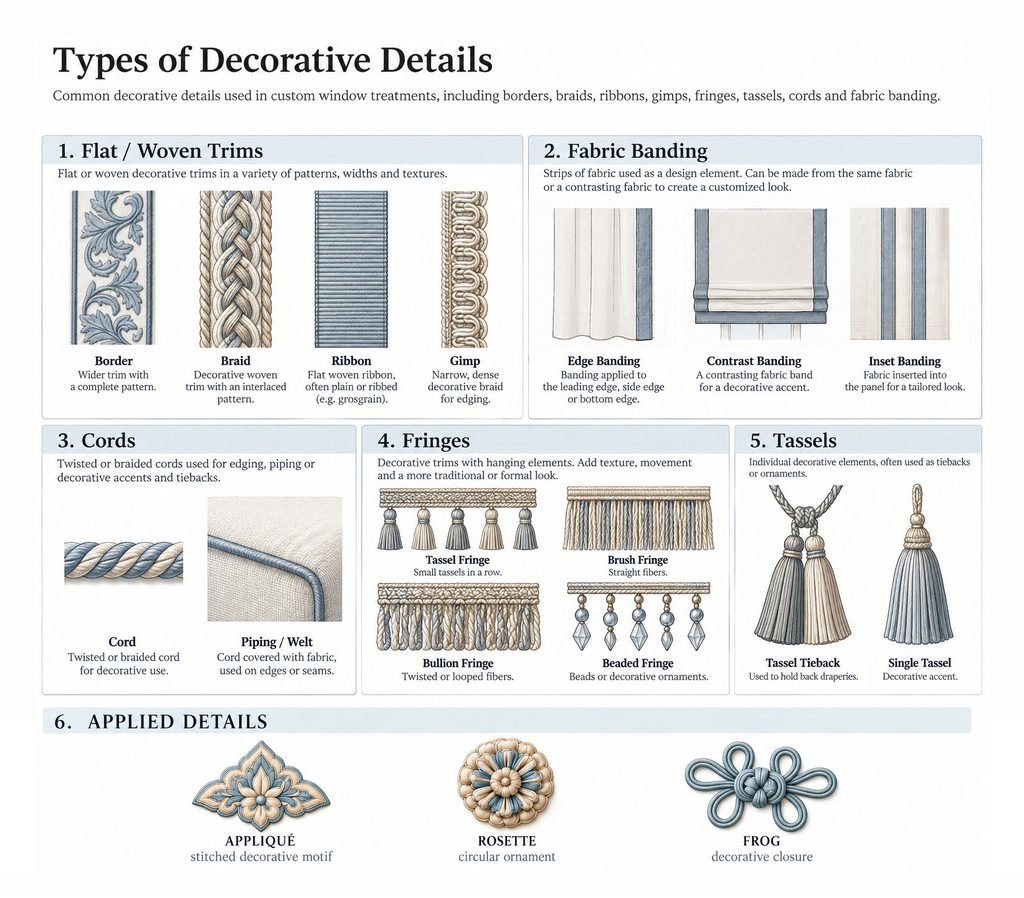
This group includes flat or woven decorative trims such as border, braid, ribbon, and gimp.
A border often has a more complete pattern and a stronger visual presence, making it useful when a clearly defined decorative edge is desired.
A braid is more closely associated with woven, interlaced, or plaited construction, and can range considerably in width and complexity.
A ribbon is generally flatter and more regular in structure. A common example is grosgrain ribbon, which is recognizable by its fine crosswise ribs.
A gimp is typically a narrower, denser decorative braid. Traditionally, it has also been used to cover seams, raw edges, or upholstery staples, so its role can be both decorative and functional.
There are no absolute width boundaries between these terms, and product naming can vary from one manufacturer to another.
Fabric Banding
Fabric banding is different from a purchased trim.
Instead of applying a separate decorative product, banding is created from fabric itself. It may be made from the same fabric as the treatment or from a contrasting material.
Common approaches include:
- edge banding
- inset banding
- contrast banding
Banding is not simply an added strip of color. It becomes part of the panel composition.
Cords
Corded details create a more dimensional line.
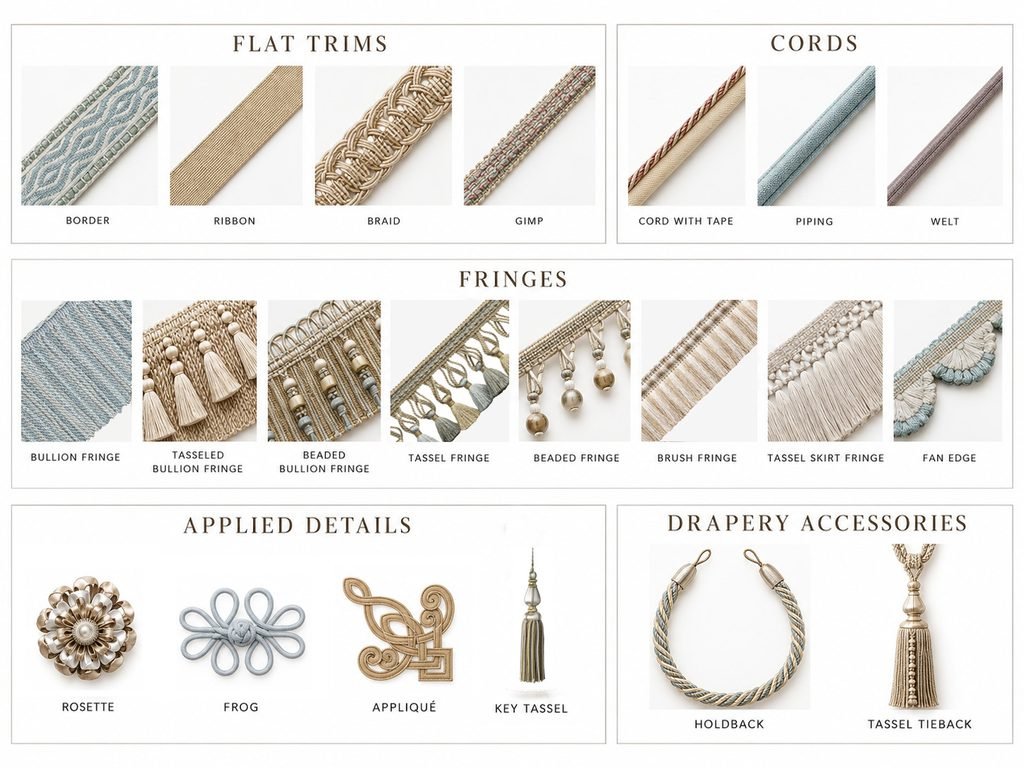
A cord is usually formed from twisted yarns and may be used as a decorative element on its own or made with a tape or lip for insertion into a seam.
Piping and welt are more closely associated with a corded edge formed within a seam, creating a narrow raised outline around a panel, cushion, valance, or other soft furnishing.
The terminology used for piping and welt can vary between workrooms, and the two terms are often used with some overlap.
Fringes
Fringe is a broad category with many variations.
Common forms include:
- Brush Fringe
- Bullion Fringe
- Tassel Fringe
- Beaded Fringe
There are also more elaborate variations such as tasseled bullion fringe, beaded bullion fringe, skirt fringe, and fan edge.
Fringe does more than add pattern. It introduces texture, movement, and visual weight, and its length, density, and material can significantly influence the finished effect.
Tassels
A tassel can be used as an individual decorative element or incorporated into tassel fringe, tiebacks, key tassels, and other hanging details.
Because tassels are dimensional, they usually have more visual presence than a flat trim, so their scale and placement need to be considered carefully.
Applied Details
Some decorative details are not continuous trims at all.
Examples include:
appliqué, rosette, and frog.
These function more like individual decorative motifs and can be used on valances, upholstery, pillows, and other custom soft furnishings.
2. Decorative Details Are Not Only Decorative
It is easy to think of trim, fringe, or tassels simply as embellishment.
But from a fabrication perspective, many decorative details also developed from practical finishing functions.
For example:
- gimp can conceal seams, raw edges, or fastening points
- piping or welt can finish a seam while reinforcing its outline
- cord can emphasize the edge of a structure
- trim can be placed over a fabric join, finishing the seam while also making the panel composition more intentional
So decorative details are not only about making a treatment look more elaborate.
They can also:
- define an edge
- finish a seam
- divide fabrics
- create a visual boundary
- adjust proportion
- introduce texture
- guide the eye
In this sense, many decorative details sit somewhere between fabrication and design.
3. Trim vs. Fabric Banding
These two ideas are easy to confuse, but the distinction is useful.
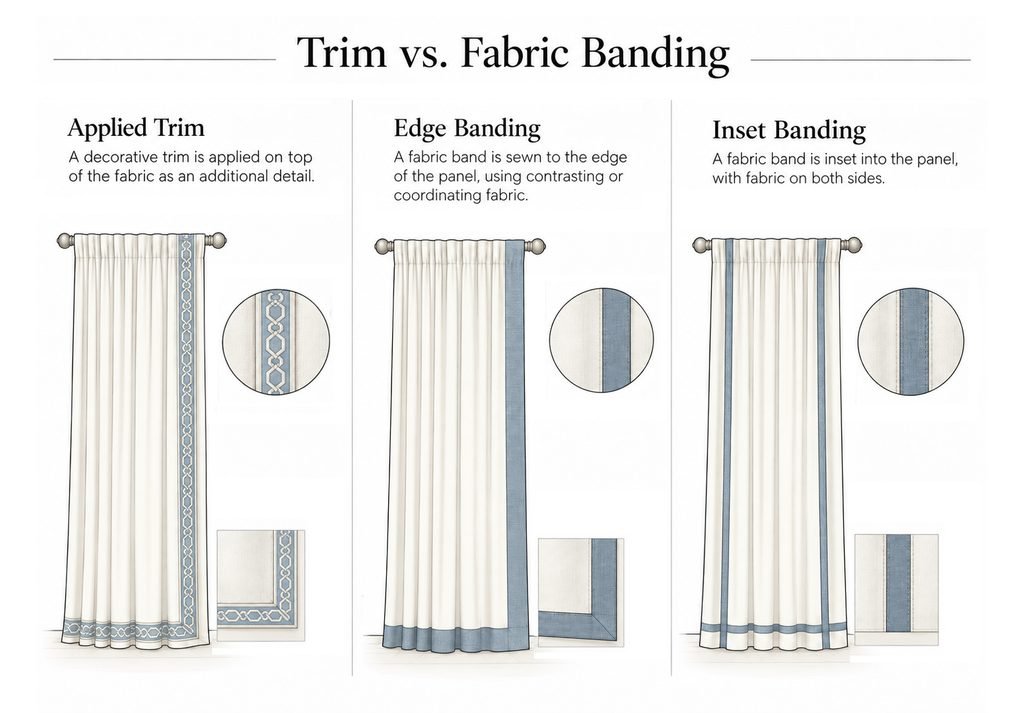
Applied Trim
Trim is usually an additional decorative material applied to an existing fabric surface.
Examples include:
border, braid, ribbon, and gimp.
It may be stitched onto the face of the fabric, along an edge, or over a seam.
In other words, the main fabric already exists, and the trim is added afterward as a separate decorative element.
Fabric Banding
Fabric banding works differently.
A band is created from fabric itself, using the main fabric, a coordinating fabric, or a contrasting material. It becomes part of the panel construction.
Banding may sit directly on the outside edge or be positioned farther inward as inset banding.
From a design standpoint:
Trim is an applied decorative element.
Fabric banding is part of the panel composition itself.
That distinction can affect:
- fabrication method
- seam construction
- finished dimensions
- visual weight
- overall proportion
So it is not enough to look only at color or pattern. The construction method also matters.
4. Common Ways Decorative Details Are Applied
Decorative details can be placed in many different ways.
Drapery Panels
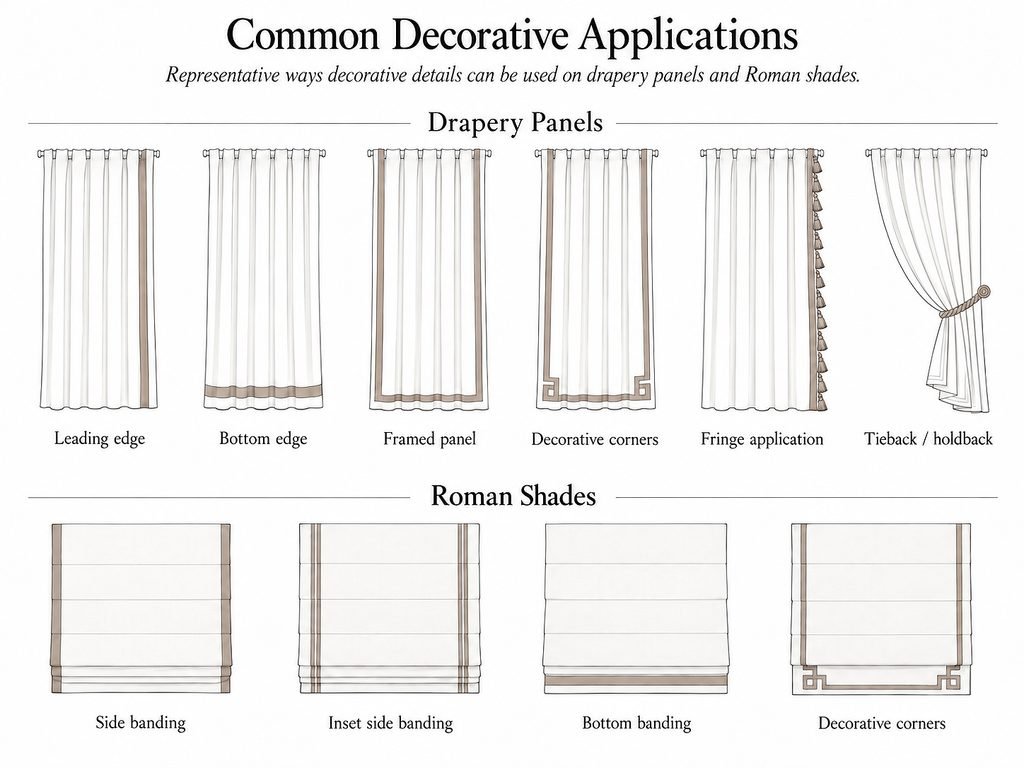
Some of the most common applications include:
Leading Edge
Trim, border, or banding placed along the leading edge creates a strong vertical line and emphasizes the inside edge of the panel.
Bottom Edge
Fringe, border, or banding can also be used along the bottom edge. Because this shifts visual weight downward, the depth of the detail should be considered together with the finished drapery length.
Framed Panel
When border or banding continues along more than one edge, the panel can take on a framed appearance, giving the outline more definition.
Inset Detail
Trim or banding can also be moved away from the outer edge, leaving a visible margin of the main fabric and creating a more deliberate composition.
Panel Composition
Trim may also be used over split panels or fabric joins. In this case, it becomes part of the panel layout rather than simply an edge treatment.
Decorative Corners
Not every detail needs to run continuously. A motif or decorative element may be concentrated at the corner or in a selected area.
Fringe Applications
Fringe may be used along the leading edge, bottom edge, or other selected edges.
Tiebacks and Holdbacks
Cord, braid, tassels, and related accessories can also be used to gather drapery while contributing to the overall decorative language.
Roman Shades
Because a Roman shade presents a relatively flat surface when lowered, the proportion and placement of decorative details are especially visible.
Common approaches include:
- side banding
- inset side banding
- bottom banding
- framed edges
- decorative corner details
Valances and Cornices
Decorative details are also widely used on valances and cornices.
Typical locations include:
- lower edges
- outlines
- face panels
- corners
- fringe accents
- cord or piping details
- applied motifs
Because valances and cornices have more defined structural boundaries, decorative trim can become especially prominent and may act as a strong visual focal point.
The applications shown here are only representative examples. There are many more ways these details can be adapted and combined.
5. How Decorative Details Change the Final Look
Even when the basic drapery treatment stays the same, changing only the decorative detail can noticeably alter the final effect.
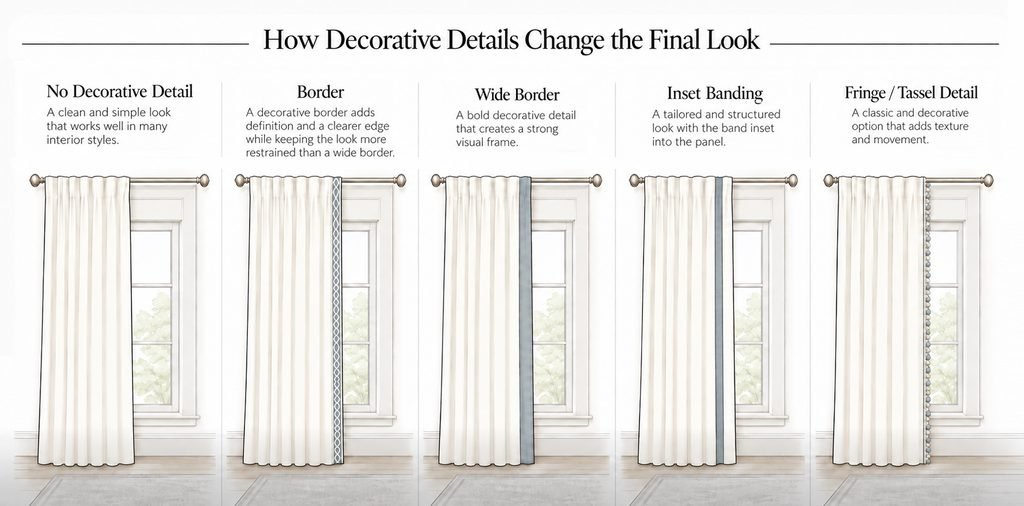
No Decorative Detail
Without an added decorative detail, the visual focus stays on the fabric, heading, fullness, and overall proportion.
The result is usually quieter and easier to integrate into a wide range of interiors.
Border
Adding a border gives the panel a more clearly defined edge.
Compared with an undecorated treatment, it introduces structure and finish while still allowing the main fabric to remain dominant.
Wide Border
As the border becomes wider, it shifts from being a small finishing detail to becoming a major part of the panel design.
Its width, pattern scale, and relationship to the overall drapery dimensions become much more important.
Inset Banding
Inset banding creates an additional vertical line within the panel.
Compared with edge banding, it places more emphasis on composition, and the remaining width of the main fabric outside the band becomes part of the design.
Fringe / Tassel Detail
Fringe and tassels introduce more obvious texture and movement.
Because they are dimensional, they often carry more visual weight than a flat trim of a similar width.
If they are oversized, they can easily overpower the fabric. When carefully scaled, they can add depth and character to a relatively simple treatment.
6. What Affects the Final Result?
The same trim can look very different from one project to another.
Several factors have a particularly strong influence.
Width / Scale
The width of a trim should relate to the scale of the entire window treatment.
The same border used on a small Roman shade and on a tall drapery panel will read very differently.
There is no single width that works for every project.
Placement
The same decorative detail can feel very different depending on whether it is placed at the:
- leading edge
- bottom edge
- inset position
- panel joint
Placement can be just as important as the trim itself.
Contrast
Low-contrast details tend to feel quieter and more integrated.
High-contrast details create a stronger visual statement.
The same applies to differences in material and texture, not only color.
Texture
A flat ribbon, woven braid, twisted cord, and soft fringe all create very different surface effects.
Even when the colors are similar, the construction of the material can change the overall character.
Pattern
A patterned border has a different visual weight from a plain ribbon.
When the main fabric already has a strong pattern, decorative trim often benefits from more restraint. A plain fabric may allow a more expressive trim to take a larger role.
7. Layering Decorative Details
Decorative details do not always need to be used individually.
Borders, braids, cords, fringes, banding, and applied details can be combined to create richer edge treatments and more layered compositions.

For example:
Border + Cord
A flat border combined with a dimensional cord can create a stronger sense of outline and depth.
Border + Fringe
A structured flat trim paired with hanging fringe brings together definition and movement.
Banding + Braid
Fabric banding can establish the larger color block or framework, while braid adds a finer decorative layer.
Trim + Fringe + Cord
Several decorative structures may be combined in one treatment to create a more complex rhythm along the edge.
Applied Details + Repeated Trim
Tassels, appliqué, or other individual motifs can also be repeated and combined to create a more complete decorative language.
Once several decorative details are layered together, the main question is no longer simply which trim to choose.
The design begins to depend more on:
scale, spacing, material relationships, repetition, and rhythm.
There is no single formula for layering, but the more elements that are introduced, the more important it becomes to establish hierarchy.
If every detail tries to become the focal point, the composition can quickly lose clarity.
Conclusion
Decorative details may occupy only a small part of a window treatment, but they can have a strong influence on the finished result.
From a narrow gimp to a wide fabric band, or from a subtle cord to a fringe with obvious movement, these details affect more than decoration alone.
They influence:
edges, proportion, rhythm, texture, and visual emphasis.
Learning the terminology is only the first step.
What matters more is understanding why a detail is placed in a particular location, how it relates to the fabric, and what role it plays within the overall window treatment.
This article serves as an overall study of Decorative Details. In future articles, I will continue to organize and explore how trim is used across different window treatment products, together with the fabrication and construction details behind those applications.