
Decorative fringe has long been part of traditional window treatment design. It can appear as a subtle finishing detail along an edge, or become a much stronger decorative feature within the overall treatment.
Fringes vary greatly in length, density, material, and construction, and these differences can change the character of a window treatment considerably. The question is not simply whether a fringe looks attractive on its own, but whether its scale, texture, and visual weight work with the fabric, treatment style, and surrounding room.
This article looks at several decorative fringe types commonly seen in custom window treatments, along with their applications, visual effects, and a small but important fabrication detail.
Common Decorative Fringe Types
There are many fringe styles on the market, and terminology can vary between trim manufacturers. The following examples are not intended as a complete classification, but rather as a practical selection of types commonly encountered in decorative window treatments and soft furnishings.

Tassel Fringe
Tassel fringe is made from a repeated series of individual tassels attached to a decorative heading. Depending on the size, spacing, color, and construction of the tassels, it can feel relatively light or considerably more formal.
Pom-Pom Fringe
Pom-pom fringe uses small rounded pom-poms as the main decorative element. It usually has a lighter and more relaxed character and works particularly well on Roman shades, valances, café curtains, and casual window treatments.
Bullion Fringe
Bullion fringe is formed from dense twisted or looped cords. It generally has more visual weight and movement than pom-pom or small tassel fringes and is often associated with traditional or more formal interiors.
Beaded Fringe
Beaded fringe incorporates beads, decorative drops, or other suspended elements. Contemporary versions are not always made from rows of traditional round beads; many use cleaner, more elongated forms that create a lighter decorative effect.
Beaded Bullion Fringe
This type combines bullion-style cord structures with beads or decorative accents. The result is richer and more layered, making it particularly suited to treatments where the trim is intended to be noticed.
Tasseled Skirt Fringe
Tasseled skirt fringe typically has a wider woven or braided heading with a continuous row of longer tassels below. Its greater drop and fuller construction give it a stronger visual presence, making it more appropriate for traditional, formal, or highly decorative window treatments.
Brush fringe and fan fringe are also common decorative trims, although today they are seen more frequently on upholstery, pillows, and other soft furnishings than on window treatments.
Where Decorative Fringes Are Used
Decorative fringe can be applied to many different types of window treatments, and its effect changes depending on where it is placed.
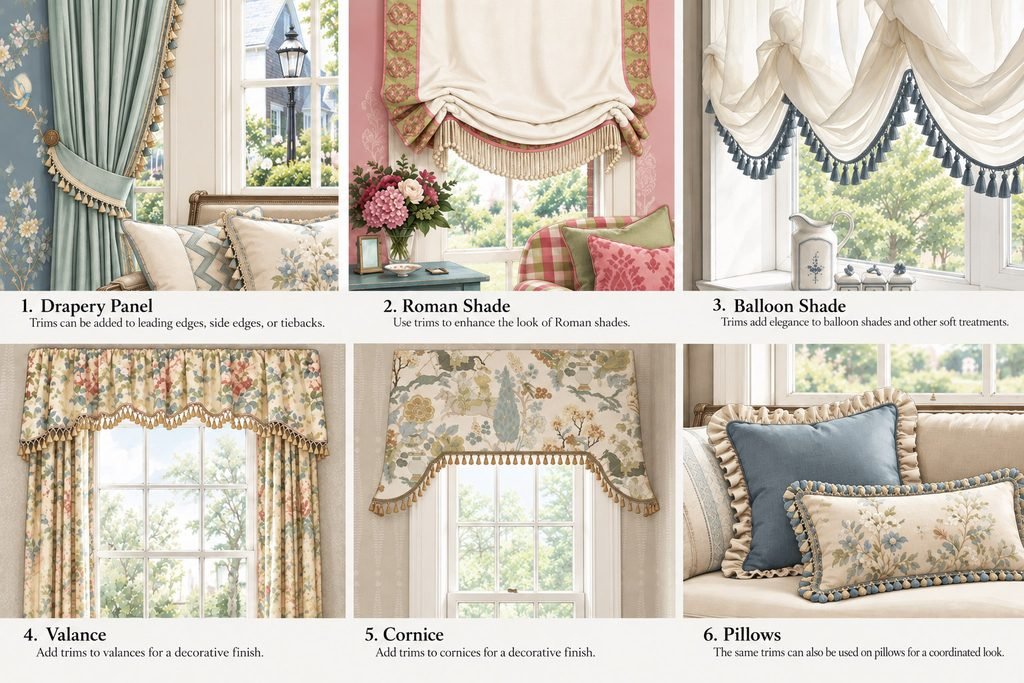
On drapery panels, one of the most common positions is the leading edge. Fringe can also appear along side edges or on tiebacks, where it turns a simple fabric edge into a more noticeable design feature.
On Roman shades, fringe is often used along the bottom edge. Because the structure of a Roman shade is relatively clean and controlled, even a small trim can create a clear decorative line.
On balloon shades, valances, and cornices, fringe often follows the lower contour of the treatment. When used along scalloped, curved, or shaped edges, tassels, bullion, or beaded trims can reinforce the silhouette of the design.
The same trims can also be carried through to decorative pillows and other soft furnishings. Repeating a trim, color, or material across window treatments and furnishings can create a subtle sense of connection within the room.
Light vs. Heavy Decorative Effect
The size, length, and density of a fringe can significantly change the visual weight of a window treatment.
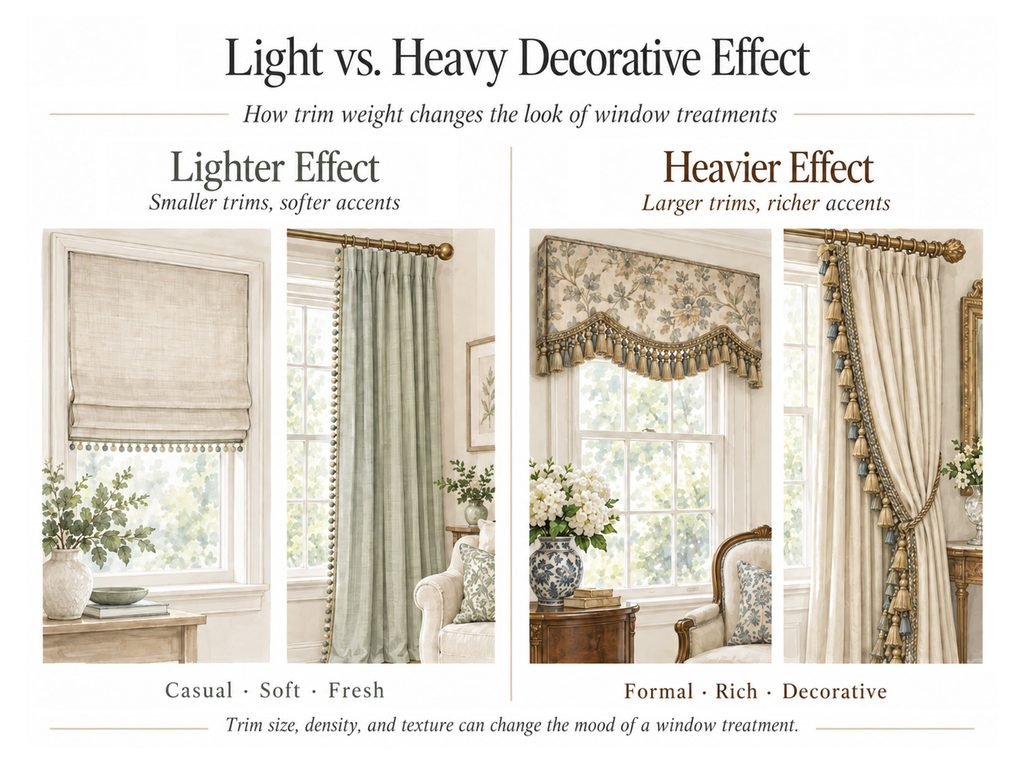
Small pom-poms, short tassels, and narrow fringes usually add detail without strongly altering the overall silhouette. They tend to create a softer, lighter, and more casual effect.
Longer, denser, or more complex trims—such as larger tassels, bullion fringe, or skirt fringe—create a stronger decorative presence. They are more likely to feel rich, formal, or traditional.
This does not mean that light trims are always modern or that heavier trims are always traditional. What matters more is the relationship between the trim and the treatment itself.
Heavier fabrics, larger valances, bold prints, and formal drapery can often support a more substantial fringe. On lighter fabrics or simpler treatments, an oversized trim can quickly overpower the design.
When selecting a fringe, I usually find it useful to consider the fabric weight and texture, the scale of the treatment, the drop and density of the trim, and the overall decorative level of the room together rather than separately.
A Small Workroom Detail: Finishing the Fringe End
One practical detail that is easy to overlook is what happens at the cut end of a fringe.
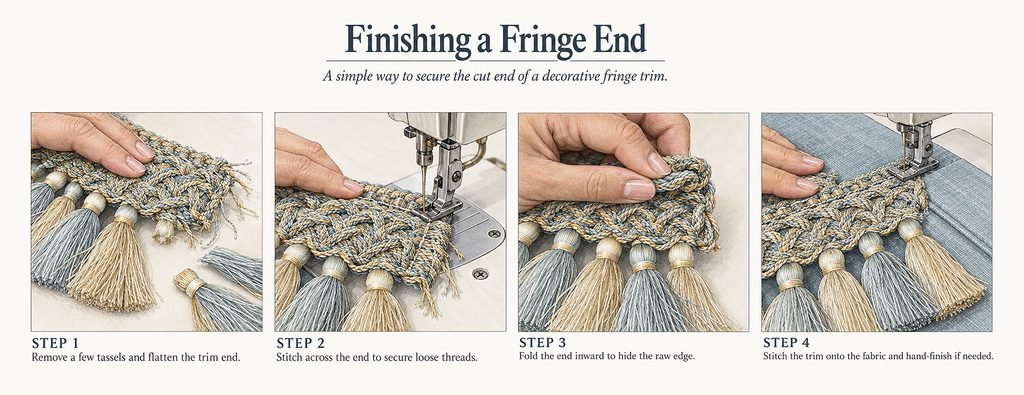
Many tassel, bullion, and braided fringes can begin to loosen or unravel once they are cut. If the raw end is left untreated, cords, yarns, or woven structures may continue to open during sewing or later use.
A typical approach is to remove a small amount of loose material at the end, secure the cut edge with stitching, fold the end inward, and then stitch the trim into the finished edge. Depending on the construction of the fringe, some hand finishing may also be needed to keep the end neat.
Different trims require slightly different handling, but the basic principle remains the same:
The cut end should be secured before it becomes part of the finished edge.
It is a small workroom detail, but one that can make a noticeable difference in how clean and stable the finished treatment looks.
Final Thoughts
Decorative fringe is not necessary for every window treatment, but when it is well chosen, it can define an edge, reinforce a shape, add movement, or connect the treatment to other soft furnishings in the room.
Rather than judging a fringe as an isolated decorative object, I prefer to look at how it behaves within the full design: whether the proportion feels right, whether the visual weight suits the fabric, whether the color relates to the room, and whether the finished construction can remain clean and controlled.
The same fringe can look very different when applied to different fabrics or treatment styles. That is what makes these small decorative details more interesting—and more important—than they may first appear.