
Patterned fabrics can change dramatically once they are made into drapery, Roman shades, valances, or cornices.
The final result depends on more than whether the fabric itself is beautiful. The starting point of the cut, the position of a dominant motif, the location of seams, and the way repeats are matched can all influence how the finished treatment reads.
For fabrics with a visible repeat, I find it useful to think about several questions together:
- What is the repeat unit?
- What happens when that unit is repeated across a larger surface?
- Where should the main motif fall on the finished treatment?
- How should multiple fabric widths be joined?
- Does the pattern need to continue across the seam?
- How does the treatment type change the way the pattern is seen?
These decisions are closely related. Pattern planning usually begins well before the fabric reaches the sewing stage.
1. Understanding Pattern Repeat
A pattern repeat is the fixed distance at which a fabric design repeats horizontally and vertically.
The two basic measurements are:
- Horizontal Repeat
- Vertical Repeat
A complete repeat unit does not necessarily contain one fully enclosed flower, leaf, or decorative motif.
What matters is that the unit can continue seamlessly in both directions. The left edge should relate correctly to the right edge, and the top should continue naturally into the bottom.
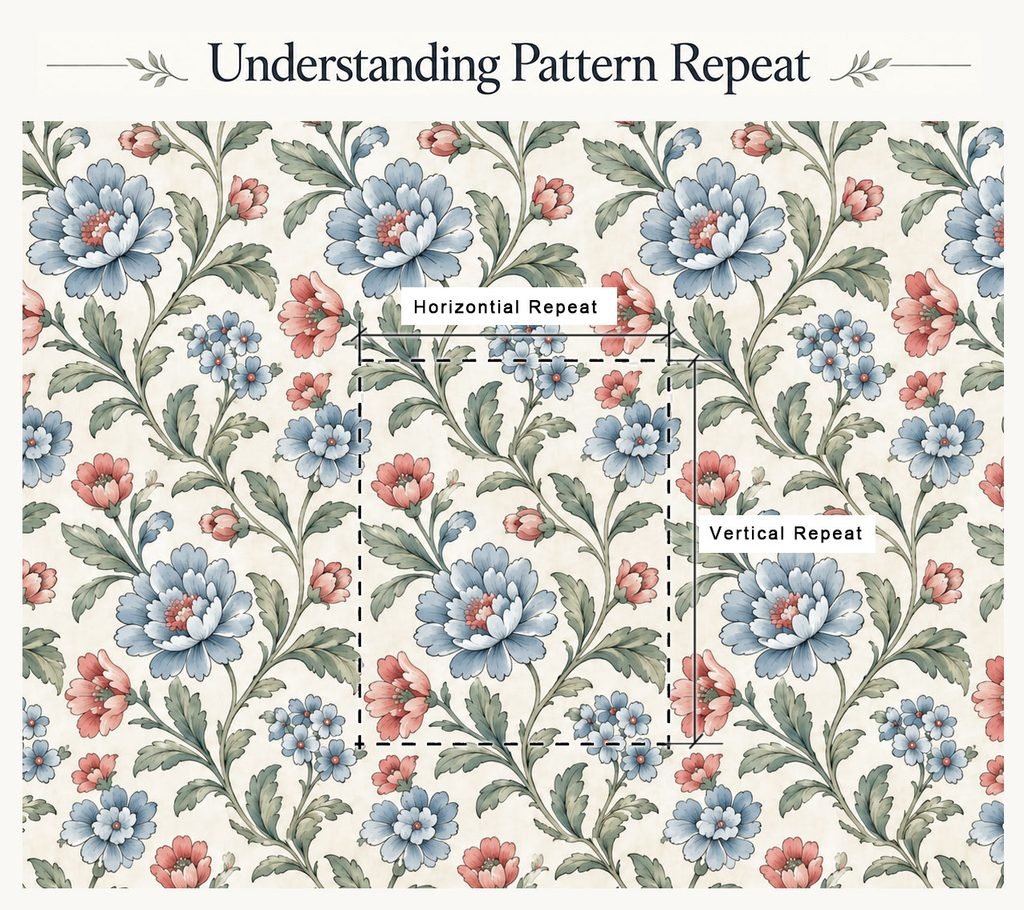
The vertical repeat often has a direct influence on cut length, motif placement, and fabric usage.
The horizontal repeat becomes especially important when planning the relationship between motifs across the fabric width and when multiple widths need to be joined.
2. From Repeat Unit to Overall Pattern
Looking at one repeat unit does not always tell us how the fabric will feel at full scale.
Once the same unit is repeated horizontally and vertically, a larger visual rhythm begins to appear.
Depending on the design, the overall pattern may develop:
- a diagonal flow,
- a strong vertical movement,
- a horizontal rhythm,
- or a more scattered distribution.
The floral pattern used in the illustration is a good example.
Its repeat unit is rectangular and regular, but once the pattern is extended across a larger area, the branches and flowers create a noticeable diagonal movement.
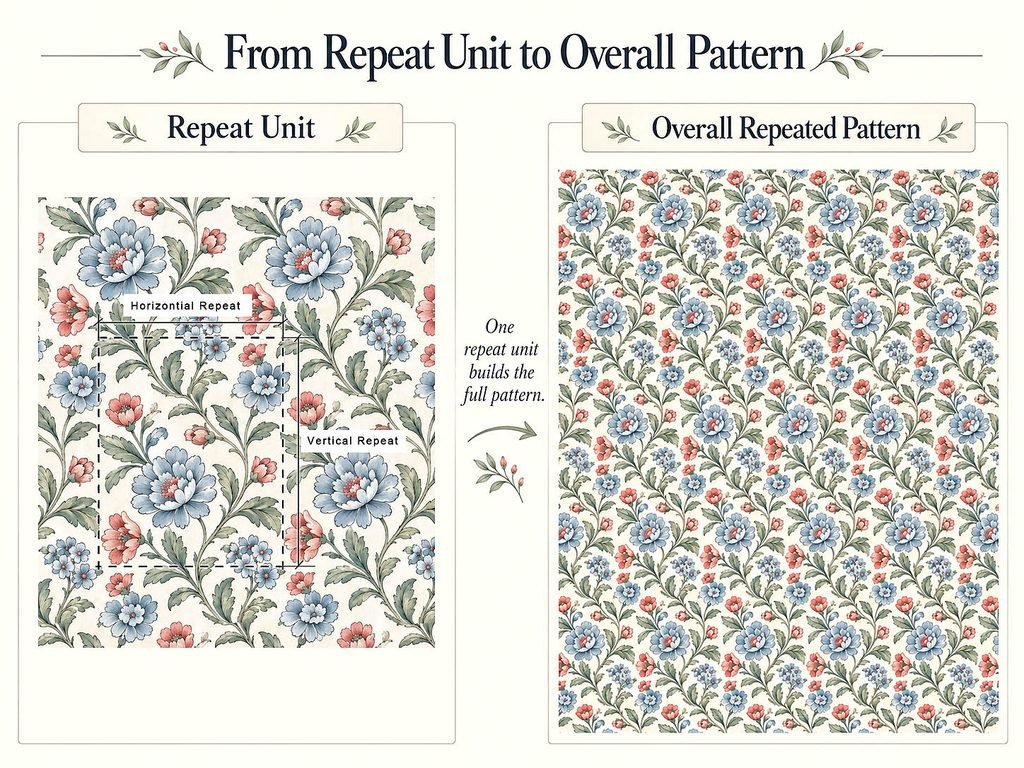
This is why it is useful to look beyond a small sample whenever possible.
A pattern may appear quite different when seen across the scale of an entire window treatment.
3. Pattern Placement: Centered, Balanced, or Poorly Cropped
Pattern placement is not simply about placing the largest flower in the center.
Some fabrics contain a strong dominant motif. In those cases, centering the motif may create a more formal or stable composition.
Other designs are more continuous, scattered, or directional. For those patterns, forcing one motif into the exact center may feel less natural than allowing the overall design to remain visually balanced.
A good placement usually considers:
- where the dominant motifs fall,
- whether one side feels visually heavier than the other,
- whether important elements are awkwardly cut at the edges,
- and whether the finished treatment looks intentionally composed rather than randomly cropped.

A centered motif can work well.
A balanced placement can work equally well.
The goal is not necessarily perfect centering. The goal is to create a placement that feels deliberate and visually comfortable.
4. Roman Shades: Flat Surfaces Make Pattern Planning More Visible
A Roman shade presents the fabric in a relatively flat plane when lowered.
Because of that, pattern placement, seams, and matching are often more noticeable than they are on a treatment with deeper folds.
When a Roman shade is wider than the usable width of the fabric, additional widths may need to be joined.
One approach is to add a narrow strip on one side.
Visually, however, this can sometimes make the shade feel unbalanced, especially when the seam is clearly visible.
A more balanced layout is often achieved by dividing the added width between both sides so the seam arrangement becomes symmetrical.
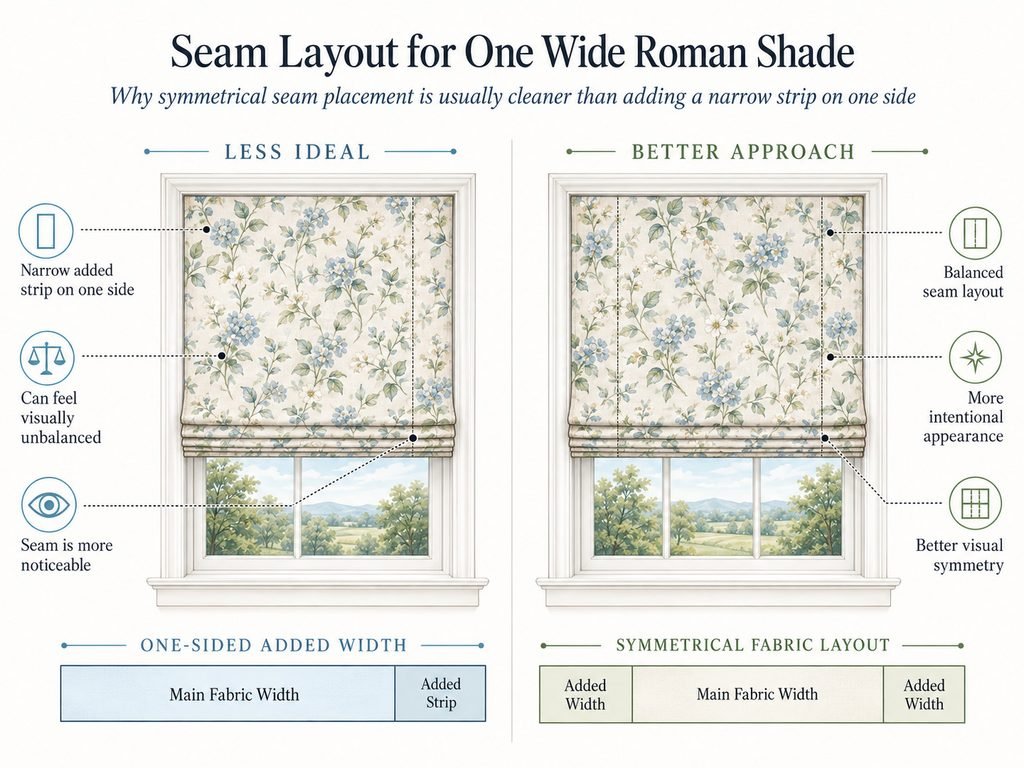
This is not a fixed rule for every project.
The main idea is to make the seam layout feel planned rather than simply added wherever extra width happens to be needed.
If the fabric is patterned, the next question is whether the motifs can also continue naturally across those seams.
5. Pattern Matching Across Seams
Pattern matching begins before sewing.
If the design needs to continue across a seam, the repeat has to be considered during cutting.
This may involve planning:
- the repeat dimensions,
- the starting point of each cut,
- the relationship between motifs on adjacent widths,
- and the additional fabric needed to maintain continuity.
Large repeats, geometric patterns, stripes, and strong trailing motifs tend to make mismatches more noticeable.
When the pattern flows naturally across a seam, the seam itself can become visually quieter.
When the pattern suddenly shifts, even a technically neat seam may become easy to see.
For this reason, pattern matching can increase:
- fabric consumption,
- cutting waste,
- and planning time.
Patterned fabric yardage therefore cannot always be calculated from finished dimensions alone.
6. Drapery: Seam Position and Pattern Matching Work Together
Drapery behaves differently from a Roman shade.
Fullness and folds change the way the pattern is seen. Some motifs move into the folds, while others remain visible on the face of the panel.
Because of this, seam placement should usually be considered together with the pleat structure.
A seam may fall:
- near a pleat transition,
- in a flatter visible area,
- or in another location where its visual impact is reduced.
There is no single seam position that is always correct.
The better choice depends on the fabric, the pleat style, the pattern, and how noticeable the seam becomes from the front.
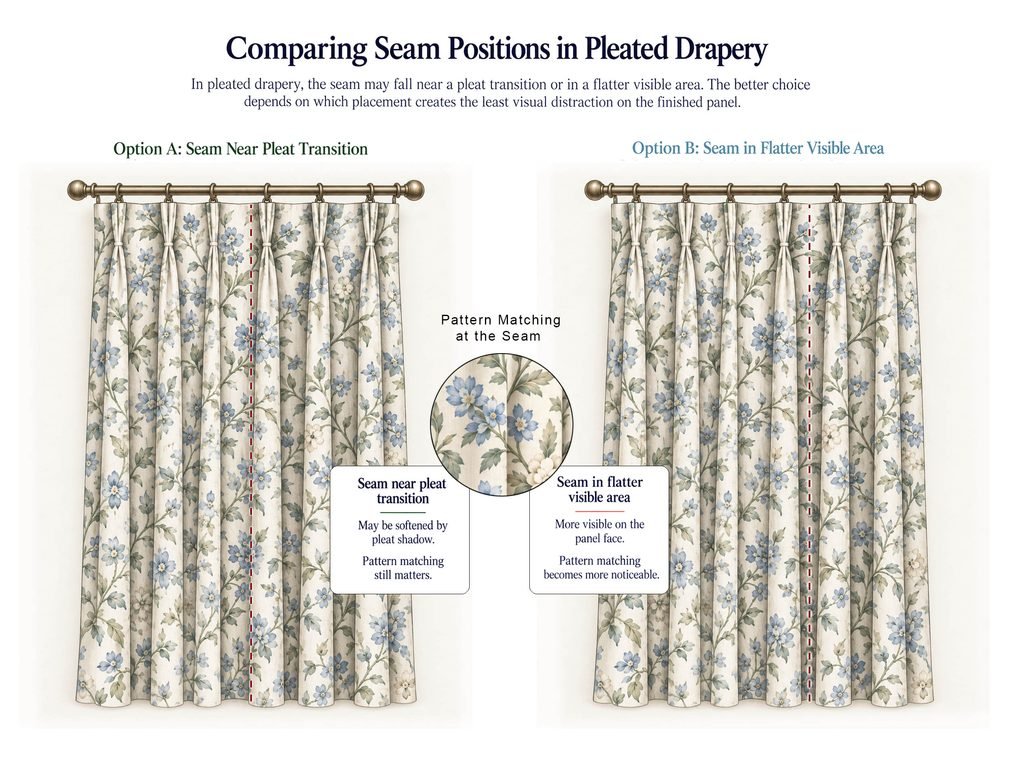
A seam close to a pleat transition may be softened by the shadow and depth of the folds.
A seam in a flatter visible area may still work perfectly well if the pattern is matched carefully and the join does not interrupt the visual flow.
For floral designs, a natural continuation of branches, leaves, and flowers across the seam can often matter more than following one fixed seam-placement rule.
The goal is to reduce visual interruption on the finished panel.
7. Valances and Cornices: Treat the Visible Area as a Cropped Composition
Valances and fabric-covered cornices usually show a much shallower section of fabric than full-length drapery.
Because of this, they can be thought of almost like a cropped composition taken from a much larger pattern.
Motif placement becomes especially important.
The largest flower does not always need to sit in the exact center.
In many cases, a slightly off-center but well-balanced arrangement feels more natural than a mechanically centered one.

For a shallow treatment, I would usually look at:
- whether the main motifs remain visually complete,
- whether the left and right sides feel balanced,
- whether important elements are awkwardly cut at the top or bottom,
- how the pattern behaves near corners and returns,
- and whether the visible section feels intentionally framed.
The goal is not necessarily perfect centering.
It is usually better to aim for a well-framed and visually balanced placement.
8. Pattern Matching and Fabric Usage
Pattern repeat can have a direct effect on fabric usage.
A larger repeat often means that more fabric may be needed to adjust the cutting position, especially when a project requires specific motif placement or close matching across multiple widths.
Additional fabric may be required to:
- align motifs across seams,
- control the starting point of a cut,
- coordinate multiple panels,
- avoid awkwardly cropped motifs,
- or maintain a visual relationship between neighboring treatments.
For this reason, repeat size should not be considered in isolation.
Fabric usage is influenced by a combination of:
- repeat size,
- treatment width,
- number of fabric widths,
- seam layout,
- placement priorities,
- and matching requirements.
The larger or more structured the pattern becomes, the more important this planning usually is.
Final Thoughts
Pattern repeat, placement, and matching may sound like separate technical topics, but they are closely connected.
Repeat determines how the design cycles.
Placement determines where that cycle appears on the finished treatment.
Matching determines whether the pattern continues naturally when multiple widths are joined.
The treatment type then changes how all of this is seen.
A Roman shade presents the fabric as a relatively flat composition.
Pleated drapery introduces folds, shadows, and changing visibility.
A valance or cornice shows only a limited section of the overall pattern.
For me, the most useful way to think about patterned fabric is not to look for one fixed rule, but to consider the relationship between:
pattern structure + treatment type + visible area + seam position
The aim is always the same: to make the finished treatment feel visually intentional, balanced, and natural.
Related Articles
- Pattern Scale in Window Treatments
https://windowtreatmentjournal.com/pattern-scale-window-treatments/ - Understanding Drapery Vertical Seams
https://windowtreatmentjournal.com/vertical-seam-placement-pleated-drapery/ - Drapery Length, Coverage, and Layering: A Visual Guide
https://windowtreatmentjournal.com/drapery-design-visual-guide/ - Understanding Roman Shade Styles
https://windowtreatmentjournal.com/roman-shade-styles-visual-reference-guide/ - Understanding Valances: Styles, Structure & Mounting
https://windowtreatmentjournal.com/understanding-valances-styles-structure-mounting/