
When we notice a beautiful window treatment in a room, we are often first drawn to its color or pattern. A soft neutral linen, a quiet stripe, a rich velvet, or a delicate embroidered detail can immediately shape the mood of a space.
But as we move closer, the fabric begins to tell us more.
We may notice the way the surface catches the light, the irregular texture of the yarn, the softness under the hand, or the weight of the cloth as it falls. What first appears to be simply “a beautiful fabric” is actually made up of several layers of information.
For window treatments, fabric is not only a decorative choice. It is also a material that will be cut, joined, pleated, folded, lined, and hung. To understand a fabric more clearly, it helps to look beyond color and pattern and ask three basic questions:
What fiber is it made from?
How is it woven?
And how is its surface character created?
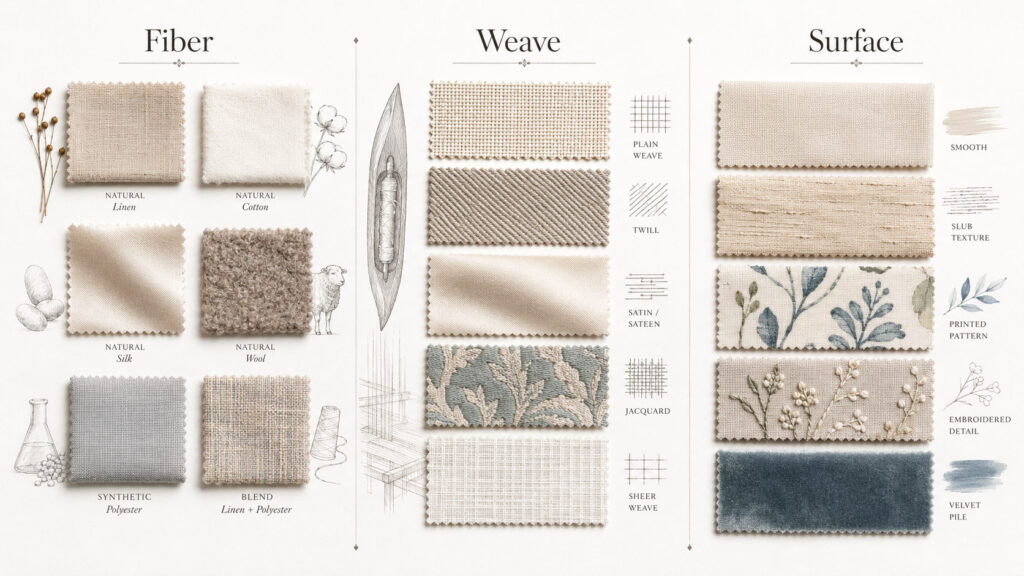
These three questions form a useful foundation for understanding fabric types in window treatments.
Fiber: What the Fabric Is Made From
Fiber is the starting point of a fabric’s character. It influences how a fabric feels, how it reflects light, how it responds to humidity and sunlight, and how stable or delicate it may be over time.
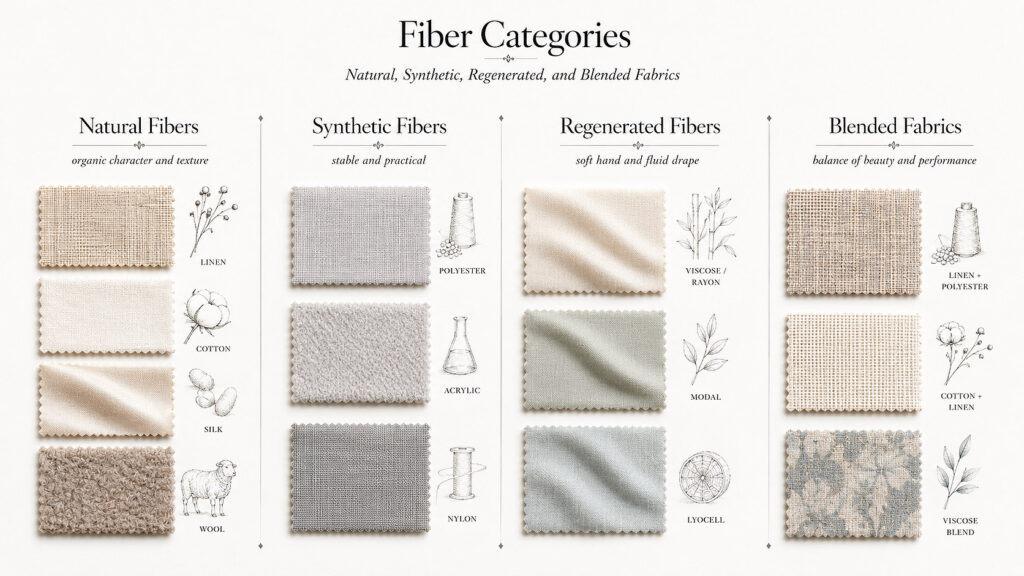
In window treatment fabrics, fibers are often described as natural, synthetic, regenerated, or blended.
Natural Fibers
Natural fibers include cotton, linen, silk, and wool.
Cotton often feels familiar, soft, and approachable. It can work beautifully in many light to medium-weight decorative fabrics, especially when a room calls for a relaxed or casual feeling. However, pure cotton may wrinkle, shrink, or fade more easily than some synthetic or blended fabrics.
Linen is one of the most loved fibers in window treatments because of its natural texture and quiet movement. Even in a plain color, linen can have depth because of the slight irregularity in the yarn. It brings softness without feeling overly formal. At the same time, linen can wrinkle, stretch, and react to changes in humidity. For this reason, many window treatment fabrics use linen blends rather than pure linen.
Silk has a refined sheen and a sense of elegance that is difficult to imitate. It can look especially beautiful in formal drapery. But silk is also sensitive. Sunlight, moisture, and abrasion can affect it over time, so silk window treatments usually require careful lining, thoughtful placement, and proper handling.
Wool is less common in everyday residential window treatments, but it can offer warmth, body, and a tailored quality. Wool blends may be used when a fabric needs a more substantial hand or a refined, structured appearance.
Natural fibers often bring character, texture, and a sense of authenticity. Their beauty lies partly in their variation. But that same natural quality also means they usually require more attention to fading, movement, shrinkage, and care.
Synthetic Fibers
Synthetic fibers include polyester, acrylic, nylon, and other man-made materials. Among them, polyester is by far the most common in window treatment fabrics.
Polyester is widely used because it is stable, durable, and generally easier to maintain. It resists shrinking better than many natural fibers and can be engineered into many different looks, from crisp sheers to textured linen-like fabrics and heavier decorative materials.
It is easy to assume that polyester is less refined than natural fiber, but that is not always true. The quality of a fabric depends not only on the fiber name, but also on the yarn, weave, finish, weight, and overall construction. A well-developed polyester blend can have good drape, texture, and practical stability.
Synthetic fibers are often valued for consistency. In window treatments, where large areas of fabric are cut, seamed, pleated, and hung, that consistency can be very useful.
Regenerated Fibers
Regenerated fibers include viscose, rayon, modal, and lyocell. These fibers are made from natural cellulose that has been processed and reformed into fiber.
They are often soft, smooth, and fluid. In decorative fabrics, viscose or rayon can add a gentle hand and a graceful drape. They may also soften the appearance of a blend and give the fabric a more relaxed movement.
However, regenerated fibers should still be considered carefully. Some can wrinkle, shrink, or lose stability when exposed to moisture. Their performance depends greatly on the weave, the blend, and the way the fabric is finished.
For window treatments, a soft hand is attractive, but softness alone is not enough. The fabric also needs enough structure to support the finished form.
Blended Fabrics
Many window treatment fabrics are blends. Linen-polyester, cotton-linen, viscose-linen, polyester-cotton, and many other combinations are common.
A blend is not simply a compromise. Often, it is a way to balance beauty and performance.
Pure linen may have wonderful texture but less dimensional stability. Adding polyester can make the fabric more practical. Cotton may feel soft and natural, but blending it with other fibers can improve drape or reduce wrinkling. Viscose may add softness and movement, while another fiber may provide structure.
This is why blended fabrics are so important in window treatments. They often sit between natural appearance and practical performance.
Weave: How the Fabric Is Built
Fiber tells only part of the story. The way a fabric is woven can change its character just as much.
Two fabrics may have the same fiber content but behave very differently because their structures are different. A polyester plain weave, a polyester satin, and a polyester jacquard are not the same fabric experience.
Weave is the structure that holds the yarns together. It affects the surface, body, texture, light reflection, and sometimes the stability of the cloth.
Plain Weave
Plain weave is one of the simplest and most common fabric structures. The yarns pass over and under each other in a straightforward pattern, creating a balanced surface.
In window treatments, many natural-looking fabrics, cotton-linen blends, and casual decorative fabrics use plain weave or a plain-weave-like structure. The result is often clean, quiet, and easy to understand.
A plain weave can look smooth and minimal, but it can also show texture when thicker yarns or slub yarns are used. This is why a plain linen-like fabric may still feel rich and layered, even without a printed pattern.
Twill Weave
Twill weave creates a diagonal line or subtle directional texture on the surface of the fabric. It often has more body than a plain weave and can feel slightly softer or more substantial.
In interiors, twill can be useful when a fabric needs quiet structure without too much decoration. It does not call attention to itself in the way a bold pattern might, but it gives the cloth more presence than a very flat surface.
For window treatments, twill fabrics can offer a good balance between softness and stability, depending on the fiber and weight.
Satin and Sateen Weaves
Satin and sateen weaves create a smoother surface with more visible sheen. Light moves across these fabrics differently, which can make them feel more formal or refined.
This sheen can be beautiful, but it also makes the fabric more sensitive visually. Creases, seam lines, directional shading, and slight differences in nap or light reflection may become more noticeable.
For large window treatments, this matters. When a fabric has a strong sheen, the cutting direction, panel matching, and handling become especially important.
Jacquard
Jacquard fabric is often misunderstood as simply “fabric with a pattern.” In fact, jacquard patterns are woven into the structure of the fabric rather than printed on the surface.
This gives jacquard fabrics depth. Even when the colors are subtle, the pattern may appear through changes in texture, light, and yarn direction.
Jacquards can be beautiful for drapery, valances, cornices, and more formal decorative treatments. But scale matters. A pattern that looks elegant on a small sample may feel too dense or too large when used across a full window. The repeat size, direction, and placement should always be considered.
Open Weaves and Sheer Structures
Some fabrics are woven with a more open structure, allowing light to pass through the cloth. Sheers, voiles, gauzes, and other open-weave fabrics belong to this world.
These fabrics are not mainly about blocking the view. They are about softening light, adding privacy during the day, and creating a layer between the room and the window.
Because they look light, they may seem simple. In practice, sheer and open-weave fabrics can be delicate to work with. They may stretch, shift, snag, or distort during cutting and sewing. The lighter the fabric, the more important its structure becomes.
Surface Character: What We See and Feel
The surface of a fabric is what we notice first when we stand near it. It may be smooth, slubby, matte, glossy, nubby, embroidered, printed, woven with pattern, or covered with pile.
But surface character does not come from one single source. It may come from the fiber, the yarn, the weave, the finishing process, or an added decorative technique.
Understanding this helps explain why two fabrics in the same color can feel completely different at the window.
Smooth Fabrics
Smooth fabrics have a clean, even surface. They can feel modern, tailored, or refined.
But a smooth surface also reveals more. Creases, seam impressions, slight puckering, and changes in light direction may be easier to see. For this reason, smooth fabrics are not always the easiest fabrics to fabricate well.
A quiet fabric can be demanding because there is less texture to hide small irregularities.
Textured Fabrics
Textured fabrics have visible yarn variation, surface irregularity, or a more tactile structure. Linen-like fabrics, slub fabrics, coarse weaves, and bouclé-inspired textures all fall into this broad category.
Texture can make a solid-colored fabric feel more alive. It can soften a room, add depth, and make large fabric surfaces feel less flat.
This is one reason textured fabrics are so useful in window treatments. Drapery panels and Roman shades often cover a large visual area. A little texture can make that surface more interesting without adding strong pattern.
However, texture needs balance. If a fabric is too loose, bulky, or irregular, it may not fold cleanly or hang as expected.
Printed Fabrics
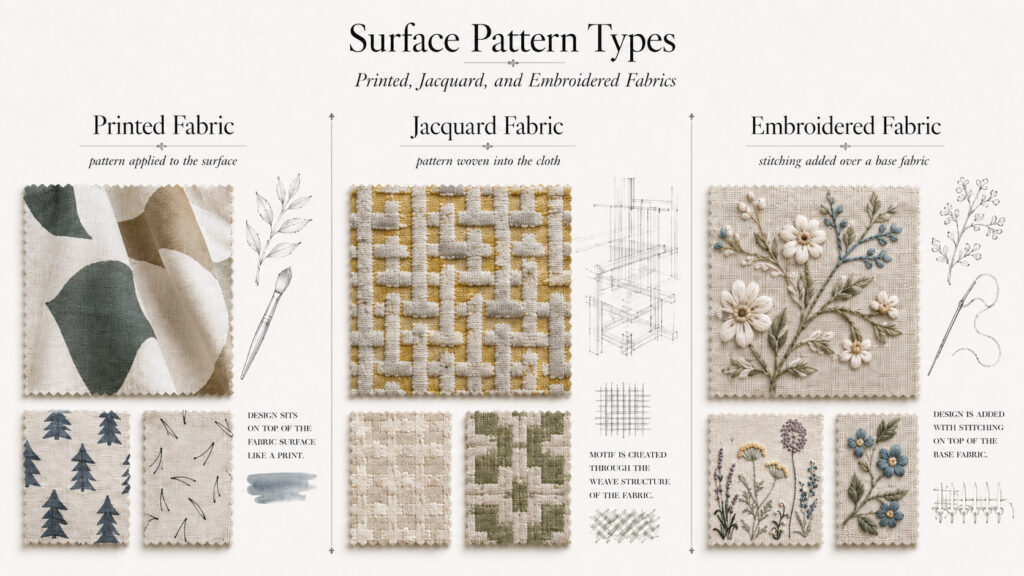
Printed fabrics receive their pattern through color applied to the surface of the cloth. This allows for a wide range of designs, colors, and styles.
In window treatments, printed fabrics can be expressive and beautiful. But they require attention to scale and repeat. A pattern that looks charming in a small memo sample may feel much stronger when repeated across a pair of drapery panels.
Pattern direction and matching also matter. Large-scale prints, stripes, and directional motifs should be planned carefully before cutting.
A printed pattern sits on the surface. This makes it different from a jacquard pattern, which is built into the fabric structure.
Jacquard Fabrics
Jacquard fabrics create pattern through weaving. The design is part of the cloth itself.
Because of this, jacquards often have a richer surface than printed fabrics. The pattern may appear through raised texture, contrast yarns, or subtle changes in sheen.
In window treatments, jacquard fabrics can add formality, depth, and decorative interest. But because the pattern is structural, it can also affect the weight, drape, and directionality of the fabric.
Embroidered Fabrics
Embroidered fabrics begin with a base cloth, then add pattern with stitching. This creates a raised, decorative surface that feels more dimensional than print.
Embroidery can bring a handmade or highly detailed quality to a window treatment. It may work especially well as a border, a lower edge detail, a valance fabric, or a special accent on a Roman shade.
But embroidered fabrics need careful planning. The weight of the stitching, the stability of the base fabric, and the placement of the motif all affect the final result. A beautiful embroidered sample may not work well if the motif falls awkwardly after the fabric is cut.
Velvet and Pile Fabrics
Velvet has a pile surface, which means the face of the fabric is covered with short, dense fibers. This gives velvet its depth, softness, and dramatic color variation.
Velvet can make window treatments feel rich and substantial. It absorbs and reflects light in a way that gives color more depth.
But velvet also has direction. The nap can make the same fabric look lighter or darker depending on how it is turned. If panels are cut in different directions, the difference may be very visible.
Velvet is also heavier than many other decorative fabrics. Its weight should be considered in relation to the hardware, pleating style, lining, and overall window treatment design.
Seeing the Three Layers Together
Fiber, weave, and surface character are separate ways of understanding fabric, but in real life they always work together.
A fabric may be made from polyester, but it could be a plain weave, a satin, a jacquard, or a sheer.
A fabric may look like linen, but it could be pure linen, a linen blend, or a linen-look synthetic.
A fabric may have a pattern, but that pattern may be printed, woven, or embroidered.
This is why a single fabric name rarely tells the whole story.
A more complete description might sound like:
“a linen-blend plain weave with slub texture”
“a polyester jacquard with a subtle sheen”
“a cotton ground with embroidered detail”
“a sheer open weave with a soft hand”
These descriptions help us see the fabric more clearly. They tell us not only what the fabric looks like, but how it is made and why it behaves the way it does.
Before Choosing, Learn to Read the Fabric
Choosing fabric for window treatments does not begin only with color. Color and pattern may create the first attraction, but fiber, weave, and surface character shape the deeper nature of the cloth.
They influence how the fabric feels in the hand, how it catches light, how it falls, how it folds, and how it may perform over time.
For drapery, Roman shades, sheers, valances, and cornices, fabric is both a visual material and a construction material. It must look beautiful, but it must also respond well to cutting, sewing, lining, pleating, folding, and hanging.
Learning to read fabric through fiber, weave, and surface is a simple but important first step. It helps us move beyond the first impression and understand what the fabric is really telling us.
Related Notes
Understanding Drapery Lining, Blackout Lining & Interlining
A closer look at lining, blackout lining, and interlining, and how these layers influence the structure, light control, and finished performance of drapery.
Read the article →
Fabric Seams in Roman Shades: Why Planning Matters on a Flat Surface
An exploration of how fabric width, seams, pattern placement, and construction decisions affect the finished appearance of Roman shades.
Read the article →
Ripplefold vs. Wave Curtain Systems: Fullness and Space Planning
A comparison of two wave-style drapery systems, including how fabric behavior, fullness, spacing, and system structure influence the finished treatment.
Read the article →
Drapery Design – A Visual Guide
A visual study of drapery design choices, including proportions, styles, layering, decorative details, and fabric applications.
Read the article →