
A custom canopy bed brings several fabric elements together within a single architectural framework. While the finished design may appear seamless, achieving that effect requires careful consideration of fabric selection, fabrication methods, mounting arrangements, and concealed hardware.
This case study explores the development of a decorative canopy bed design, with particular attention to the radial pleated ceiling treatment and its installation concept.
1. The Design Request
The design began with a client’s request for a decorative canopy bed treatment that would create a soft, elegant, and enclosed atmosphere within the bedroom.
The proposed design features a radial pleated fabric ceiling, a tailored valance around the upper perimeter, decorative corner curtains, and separate drapery behind the headboard.
The main consideration was how to bring these elements together while allowing each component to be fabricated and installed independently.

The proposed canopy bed design, highlighting the four main decorative elements.
2. Design Components & Fabric Coordination
The design was divided into four principal fabric elements.
1. Radial Pleated Ceiling Canopy
A lightweight ivory fabric creates the radial pleats, drawing the eye toward a central decorative feature.
2. Tailored Valance
A muted blue-gray fabric defines the upper perimeter, finished with a contrasting beige decorative border.
3. Decorative Corner Curtains
Coordinating blue-gray curtain panels repeat the decorative border used on the valance. An ivory-colored lining provides a softer appearance when viewed from inside the canopy.
4. Headboard Backdrop Drapery
Separate ivory drapery panels create a soft backdrop behind the upholstered headboard, complementing the ceiling treatment.
The restrained combination of ivory, muted blue-gray, and decorative borders connects the individual components without overwhelming the overall design.
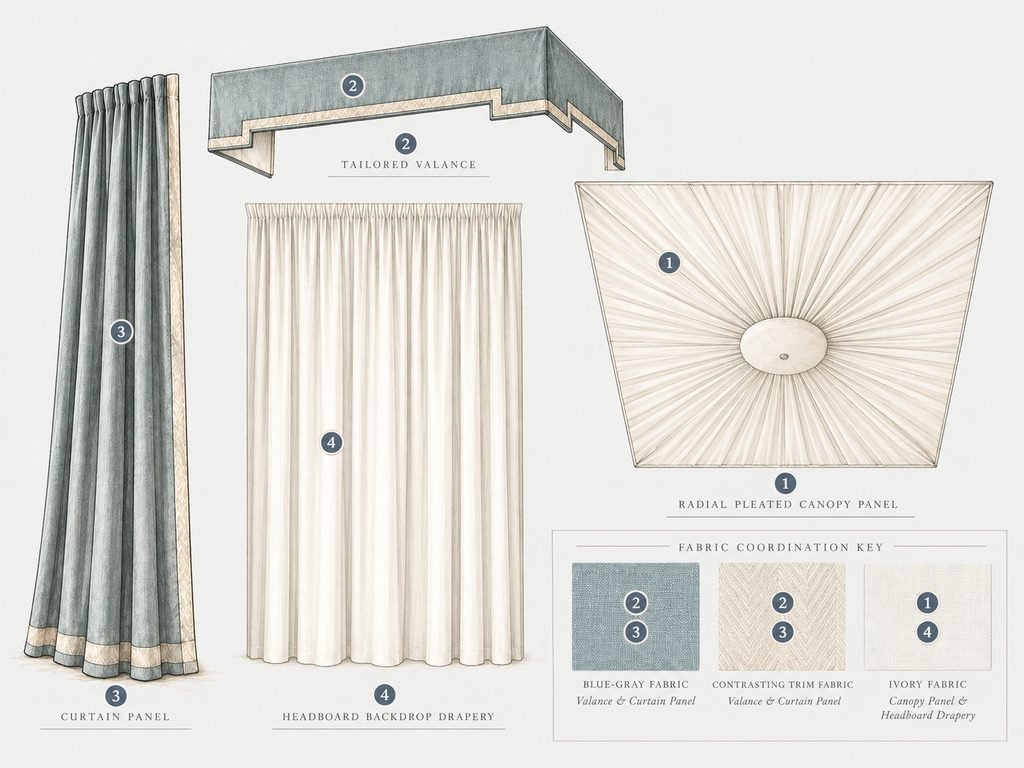
Individual fabric elements and their coordinated fabric and border selections.
3. Radial Pleated Canopy – Fabrication Study
The radial pleated ceiling presented the most interesting fabrication challenge in this project.
Rather than constructing the ceiling as one large fabric piece, we explored a four-panel approach. Each section can be prepared separately and installed around a shared central mounting point.
Fabric Selection and Fullness
A relatively lightweight fabric was selected to create soft, continuous pleats while minimizing the weight of the ceiling treatment.
For the fabrication sample, we used 2.0× gathering fullness.
For example, a finished outer attachment edge measuring 2.2 m (approximately 86.6 inches) was formed by gathering approximately 4.4 m (173.2 inches) of fabric width. Narrow hems were used for the fabric edges.
Based on this sample, a gathering ratio of approximately 1.5×–2.0× may provide a useful starting range for similar lightweight radial treatments, depending on the fabric characteristics and desired appearance.
Four-Panel Construction
Each panel is gathered along its outer attachment edges, while the fabric converges toward a central circular wooden board.
The fabric is secured to this central board, creating the characteristic radiating pleats.
The four sections are designed to be installed individually, with slight overlaps between adjacent panels to help maintain visual continuity.
The central board is prepared with mounting holes before fabrication and finished with coordinating fabric.
Once the four panels are installed, a separate decorative circular cover, slightly larger than the functional mounting board, conceals the fabric attachment points and installation hardware.
The cover is designed with hook-and-loop fastening around its perimeter and a central screw connection for additional security. A matching fabric-covered button conceals the screw head.

A fabrication sample demonstrating 2.0× gathering fullness and the radial arrangement of fabric around the central mounting board.
4. Ceiling Installation Concept
To accommodate the different fabric components, the mounting arrangement was developed as a series of independent layers.
A Layered Mounting System
Working from the outer perimeter toward the center, the proposed system consists of three primary elements:
- Outer Valance Track — supports the decorative valance around the upper perimeter.
- Inner Curtain Track — supports the decorative corner curtains and headboard backdrop drapery.
- Wood Mounting Frame — provides a separate attachment surface for the radial ceiling panels.
A wooden frame is positioned inside the curtain track.
The design provides an attachment surface approximately 25 mm (1 inch) wide, corresponding to the width of the proposed hook-and-loop tape.
The gathered outer edges of the radial canopy panels attach to the underside of this wooden frame, while the central mounting board is secured separately to an appropriate supporting structure.
This arrangement allows the valance, curtains, and radial ceiling treatment to be installed without relying on a single shared attachment system.
Concealing the Inner Track
An additional consideration was the appearance of the ceiling when viewed from the bed.
To conceal the curtain track and adjacent mounting hardware, we introduced an inner concealment valance along the inside edge of the wooden frame.
This narrow fabric drop can be finished flat or lightly gathered, using fabric coordinated with the radial ceiling.
Its purpose is to create a clean transition between the pleated ceiling and the surrounding drapery, while keeping the installation components out of direct view.
Finishing the Center
The central decorative cover provides the final finishing detail.
By separating the functional mounting board from its decorative cover, the installation points remain accessible during assembly, while the finished ceiling retains a clean central focal point.
The proposed attachment method also allows the decorative cover to be removed when access to the mounting hardware is required.
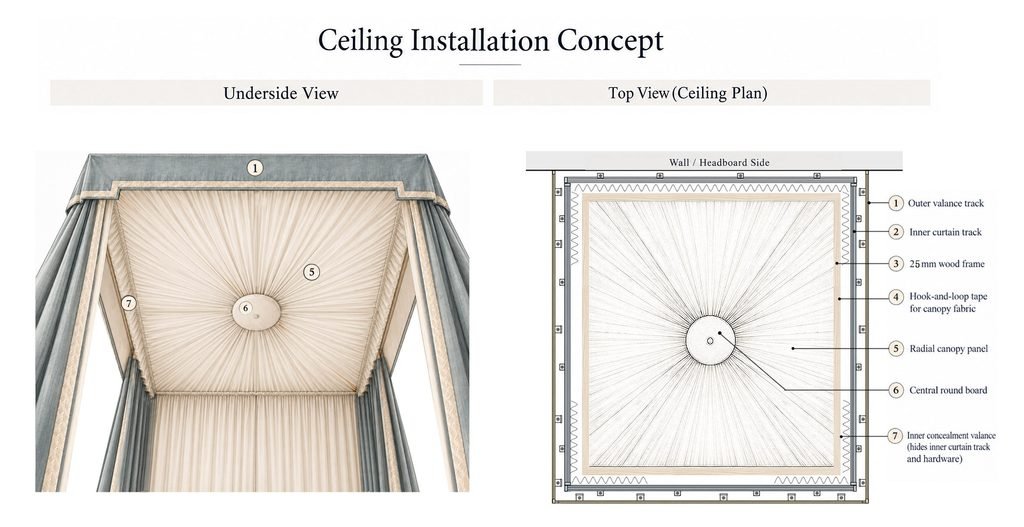
The underside view illustrates the finished appearance, while the ceiling plan identifies the separate tracks, wooden frame, radial fabric attachment, central mounting board, and concealed inner valance.
5. Design Reflection
The main objective of this study was to translate a visually complex canopy bed design into a series of manageable fabric components.
The four-panel radial ceiling, independent curtain and valance tracks, concealed mounting frame, and removable central decorative cover were developed to balance the intended appearance with practical fabrication and installation considerations.
An initial radial fabric sample has been completed, while the full mounting arrangement remains a proposed solution requiring further installation testing.
This project illustrates an important aspect of custom soft furnishing design: the finished appearance is only one part of the process. Fabric behavior, construction methods, mounting conditions, and access for future maintenance all contribute to a successful design.