
Decorative borders are one of the most versatile finishing details used in window treatments. Unlike fringe, which adds movement and drop, a border usually works through a continuous line—defining an edge, introducing contrast, adding pattern, or giving a treatment a more finished appearance.
On drapery panels, Roman shades, valances, cornices, and other soft furnishings, a border can be almost understated or become a strong visual feature. Its effect depends on width, pattern, material, contrast, and where it is placed within the design.
This article looks at several decorative border styles commonly seen in window treatments, along with their applications, visual effects, and a few practical details to consider at corners and junctions.
Common Decorative Border Styles
Market terminology varies considerably between trim manufacturers. Borders may be named according to pattern, material, construction, or decorative technique, so the examples below are best understood as selected styles and commonly used market terms rather than a fixed industry classification.

Greek Key Border
Recognized by its repeating geometric motif, a Greek key border creates a strong, structured line. It works particularly well where the edge or corner of a treatment needs clear definition.
Botanical Border
Botanical borders feature flowers, foliage, vines, or other plant-inspired motifs. They tend to feel softer and more decorative and are often at home in traditional, English country, or transitional interiors.
Striped Border
Striped borders are simple and highly adaptable. Depending on scale and color contrast, they can feel casual, tailored, classic, or contemporary.
Embroidered Border
Embroidery adds texture and dimension to the surface of the trim. An embroidered border can be subtle and refined or become a stronger decorative feature depending on the scale of the motif.
Braided Border
Braided borders rely more heavily on construction and texture. Their woven or braided structure gives the edge more physical presence than a flat tape.
Velvet Border
Velvet borders create contrast primarily through material and depth of color rather than pattern. Even a simple solid velvet border can add richness and visual weight.
Appliqué Border
Appliqué borders use applied or cut elements to create decorative motifs. They often have more dimension than a standard woven or embroidered tape and can become a distinctive statement detail.
Tape Border
Tape border is a broad term for a relatively flat, regular decorative band. It may be solid, striped, geometric, or lightly textured and is one of the most flexible forms for everyday use.
Where Decorative Borders Are Applied
Decorative borders are most effective when they reinforce the structure of the treatment rather than simply sitting on top of it.

On drapery panels, the leading edge is one of the most common placements. A border here strengthens the vertical line of the panel and can make a simple treatment feel more tailored.
On Roman shades, borders are often used along the side edges, the bottom edge, or both. Side borders create a framed effect, while a bottom border works more like a finishing line.
On valances and cornices, a border can follow the lower edge to reinforce the silhouette or create separation between the main fabric and the edge detail.
The same border can also be repeated on pillows or used more lightly on sheer panels. In these secondary applications, the goal is often coordination rather than emphasis.
How Decorative Borders Change the Look
The width, pattern, and contrast of a border can change the character of the same treatment quite dramatically.

Without a border, a Roman shade usually feels quieter and more dependent on the fabric itself.
A narrow border introduces definition without taking over the design. It can make the shade feel more tailored and finished while still keeping the overall look restrained.
A wider patterned border creates a stronger visual focus. It adds more decorative character and can shift attention toward the edge of the treatment.
The important point is not that a wider border is necessarily better or more formal, but that width and contrast change the visual balance of the treatment.
Drapery: A Different Effect
The same principle applies to drapery, although the visual result is different.
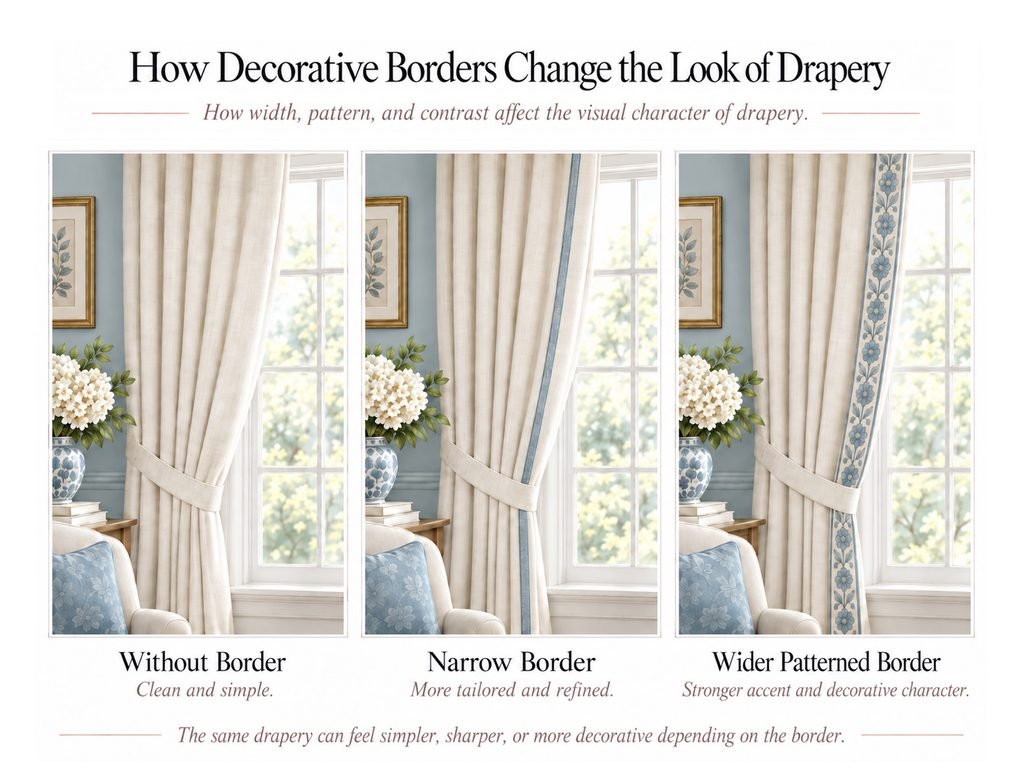
On drapery, the leading edge naturally creates a strong vertical line. A narrow border can sharpen that line and make the panel feel more refined.
A wider patterned border has more presence and may become an important part of the overall composition. Because drapery already has movement and fullness, the scale of the border usually needs to be judged carefully so that it supports the panel rather than overpowering it.
This is one reason border size and placement should be considered in relation to the treatment itself, rather than chosen in isolation.
Corner & Junction Treatments
When a decorative border runs both vertically and horizontally, the corner becomes an important part of the finished design.
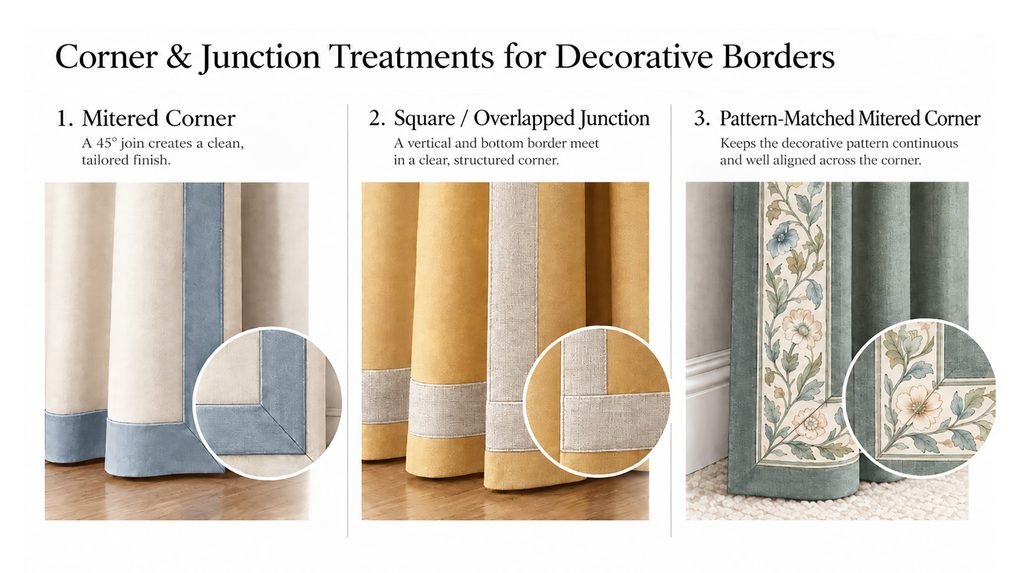
Mitered Corner
A mitered corner uses a 45° joint to create a clean, tailored turn. With a solid or relatively simple border, the focus is on the geometry of the corner itself.
This approach works especially well when a crisp, structured finish is desired.
Square / Overlapped Junction
A square or overlapped junction allows the vertical and bottom borders to meet at a right angle.
Instead of creating a diagonal seam, one border meets or overlaps the other in a clearly defined corner. This can work well with wider trims, thicker constructions, or directional patterns where a miter is less practical.
Pattern-Matched Mitered Corner
When the border has a noticeable motif or repeat, a mitered corner may also need pattern matching.
In this case, the goal is not only to create the 45° joint, but also to keep the decorative motif aligned so that the turn feels intentional rather than interrupted.
The material, thickness, repeat, and direction of the border all affect which corner treatment will work best.
Final Thoughts
Decorative borders may appear to be a small detail, but they can influence proportion, outline, contrast, and the overall character of a window treatment.
A narrow border can quietly sharpen a design, while a wider or more decorative border can become a stronger visual feature. What matters most is how the border relates to the fabric, treatment scale, placement, and the decorative level of the room.
The finishing details matter as well. Corners and junctions often reveal whether a border feels fully integrated into the design or simply added afterward.
For me, the most successful border is usually the one that feels intentional—clear enough to contribute something to the treatment, but still in balance with the fabric and the room around it.