
Decorative cord is a small but useful finishing detail in window treatments and soft furnishings.
Unlike a decorative border, cord usually does not occupy much visual space. Instead, it tends to appear along edges, seams, or transitions between fabrics, where it adds a fine raised line, helps define a junction, or gives the treatment a more finished appearance.
Decorative cords come in several forms. Some are used as standalone surface-applied details, while others include a tape that allows them to be sewn neatly into a seam. Piping and welt create a similar raised edge through a more structured sewn-in construction.
This article looks at several common cord structures, typical applications, and the difference between self welt and contrast welt.
Common Decorative Cord Structures
Terminology varies between trim manufacturers and workrooms, so terms such as cord, cord with tape, piping, and welt are not always used in exactly the same way. It is often more useful to understand them by construction and application.
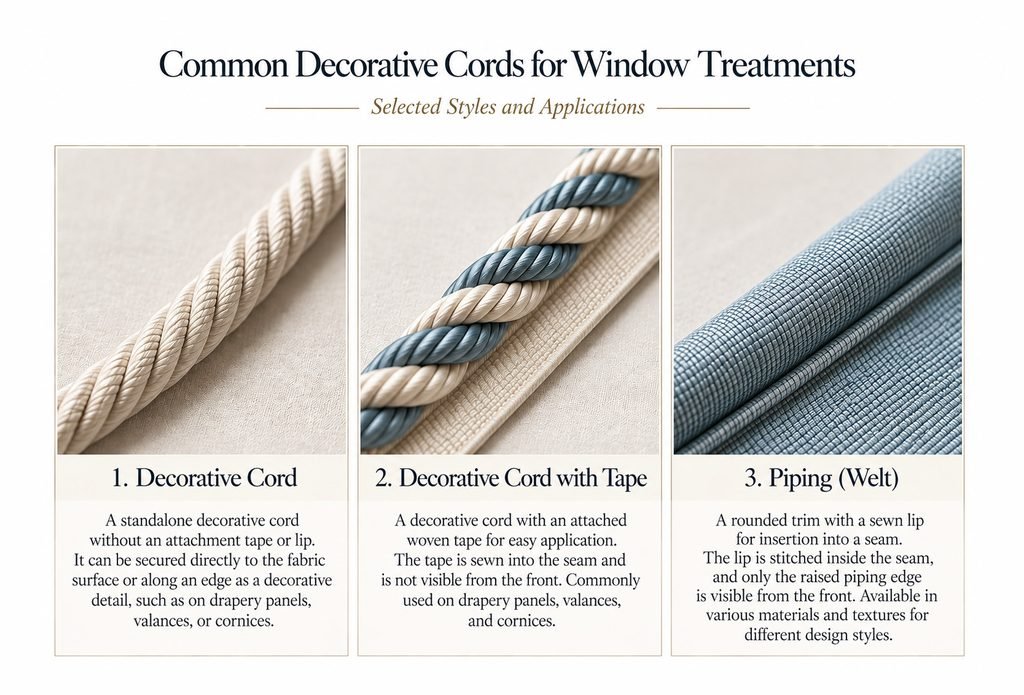
Decorative Cord
A decorative cord can be used as a standalone trim without an attachment tape or sewing lip.
It may be secured directly to the fabric surface or along an edge to create a fine decorative line. Depending on the design, it can also follow curves, shaped details, or other decorative elements.
Its main role is as a relatively flexible, surface-applied detail rather than something that must be inserted into a seam.
Decorative Cord with Tape
This type of decorative cord has a woven tape attached behind the visible cord.
During fabrication, the tape is usually sewn into a seam or secured within the construction, so the cord itself remains the main visible element from the front.
This structure makes it easier to incorporate cord neatly into drapery, valances, cornices, and other soft furnishings.
Piping / Welt
Piping or welt usually appears as a narrow, rounded, slightly raised edge.
It includes a sewing lip that is inserted into a seam, leaving only the rounded piping edge visible from the front.
Piping may be purchased as a finished trim or custom-made by the workroom using self or contrast fabric.
Where Decorative Cords Are Used
Decorative cord is usually a supporting detail rather than the main visual feature of a treatment. It works especially well along edges, seams, and transitions between fabrics.
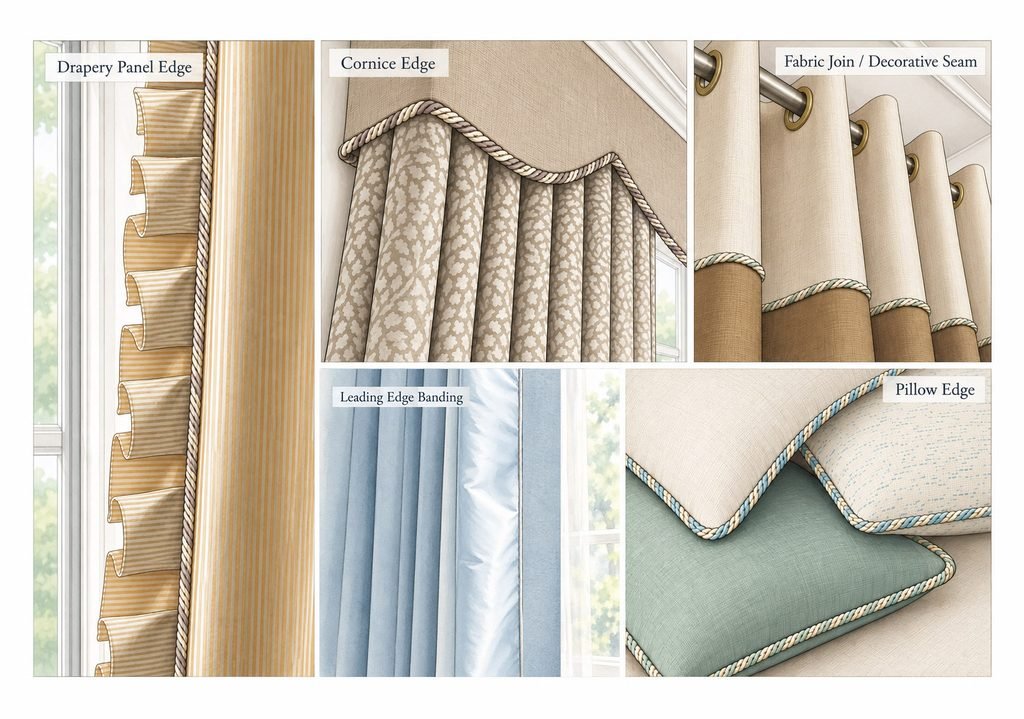
Drapery Panel Edges
On drapery panels, decorative cord can be used along panel edges or at transitions between decorative fabrics.
Because the cord is relatively narrow, it does not usually change the scale of the panel in the way a wider border can. Instead, it adds a subtle raised line that helps the edge feel more complete.
Leading Edge Banding
When banding, contrasting fabric, or layered fabric is used along the leading side of a drapery panel, cord can be placed between the two materials.
This helps define the transition and gives the banding a more deliberate, finished appearance.
Fabric Joins and Decorative Seams
Cord can also be introduced where two fabrics meet.
A simple join can become a decorative seam, while the cord creates a clearer separation between different colors, textures, or patterns.
Valances and Cornices
Cord works well along the lower edge, shaped edge, or other outlines of valances and cornices.
On curved, scalloped, or shaped profiles, a narrow cord can reinforce the silhouette without adding the visual weight of a wider trim.
Pillows and Coordinating Soft Furnishings
The same cord can be repeated on pillows, cushions, and other soft furnishings.
This allows window treatments and surrounding textiles to share the same trim language, creating a subtle sense of coordination within the room.
Self Welt and Contrast Welt
Welt can also be used in two visually different ways: self welt and contrast welt.
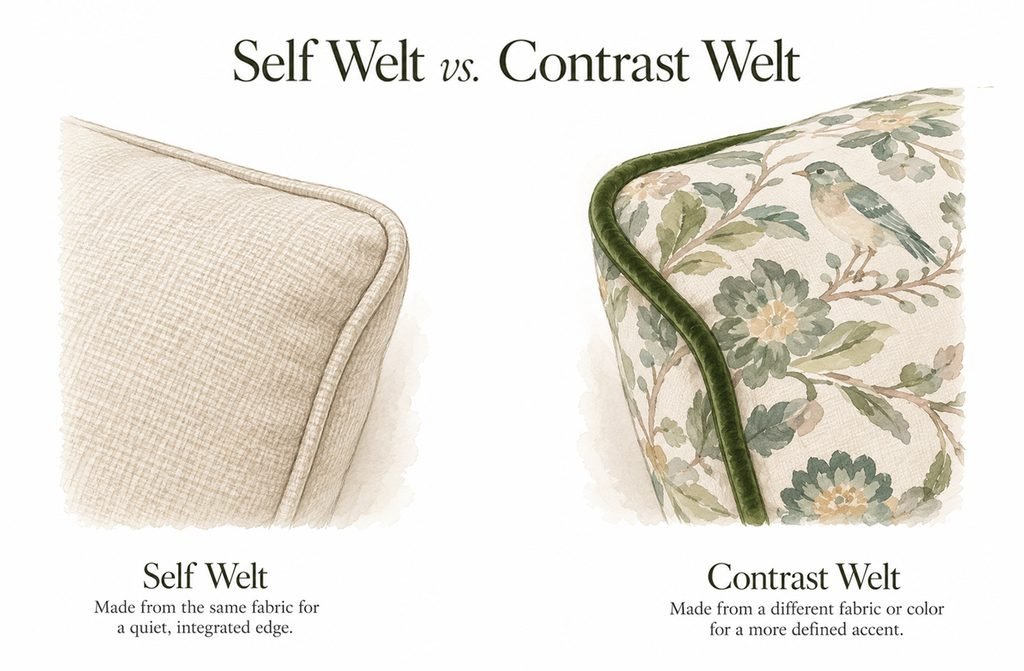
Self Welt
Self welt is made using the same fabric as the main treatment or furnishing.
Because the material and color match the surrounding fabric, the edge remains relatively quiet and integrated.
The emphasis is on structure and finish rather than introducing an additional color or pattern.
Contrast Welt
Contrast welt uses a different fabric, color, or texture.
The construction is essentially the same, but the contrast makes the edge more visible and decorative.
The difference between the two is therefore primarily visual:
Self welt emphasizes integration, while contrast welt emphasizes definition.
Cord as a Supporting Detail
Decorative cord rarely needs to become the visual center of a window treatment.
Its strength is usually in the way it supports other elements:
- along panel edges
- between banding and the main fabric
- at fabric joins
- along shaped valance or cornice edges
- on pillows and coordinating soft furnishings
The cord may occupy only a very small area, but it can make a seam, edge, or transition feel more intentional and complete.
This is one of the main differences between cord and more visible decorative trims such as wider borders or fringes.
Borders and fringes are often noticed immediately. Cord is usually quieter, acting more like a fine connecting line within the overall design.
Final Thoughts
The value of decorative cord is usually not in becoming the main feature, but in the way it handles edges, seams, and transitions between materials.
Standalone decorative cord can be used as a surface-applied detail. Cord with tape can be incorporated neatly into a seam. Piping and welt create a more structured rounded edge.
Self welt and contrast welt then offer two different visual directions—one allowing the edge to blend into the main fabric, the other giving it a clearer decorative emphasis.
These details may be small, but in custom window treatments, they often contribute significantly to how complete and coordinated the finished design feels.