
Drapery length may seem like a simple measurement decision, but even a small change at the hem can noticeably affect how a window treatment looks and functions.
A curtain ending around the windowsill feels very different from one hovering just above the floor. And among floor-length treatments, the difference between Float, Kiss, Break, and Puddle may be only an inch or two, yet the finished appearance can change considerably.
I have touched on drapery length in earlier articles about design and measuring. Here, I wanted to look at this subject on its own and organize six common approaches:
Sill, Apron, Float, Kiss, Break, and Puddle.
A Note on the Measurements
I reviewed published measuring and design guidance from established window-treatment and home-furnishing brands when compiling the reference ranges below.
These dimensions are best understood as practical starting points rather than fixed industry standards.
Individual brands, workrooms, and designers may define their own allowances based on product construction, fabric behavior, installation method, sill or floor conditions, and the intended visual effect.
| Drapery Length | Practical Reference | Visual Relationship |
|---|---|---|
| Sill | About 1/2 in. above the sill to 1 in. below the sill | Finishes within the sill area |
| Apron | About 3–4 in. below the sill | Clearly extends below the sill while remaining a short treatment |
| Float | About 1/2–1 in. above the floor | Approaches the floor without touching |
| Kiss | At floor level; no intentional clearance or excess | Just touches the floor |
| Break | About 1–2 in. of extra length | Touches the floor and develops a soft bend |
| Puddle | About 3–8 in. of extra length | Creates visible fabric pooling on the floor |
The ranges overlap slightly with the terminology used by different companies. That is normal. What matters is that the measurement and the intended finished appearance are defined together.
1. Sill Length
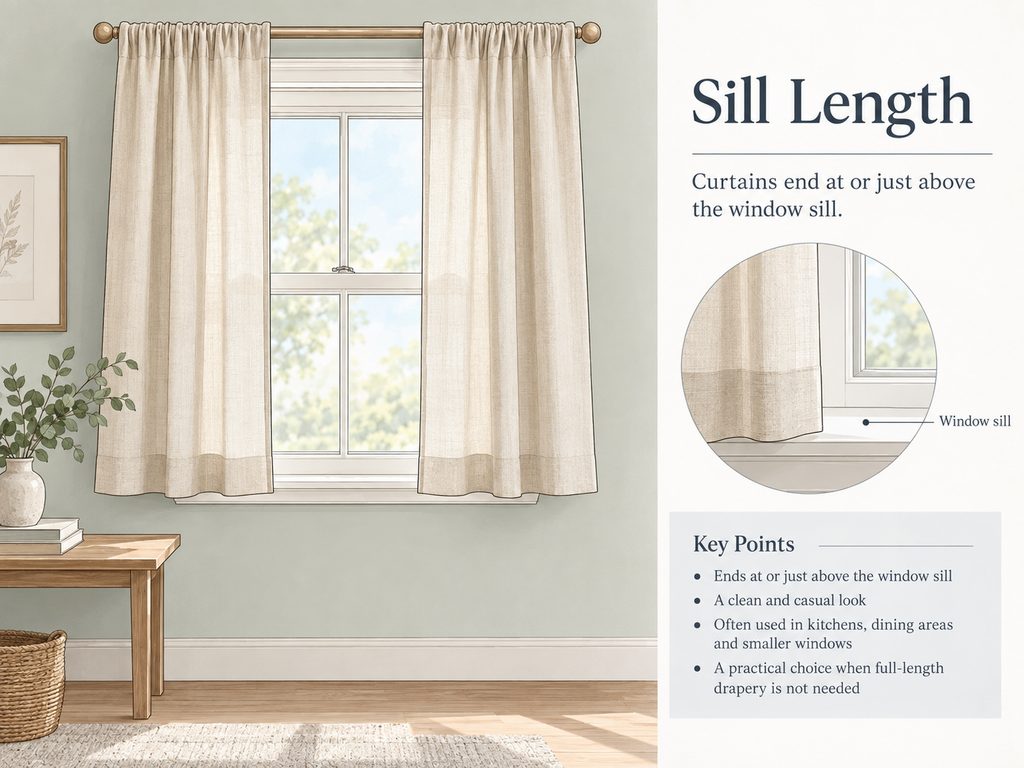
Sill Length finishes around the windowsill.
It may stop slightly above the sill, meet it, or extend just below it. I find it more useful to think of Sill Length as a small zone around the sill rather than one exact measurement.
Published guidance supports this broader interpretation: sill-length treatments are commonly described as ending at the sill, while some measuring guides allow the hem to extend slightly below it.
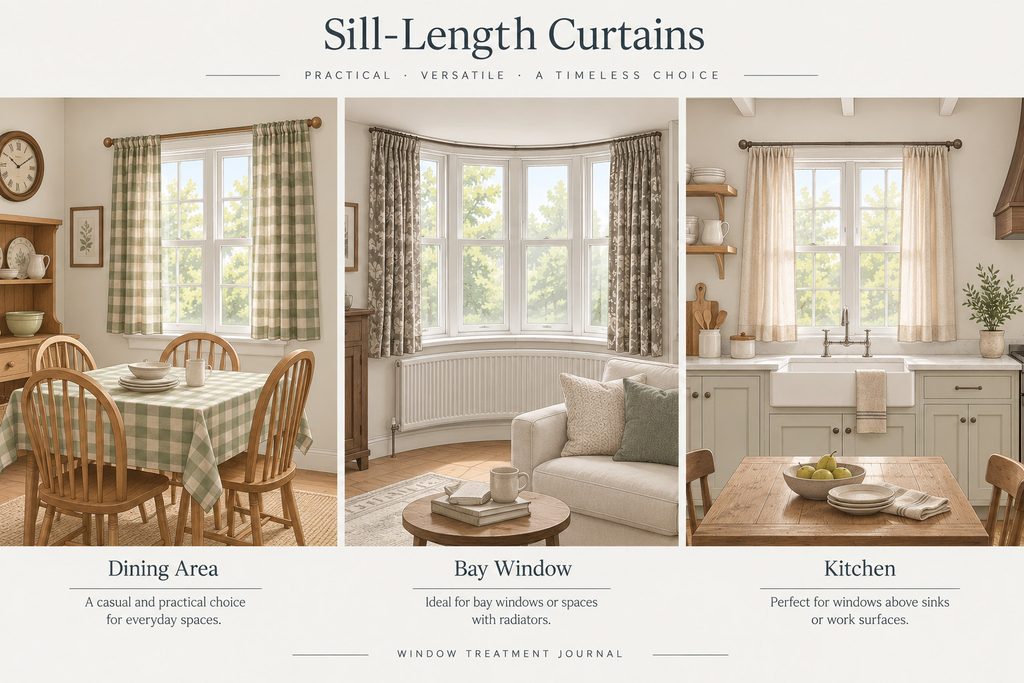
This length tends to feel lighter and more casual than floor-length drapery. It often works well in kitchens, breakfast areas, small dining spaces, or wherever a countertop, cabinet, window seat, or other fixed element makes full-length curtains impractical.
The depth of the sill also matters. A hem resting directly against a deep sill may rub during use, while one that finishes too far away can begin to look unintentionally short.
The goal is simply to keep the hem visually connected to the sill.
2. Apron Length
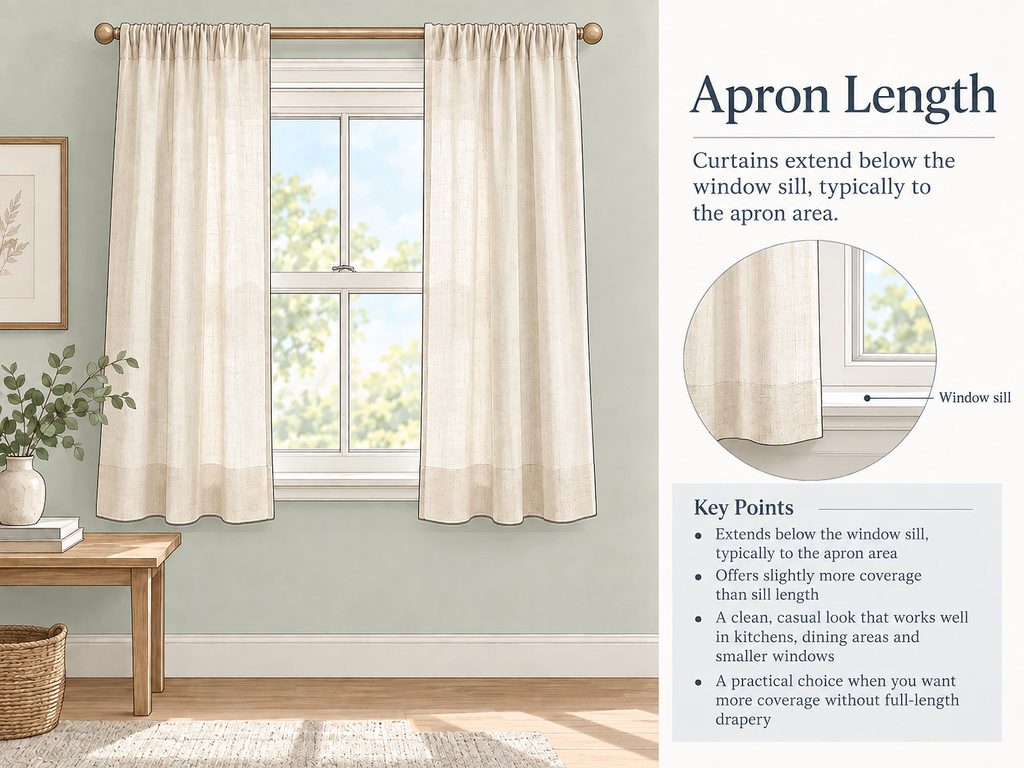
Apron Length extends past the sill and finishes farther down the wall, around the apron area below the window.
It is still a short treatment, but compared with Sill Length it gives the window a little more vertical weight.
A useful reference is approximately 3–4 inches below the sill. West Elm, for example, illustrates Apron Length at 4 inches below the sill.
In practice, Apron Length works best when it reads clearly below the sill rather than looking like a slightly long Sill treatment.
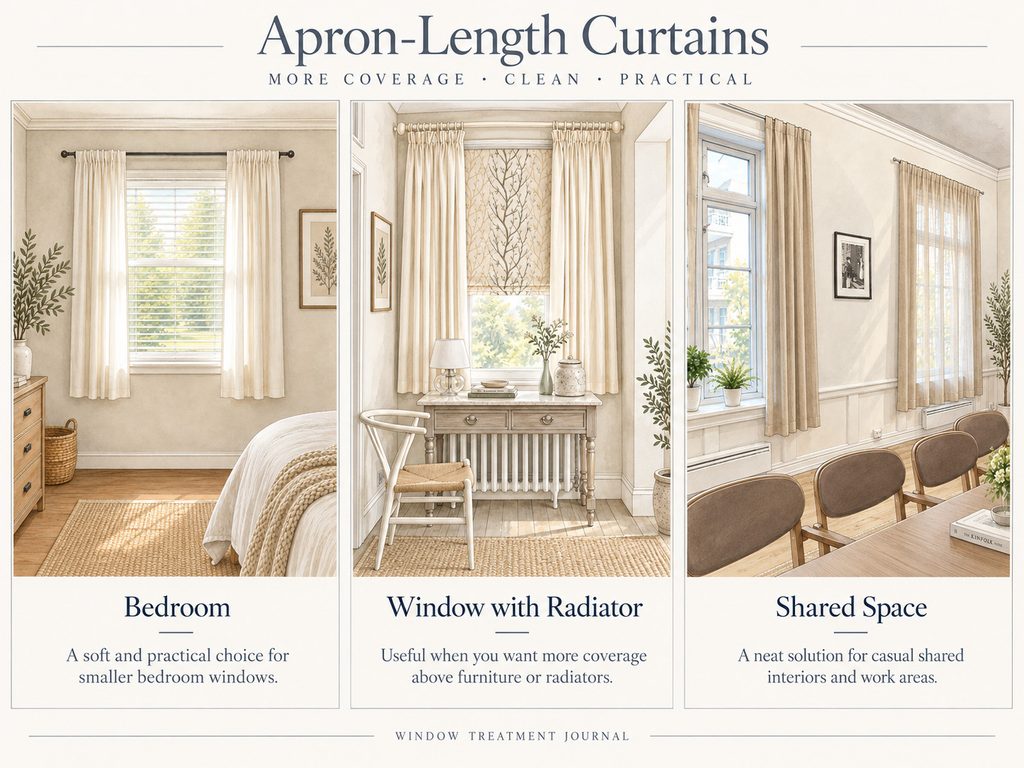
It can be useful where radiators, low furniture, or other obstructions make floor-length drapery less practical.
Window proportion matters here. If the hem extends too little, Sill and Apron become visually difficult to distinguish. If it drops too far, the treatment can begin to look like floor-length drapery that simply came up short.
3. Float Length
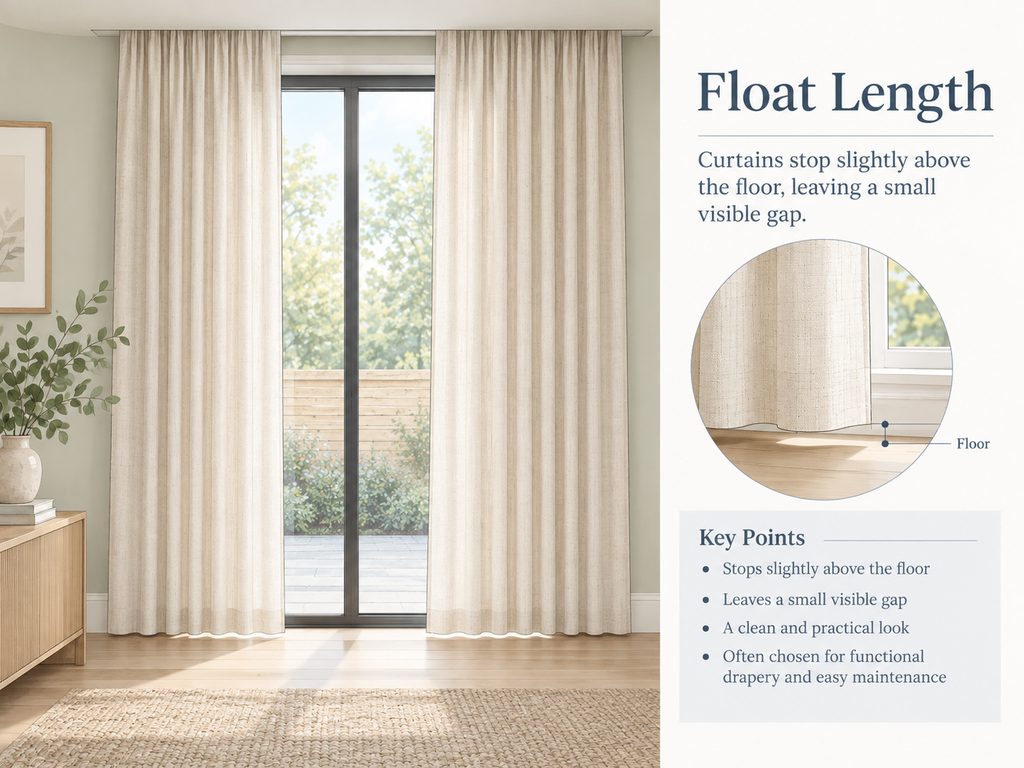
With Float Length, we move into floor-length drapery.
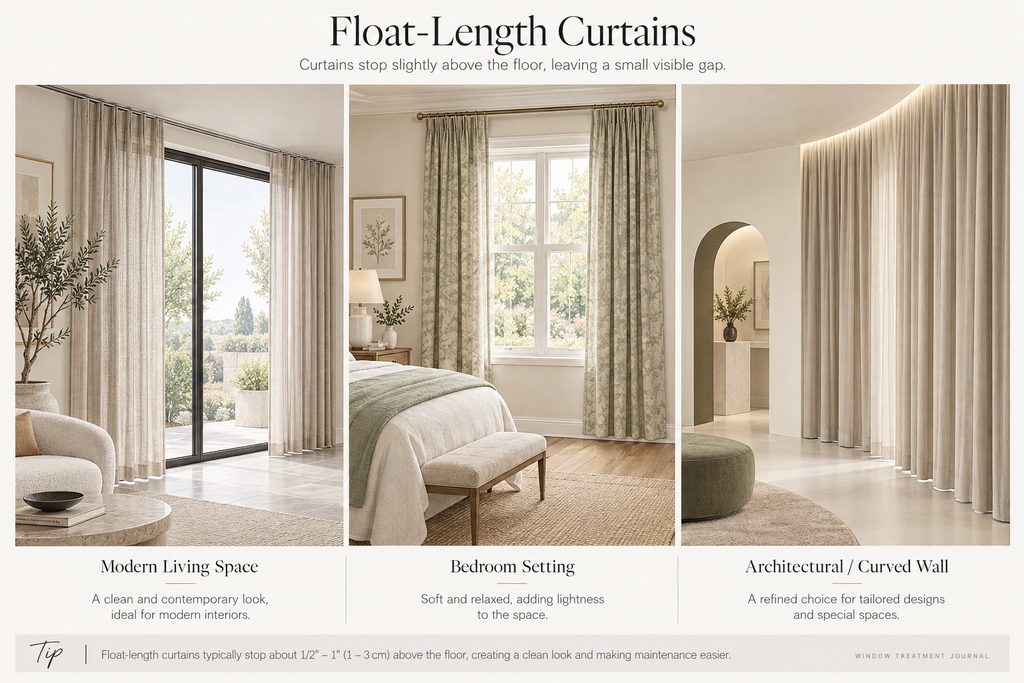
The hem approaches the floor but stops just short of touching it.
For this article, I am using approximately 1/2–1 inch above the floor as a practical reference range. The Shade Store commonly recommends about 1/2 inch of clearance, while Pottery Barn also uses 1/2 inch for a clean, frequently operated drape.
For everyday functional drapery, Float is often one of the most practical choices.
Because the hem stays clear of the floor, the panels are easier to operate and less exposed to dirt, abrasion, or being stepped on. It can also be useful in homes where cleaning, pets, or frequent opening and closing are part of daily use.
Float is slightly more forgiving of uneven flooring as well. A deliberate clearance can absorb small variations that would be much more noticeable with an exact floor finish.
Visually, the result is clean, tailored, and relatively light.
4. Kiss Length
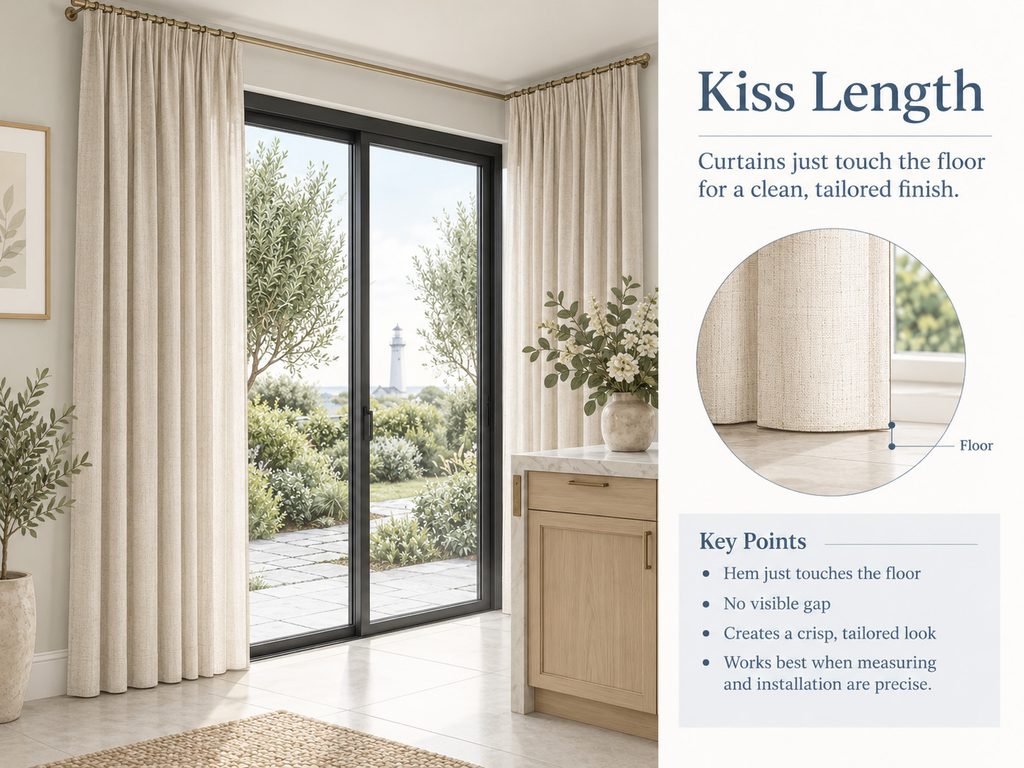
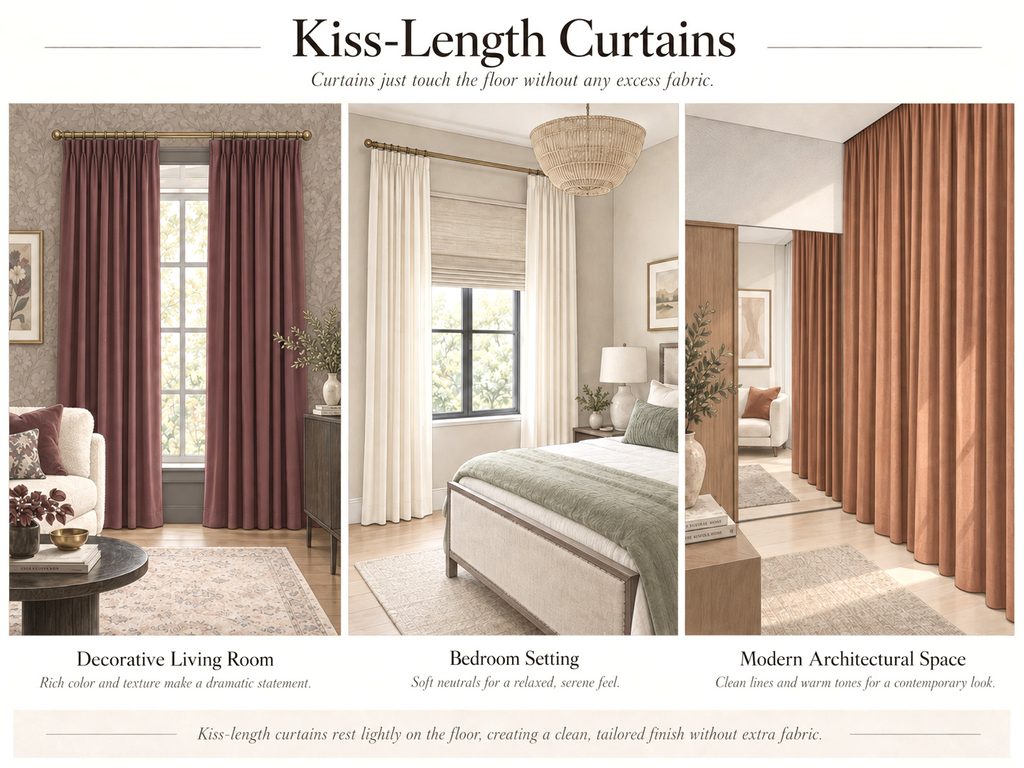
Kiss Length describes a hem that just meets the floor, without a visible gap and without intentional extra fabric.
A simple way to think about it is:
finished at floor level
Not every brand uses “Kiss” as a separate formal category. Some simply describe this appearance as floor-length drapery that “just touches the floor.” Pottery Barn uses that wording in its length guidance.
The visual difference between Float and Kiss may be small, but the installation tolerance is not.
The finished result depends on the actual rod or track height, floor level, hook or carrier position, fabric relaxation, and even what happens after steaming and dressing.
A little short, and the treatment reads as Float. A little long, and the hem begins to develop a Break.
When it is executed accurately, Kiss gives a very complete and polished floor finish—no visible clearance and no fabric pooling at the base.
5. Break Length
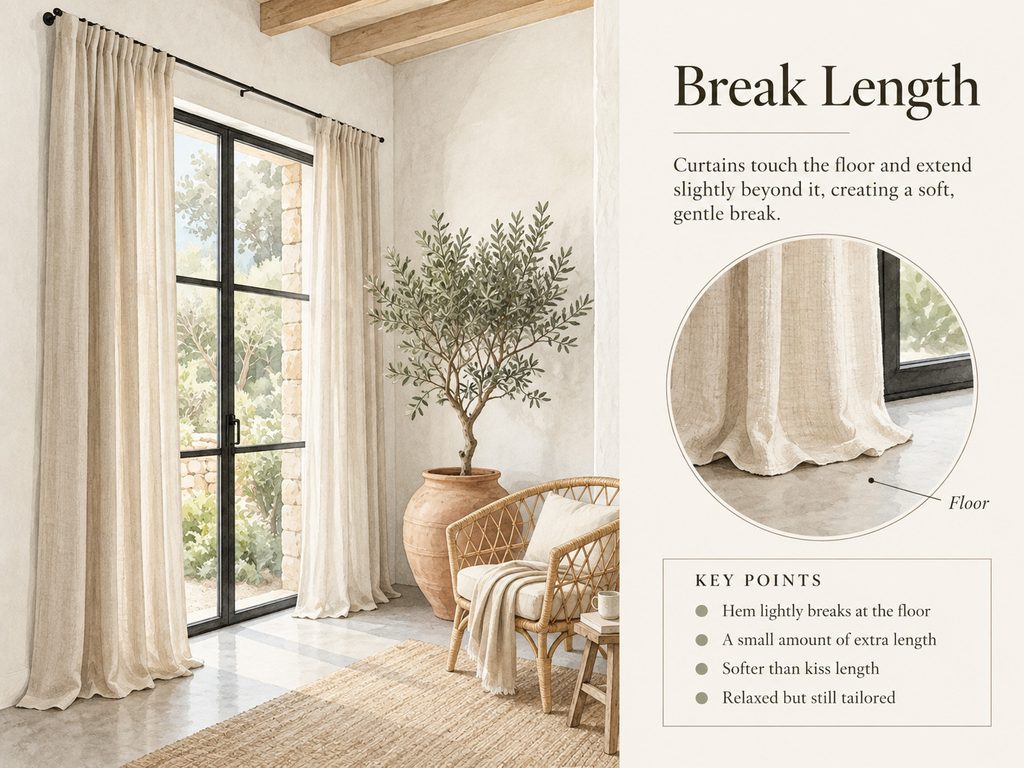
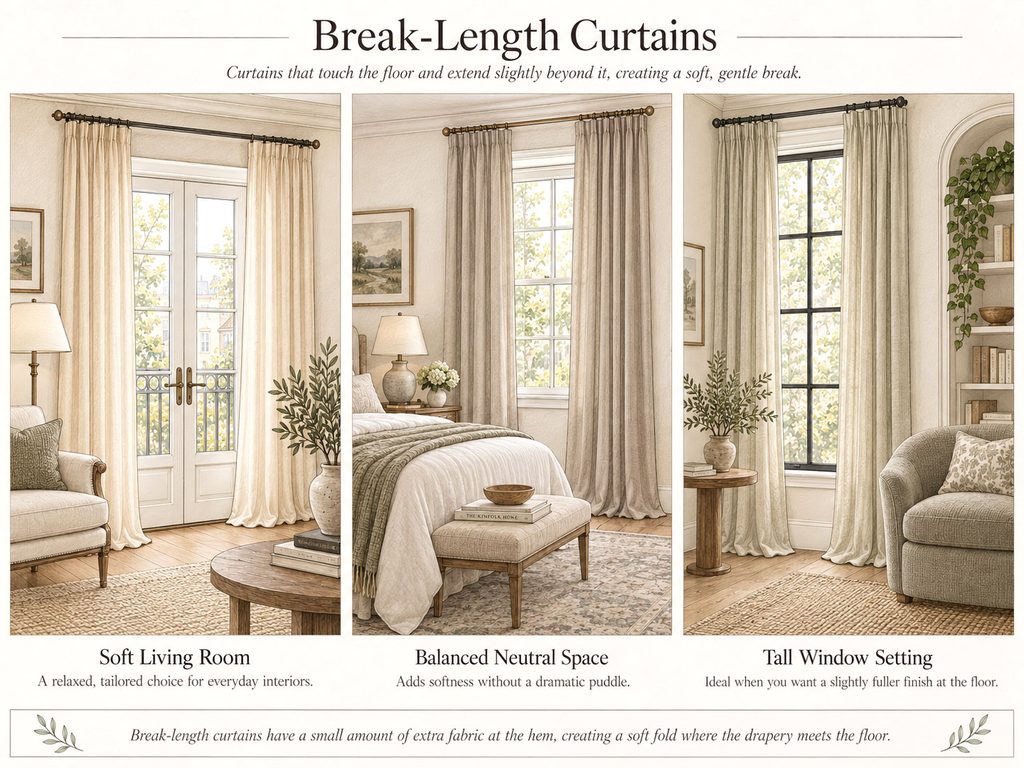
Break Length introduces a small amount of additional length.
The curtain reaches the floor and continues just enough for the hem to develop a soft bend.
A useful reference is about 1–2 inches of extra length. The Shade Store describes Break in this range, although some of its measuring guides calculate that allowance from a Float measurement rather than directly from the floor.
The visual idea is more important than the number alone:
touching the floor + a small, soft fold
Break feels a little softer and more relaxed than Kiss without becoming a true puddle.
Fabric behavior matters quite a bit here. A soft linen may form a natural break with very little excess, while a heavier or stiffer fabric may respond differently to the same allowance.
Once the fabric begins to spread noticeably across the floor rather than simply bending at the hem, the treatment starts moving toward Puddle.
6. Puddle Length
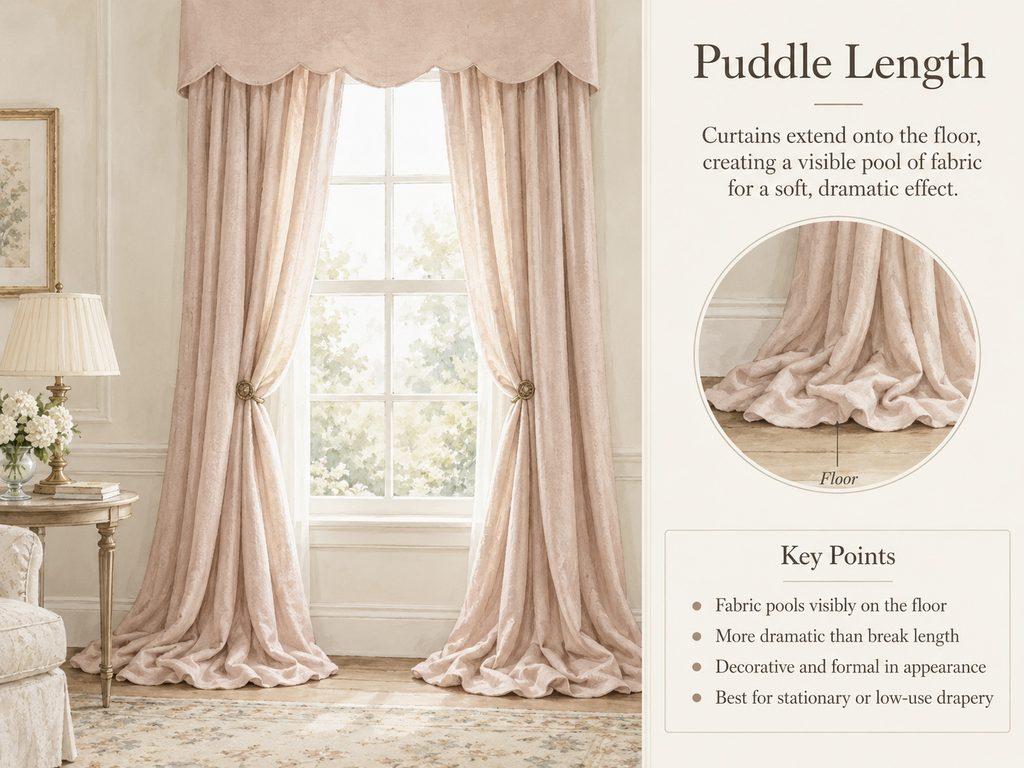
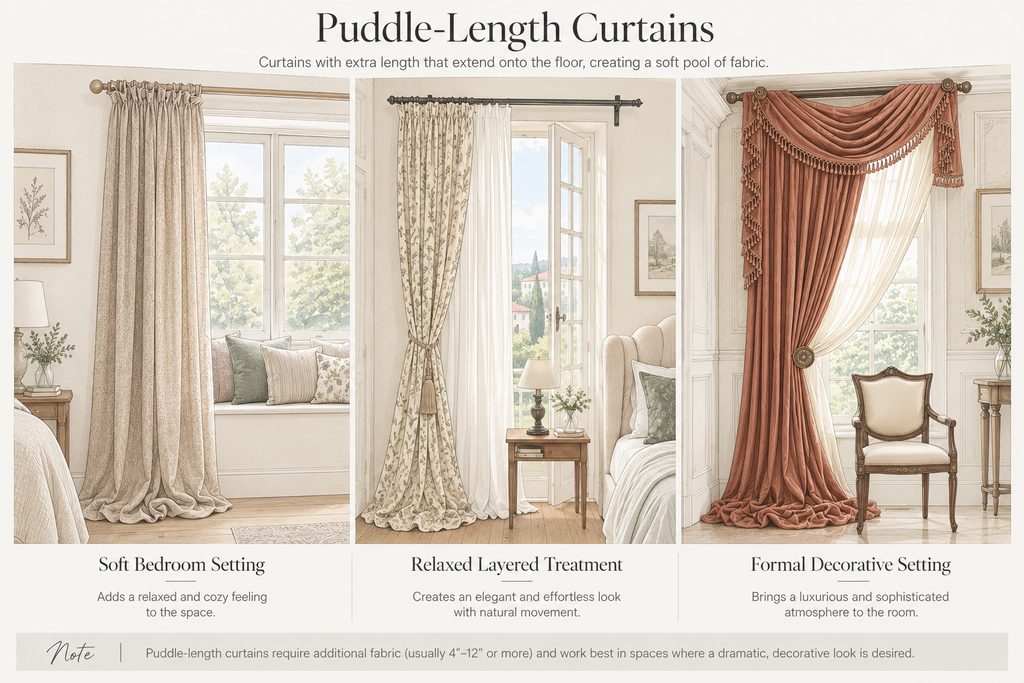
Puddle Length is the most decorative of these six approaches.
The drapery extends beyond floor level so that excess fabric rests visibly on the floor.
Published guidance varies more here, which makes sense because puddling can be subtle or quite dramatic. The Shade Store commonly recommends about 3–6 inches of excess fabric, West Elm illustrates approximately 5–8 inches, and Pottery Barn uses 6–8 inches for a fuller puddled effect.
For that reason, I prefer to think of Puddle as a design range rather than one fixed measurement.
Less excess produces a restrained pool of fabric. More length creates a fuller and more dramatic effect.
Fabric choice becomes especially important. Linen, velvet, and other fabrics with a soft hand usually form more graceful folds, while a stiff fabric can become bulky at the floor.
In everyday use, Puddle also asks for more maintenance than Float or Kiss. The fabric remains in contact with the floor, collects more dust, and is less convenient for frequent operation.
It is therefore often better suited to stationary panels or decorative treatments that are moved less often.
Float, Kiss, Break, and Puddle as a Continuum
These four floor-related lengths become easier to understand when they are viewed as a progression:
Float → Kiss → Break → Puddle
- Float: slightly above the floor
- Kiss: just touching the floor
- Break: touching with a small soft fold
- Puddle: visibly pooling on the floor
The difference may only be an inch or two, but the visual result can change considerably.
For specifications and product guides, I find it useful to define more than the name alone.
A clearer format is:
name + numeric allowance + visual intent
For example:
Float — approximately 1/2 in. above floor
Kiss — finished at floor level
Break — slight excess for a soft fold
Puddle — added length for visible pooling
This helps reduce ambiguity between the designer, client, installer, and workroom.
Fabric Changes the Result
Finished length is only one part of the equation.
The same extra inch can look very different in two fabrics.
Soft linen, sheer materials, and fabrics with a fluid drape tend to respond naturally at the floor. Heavier fabrics create more weight, while stiffer fabrics may develop a sharper bend instead of a soft break.
For Break and Puddle in particular, I would never look at the numeric allowance without also considering the fabric itself.
I tend to think of the final result as a combination of:
measurement + fabric + installation + gravity
Function Matters Too
For drapery that is opened and closed every day, floor clearance and maintenance become practical considerations.
Float is often the easiest to live with, while a carefully executed Kiss can provide a very clean finish.
When the treatment is primarily decorative—such as stationary panels—there is more freedom to use Break or Puddle for a softer or more expressive result.
There is no single “best” drapery length.
The right choice depends on the room, how the treatment will be used, the behavior of the fabric, and the actual installation conditions.
Final Thoughts
Drapery lengths are often separated by only a few inches, yet those small differences can noticeably change the finished treatment.
Sill and Apron are largely about how the curtain relates to the windowsill and the elements below it.
Float, Kiss, Break, and Puddle describe different ways the drapery meets—or avoids—the floor.
What I find most useful in organizing these lengths is not trying to identify one universally correct number. It is understanding which dimensions provide a useful starting point, which belong to a broader design range, and which need to be adjusted for the fabric and the actual installation.
That makes these terms more useful not only for design, but also for measuring, specification, and fabrication.
Related Reading
Drapery Length, Coverage, and Layering: A Visual Guide
A broader look at how length, coverage, draw direction, and layering affect the finished appearance of drapery.
How to Measure for Drapery
A practical guide to the measurements that determine finished drapery size and placement.
Understanding Drapery Stack Back
A closer look at how fabric, heading style, and construction affect the space drapery occupies when open.
Reference Sources
The dimensional ranges in this article were compiled from published measuring and design guidance from established U.S. window-treatment and home-furnishing brands, including The Shade Store, Pottery Barn, and West Elm. Their recommendations vary slightly, which is why the figures above are presented as practical reference ranges rather than fixed standards.