
When we think about window treatments, we often focus first on the main fabric: the drapery panels, the sheers, the Roman shade, or the way the fabric falls across the window.
But sometimes, what makes a window feel truly finished is not only what happens below. It is what happens at the top.
The upper part of a window can easily feel unfinished. There may be a drapery track, a Roman shade headrail, roller shade hardware, brackets, or the layered structure of several window treatments working together. In other rooms, the top of the window may simply feel too plain, too hard, or disconnected from the rest of the space.
This is where a valance or cornice can be useful.
Both are known as top treatments. They are used to complete the upper portion of a window, either by softening it, framing it, concealing hardware, or helping the window feel better proportioned within the room.
What Is a Valance?
A valance is a fabric-based top treatment. It is installed above the window and may be used on its own or combined with drapery, sheers, Roman shades, or other window treatments.
Because a valance is made primarily from fabric, it usually has a softer feeling than a cornice. It may be tailored and simple, or it may include pleats, shaped edges, gathers, scallops, or a more formal swag design.
A well-designed valance can soften the top of a window and add a layer of fabric without covering the entire opening. It can also help connect the window treatment to other textiles in the room, such as upholstery, pillows, bedding, or wall color.
In some cases, a valance is decorative. In others, it has a practical job, such as hiding part of a track or headrail. Often, it does both.
Still, a valance is not simply “a piece of fabric above the window.” Its height, shape, fabric weight, pattern scale, lining, and bottom edge all affect how it looks. If the proportion is wrong, even a beautiful fabric can feel awkward.
What Is a Cornice?
A cornice is a more structured top treatment. It is usually built on a board, frame, or other rigid base, then covered with fabric, padding, trim, or another decorative material.
If a valance feels softer and more fabric-led, a cornice feels more architectural. It creates a cleaner, firmer line at the top of the window.
Cornices are especially useful when hardware needs to be hidden. They can cover drapery tracks, Roman shade headrails, roller shade mechanisms, brackets, or the top structure of a layered treatment. By covering these functional parts, a cornice can make the finished window look more intentional and complete.
A cornice does not have to look heavy or old-fashioned. With a simple shape, the right scale, and a quiet fabric, it can feel very clean and current. It can work in traditional rooms, transitional interiors, and even more contemporary spaces when the design is kept restrained.
Valance vs. Cornice: The Main Difference
Valances and cornices are both top treatments, and they can serve similar purposes. Both can frame a window, hide hardware, add visual weight, or help a window treatment feel more finished.
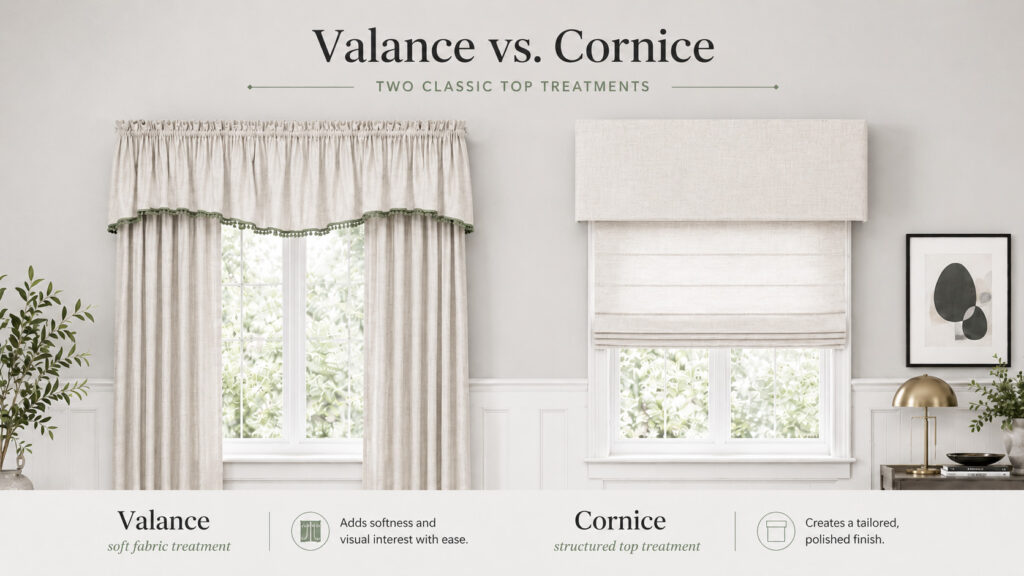
The main difference is structure.
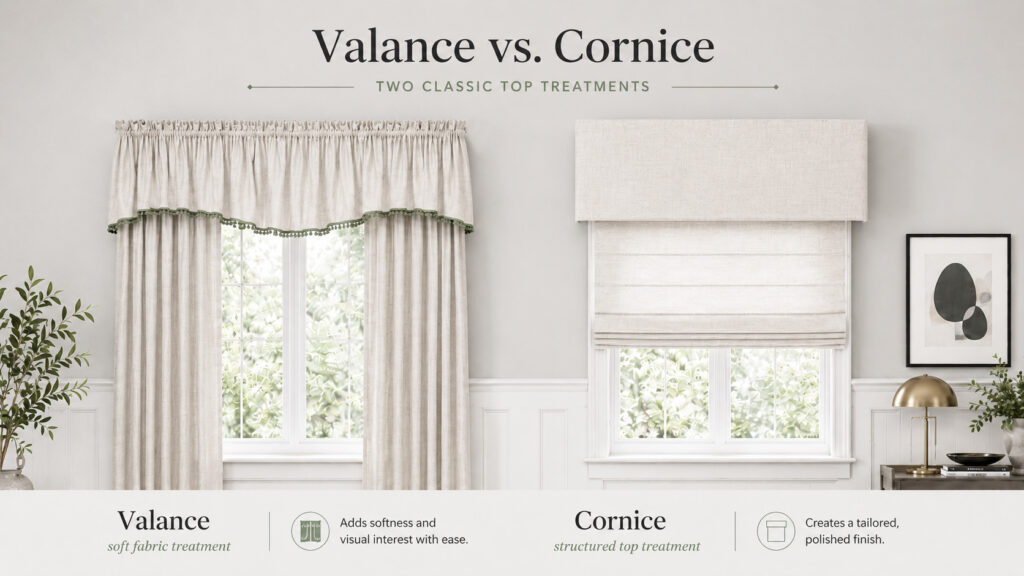
A valance is a soft fabric treatment.
A cornice is a structured upholstered frame.
A valance tends to feel softer, lighter, and more textile-driven.
A cornice tends to feel cleaner, firmer, and more architectural.
This does not mean one is traditional and the other is modern. Both can look classic or updated. The final effect depends on the proportion, fabric, shape, trim, and the room around it.
Why Use a Top Treatment?
A good valance or cornice is rarely just extra decoration. It usually has a reason to be there.
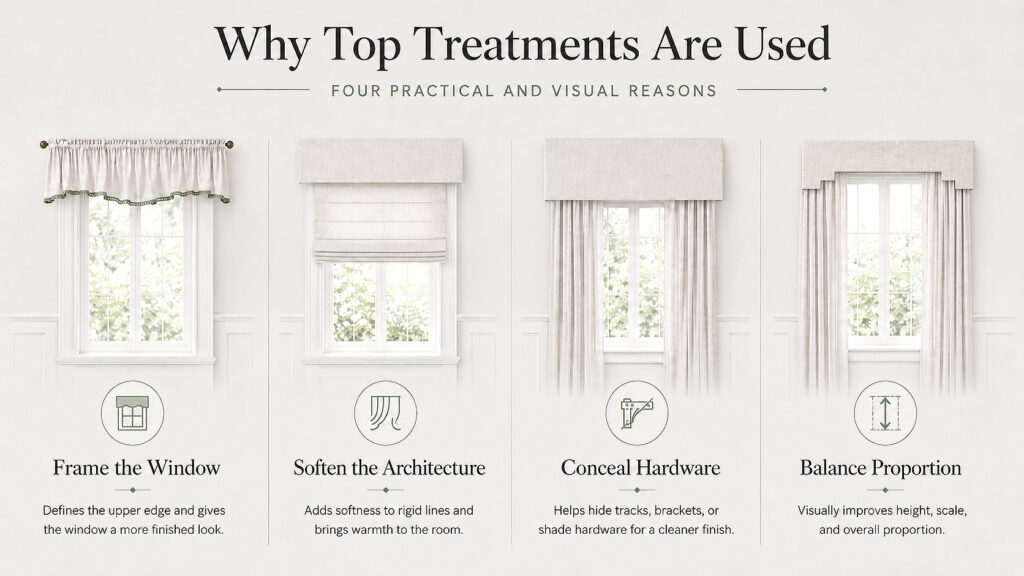
It may frame the window, giving the top of the opening a clearer and more finished edge.
It may soften the architecture, especially when the window frame, wall, or hardware feels too hard or exposed.
It may conceal hardware, which is one of the most practical reasons to use a top treatment. Tracks, headrails, brackets, and layered systems often look better when they are quietly hidden.
It may also help balance proportion. A top treatment can make a window feel taller, wider, or more connected to the room, depending on how it is sized and installed.
In custom window treatments, refinement is often not about adding more decoration. It is about knowing what to show, what to hide, and how to make the whole window feel considered.
When Valances and Cornices Work Best
Valances and cornices work best when the window needs a stronger sense of completion.
They may be useful when hardware needs to be covered, when a Roman shade or layered treatment needs a cleaner top finish, or when the room calls for more softness, fabric, or architectural definition.
They can also help when several windows need to feel more unified, or when the window proportion needs a little visual adjustment.
That said, not every window needs a top treatment. In a very minimal space, a clean exposed track or simple shade may be the better choice. If the window already has strong proportions, or if there is very little space above it, adding a valance or cornice may feel unnecessary.
The question is not simply, “Would this look decorative?”
A better question is:
Does this help the window feel more complete?
A Finishing Element, Not an Afterthought
Valances and cornices are not automatically old-fashioned. They only feel dated when they are added without a clear purpose, or when the proportion, fabric, and style do not belong to the room.
Used well, they can be quiet and practical. They can frame the window, soften the architecture, conceal hardware, or bring balance to a layered treatment.
In custom window treatments, the top of the window should not be an afterthought. Sometimes the detail that seems the quietest is the one that makes the whole window feel finished, intentional, and connected to the room.
Related Notes
Exploring Valance Styles: A Visual Reference for Design and Structure
A visual guide to common valance styles, comparing tailored, pleated, scalloped, shirred, festoon, swag, and other forms through shape, structure, proportion, and drape.
Cornice Shapes: A Visual Reference for Window Treatment Design
A visual reference to cornice shapes and details, helping compare profiles, curves, scallops, overlays, pleats, and fabric treatments during the design process.
Understanding Swags, Cascades, Jabots & Tails
A visual terminology guide to traditional top-treatment elements, with representative forms that clarify their structure, placement, and differences.
Board-Mounted Valances: Structure & Attachment
A closer look at how board-mounted valances are structured and attached, including the relationship between the mounting board, fabric treatment, projection, and installation.