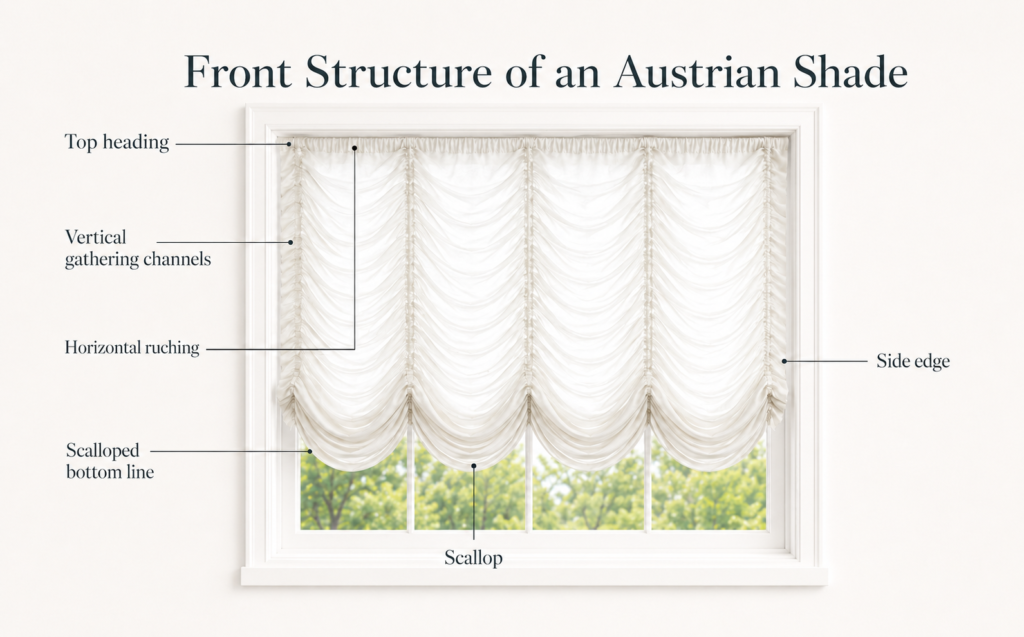
An Austrian shade is easy to recognize from the front: soft horizontal ruching, vertical sections, a scalloped lower edge, and a more decorative character than a standard Roman shade.
But in the workroom, an Austrian shade is not defined by appearance alone. It is not simply a matter of “how many scallops” or “how much fabric.” The final result depends on how fullness is planned, how the fabric is gathered, how the shade is supported, and how the lifting system works with the weight of the finished piece.
Two Austrian shades can share the same finished size and still look completely different. One may feel light, soft, and gently gathered. Another may feel rich, full, and highly decorative. A third may use plenty of fabric but still lose its shape, becoming wider at the top and narrower toward the bottom.
The difference is not only style. It is construction.
A well-made Austrian shade depends on six key decisions: vertical fullness, horizontal fullness, fabrication method, vertical control, decorative trim placement, and operating system.
1. Vertical Fullness: Controlling the Density of the Ruching
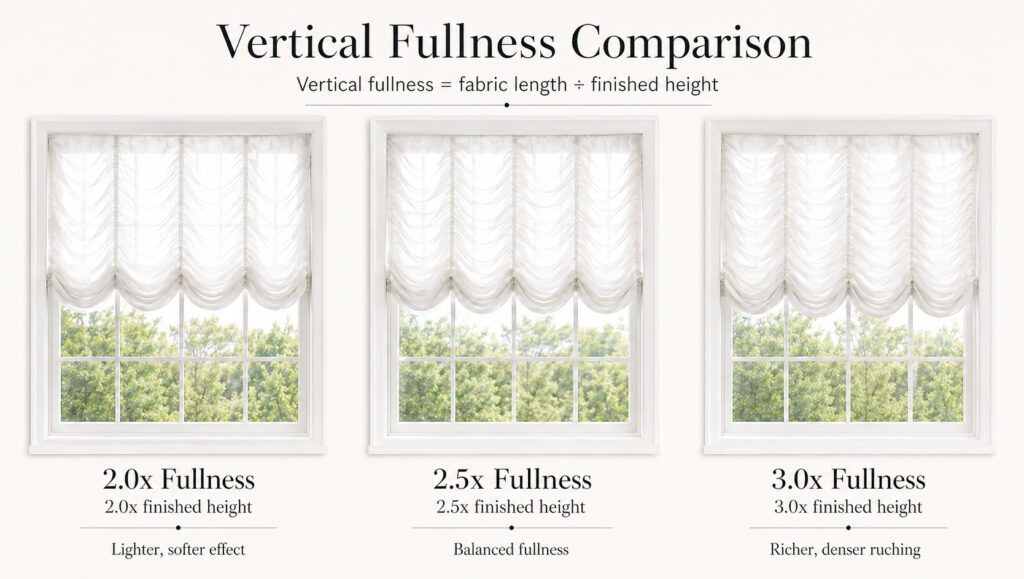
The most recognizable feature of an Austrian shade is the continuous horizontal ruching from top to bottom. This effect is mainly created by fullness in the length of the fabric.
The finished height and the cut length are not the same.
For example, if the finished height of the shade is 2 meters, the fabric height may be cut at 4 meters for 2x fullness, 5 meters for 2.5x fullness, or 6 meters for 3x fullness.
The more vertical fullness is added, the denser the horizontal ruching becomes. A lower fullness creates a lighter, looser effect. A higher fullness creates deeper folds, stronger texture, and a fuller scalloped bottom.
However, more fabric does not automatically mean a better shade.
Too little vertical fullness can make the shade look flat and underdeveloped. Too much fullness, especially in a heavier fabric, can make the shade feel bulky, heavy, or difficult to lift.
Vertical fullness controls the depth and rhythm of the shade, but it must always be considered together with fabric weight, finished height, support structure, and the lifting system.
2. Horizontal Fullness: Shaping Each Scallop
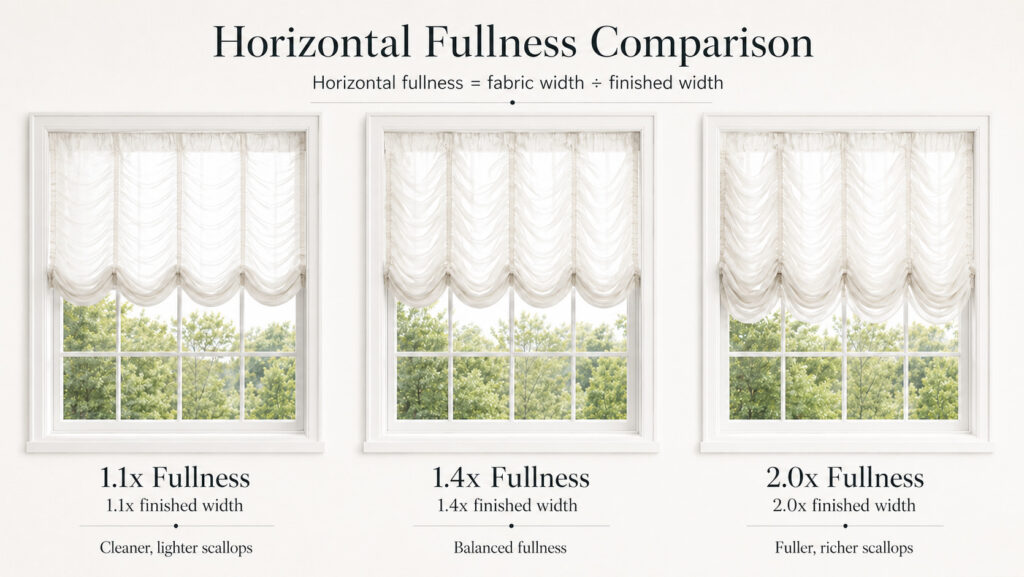
An Austrian shade also needs fullness across the width.
This is where many construction decisions begin. The width is not only a finished measurement; it must be divided into planned scallop sections.
For example, if the finished width is 3 meters and the shade is divided into 6 scallops, each finished scallop is 50 cm wide.
But each scallop does not necessarily use only 50 cm of fabric.
If each scallop is cut at 55–60 cm, the result will be more controlled, with cleaner vertical lines and a lighter appearance.
If each scallop is cut at 70–75 cm, the shade will feel softer, fuller, and more decorative. This is often a practical range for many Austrian shade projects.
If each finished 50 cm scallop uses 100 cm of fabric, the width fullness becomes 2x. The effect can be very rich and traditional, but it usually works best with lightweight fabrics and requires stronger control in fabrication.
For a 3-meter-wide shade with 6 scallops, the width planning may look like this:
| Horizontal fullness approach | Cut width per scallop | Total cut width | Visual effect |
|---|---|---|---|
| Controlled | 55–60 cm | 330–360 cm | Cleaner, lighter, more structured |
| Medium fullness | 70–75 cm | 420–450 cm | Soft, full, practical for many projects |
| Highly decorative | 100 cm | 600 cm | Very full, dense, and traditional |
Horizontal fullness gives each scallop its body.
If there is not enough width, the scallops may look thin and weak. If there is too much width, the vertical channels may become harder to control, and the shade can begin to feel closer to a balloon shade than a refined Austrian shade.
3. Fabrication Method: The Fullness Determines the Workroom Approach
There is no single construction method for every Austrian shade.
The way the shade is made should follow the amount of fullness, the fabric type, and the desired final look.
For lighter fabrics and moderate fullness, shirring tape or gathering tape can be used to create soft, natural ruching. This method is efficient and works especially well with sheers, voile-like fabrics, lightweight decorative fabrics, and softer materials.
When the fullness is greater, or when the design requires more precise control, the shade usually needs more handwork. The workroom may need to hand-adjust the gathers, hand-set folds, or secure key areas so that each scallop stays in its planned position.
This is especially important when the vertical channels, seam lines, trim lines, or scallop divisions need to align accurately.
In some cases, a combined method works best: tape is used to create the basic gathering, while hand-finishing is used to refine the top, vertical channels, and lower scallop line.
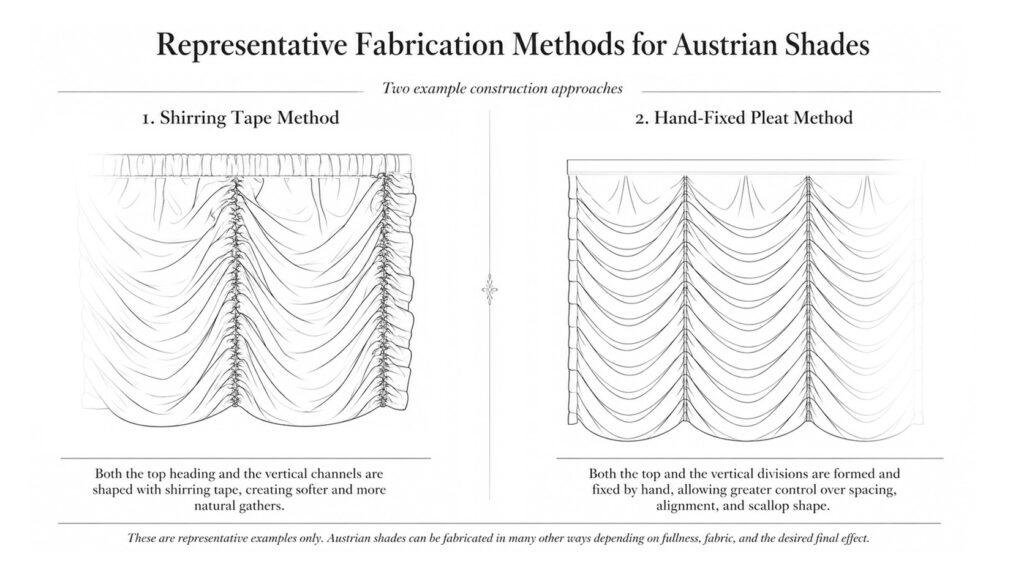
In simple terms:
Light fullness can be more relaxed.
Medium fullness can often be shaped with shirring or gathering tape.
Heavy fullness requires more hand control and structural planning.
The fabrication method should never be chosen separately from the fullness. The same finished style may require very different workroom methods depending on the amount of fabric built into the shade.
4. Vertical Control: Preventing the Shade from Narrowing at the Bottom
Austrian shades can easily become wider at the top and narrower toward the bottom.
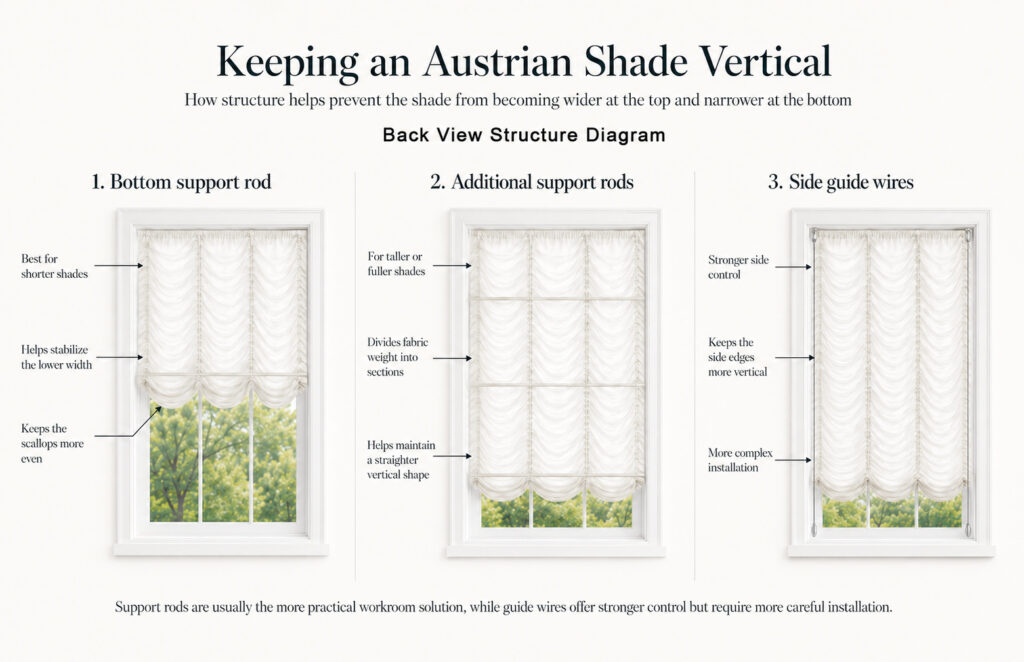
This happens because the fabric weight pulls downward and inward, especially when both vertical and horizontal fullness are high. The issue becomes more noticeable on taller shades, heavier fabrics, or very full constructions.
One practical workroom solution is to use horizontal support rods.
For a shorter shade, a support rod at the bottom may be enough. It helps stabilize the lower width, keeps the scallops more even, and prevents the side edges from pulling inward.
For a taller shade, or a shade with more fabric weight, additional horizontal support rods can be placed at intervals through the height of the shade. These rods divide the fabric into more controlled sections, helping the vertical lines stay straighter and the scallops remain more consistent.
Another method is to use vertical guide wires at the side edges. This allows the shade to travel more directly up and down along a fixed vertical path. It gives stronger control over the side lines, but it also makes installation more complicated. The wires need accurate top and bottom fixing points, proper tension, and careful on-site adjustment.
For most projects, horizontal support rods are the more practical workroom solution. Vertical guide wires are better suited for larger shades, special installations, or projects where the site conditions allow for more complex installation.
5. Decorative Trim: Following the Scallop and the Structure
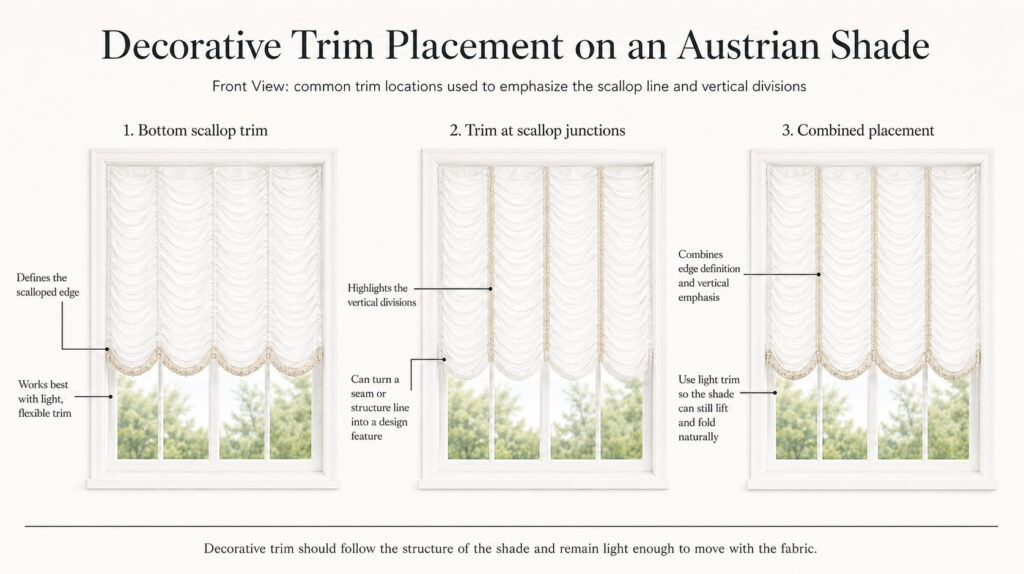
An Austrian shade naturally works well with decorative trim. The scalloped lower edge, vertical divisions, and gathered surface all provide opportunities for detail.
Trim can be added along the bottom scallop line to emphasize the curve. This can help define the lower edge, especially on lightweight or sheer fabrics where the scallop might otherwise feel too soft.
Trim can also be placed at the scallop junctions, along the vertical valley lines or division lines. This can turn a construction line into a design feature. It is especially useful when seam lines, joining lines, or vertical gathering lines need to be visually controlled rather than hidden.
But trim should not be treated as an afterthought.
Austrian shades move, gather, and lift. Any trim added to the shade must work with that movement.
A trim that is too heavy can pull the scallops down and change the curve.
A trim that is too stiff can fight against the soft gathered fabric.
A vertical trim must align with the scallop divisions, or the shade will look visually unsettled.
A thick cord, bead trim, or fringe may affect how the shade stacks when lifted.
On an Austrian shade, decorative trim should follow the structure. It should reinforce the scallop line, the vertical channels, or the planned fabric movement, rather than interrupting them.
6. Operating System: Manual, Motorized, or Cordless
An Austrian shade can be made with a manual system, a motorized system, or, when suitable, a cordless system.
But the operating system is not just a final accessory. It is part of the construction plan.
For a small, lightweight, decorative Austrian shade, a manual system may be simple and practical. But as the shade becomes larger, fuller, or heavier, manual lifting can become difficult. Uneven pulling can also affect how the shade rises.
Motorization is often a better option for larger shades, high windows, or heavier constructions. A motor can provide smoother lifting and reduce the risk of uneven operation. However, the workroom must consider the finished weight, motor capacity, headrail space, fabric stack, and power access before production.
A cordless system can offer a cleaner and safer solution, especially for residential spaces. But not every Austrian shade is suitable for cordless operation. The decision depends on the shade size, fabric weight, fullness level, and mechanism capacity.
The operating system must match the shade. A high-fullness Austrian shade with heavy fabric cannot be treated the same way as a small decorative sheer shade.
Conclusion
An Austrian shade is not a fixed formula.
Its final look is shaped by how the fabric is planned in both directions, how the fullness is created, how the shade is stabilized, where decorative details are placed, and how the lifting system supports the finished weight.
Vertical fullness determines the density and depth of the ruching.
Horizontal fullness determines the body of each scallop.
Fabrication method determines how the fabric is gathered, folded, secured, and refined.
Vertical control keeps the shade from narrowing or losing shape.
Decorative trim must follow the scallop line and construction lines.
The operating system determines whether the shade can function smoothly and safely.
A good Austrian shade is not only soft, romantic, or decorative. It is a carefully balanced fabric structure.
When fullness, fabrication, support, trim, and operation work together, the result is a shade that looks rich and dimensional, while still remaining stable, vertical, and usable.
Related Notes
Understanding Roman Shade Styles: A Complete Guide to Appearance and Design Differences
A closer look at how different Roman shade styles develop their distinctive appearance through structure, fullness, folds, and fabric behavior.
Roman Shade Styles — A Visual Reference Guide
A visual overview of Roman shade styles, from structured and relaxed designs to balloon, Austrian, layered, and specialty forms.
Understanding Roman Shades: A Complete Guide to Styles, Construction, Operation, and Details
A broader reference to Roman shade appearance, construction, operation, and fabrication details, helping place Austrian shades within the wider Roman shade family.
How Fabric Texture Changes the Look of Window Treatments
A study of how fabric texture, weight, softness, and surface character influence drape and the finished appearance of a window treatment.