
Ripple fold drapery, also known in many markets as wave curtain, is loved for its clean, continuous, and evenly spaced folds. It works especially well for contemporary homes, hotels, apartments, offices, and large floor-to-ceiling windows where a soft but architectural window treatment is desired.
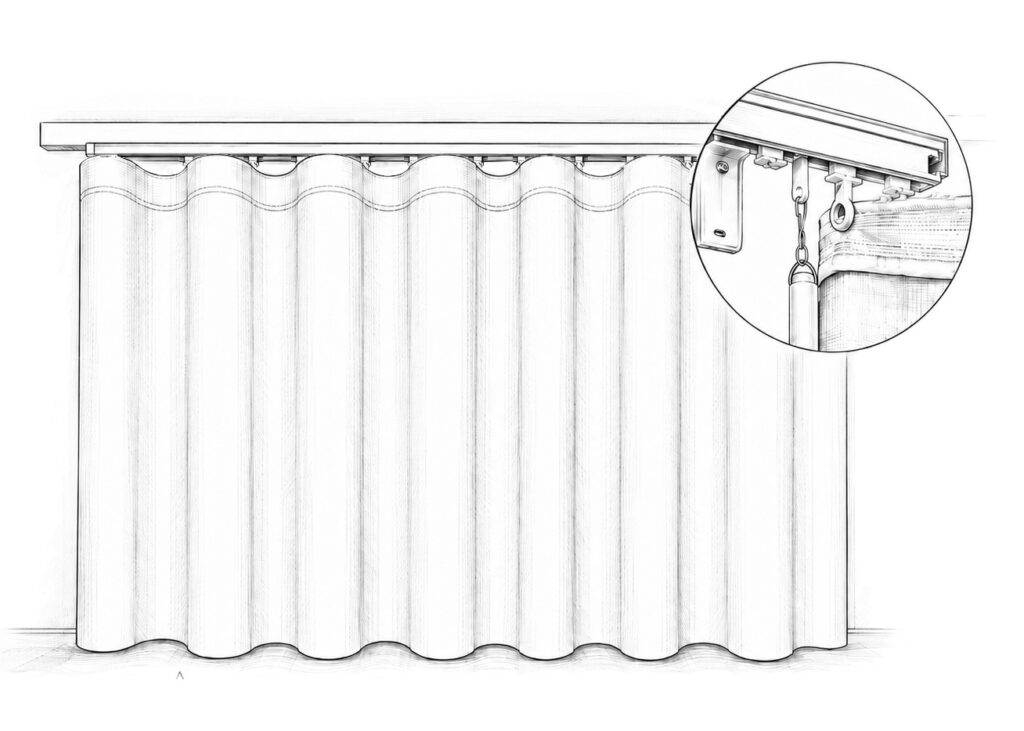
In North America, this style is commonly called ripple fold drapery or ripplefold drapery. In Europe, the United Kingdom, and some international markets, many designers and suppliers use the term wave curtain or wave system.
Although the terminology may vary by region, both terms generally describe a similar visual effect: a curtain that forms soft, continuous S-shaped waves along a track system. However, ripple fold or wave curtain is not simply a fabric style. It is a complete system. To create a stable, even, and elegant wave effect, the tape, carriers, track, fullness, and closure method must all work together.
• Is Ripple Fold the Same as Wave Curtain?
Visually, ripple fold drapery and wave curtains are very similar. Both styles create a smooth, repeated wave rather than a traditional fixed pleat.
The difference is often in the terminology and hardware system used in different markets.
In North America, the term ripple fold is more common. The system often involves snap tape, snap carriers, master carriers, and fullness options.
In Europe, the term wave curtain or wave system is more widely used. These systems often include wave tape, wave hooks, gliders, or runners.
In simple terms, ripple fold drapery and wave curtain belong to the same general design concept, but the tape, carrier, hook, and track details may vary by brand, region, and installation method.
• Why Ripple Fold / Wave Curtain Is a System
Many people think that a ripple fold curtain is created simply by sewing a special tape to the top of a fabric panel. In reality, the wave effect depends on several parts working together.
The position of the snaps, buttons, or hook points on the tape determines where the fabric connects to the track system.
The spacing between carriers inside the track determines the rhythm of the waves.
The weight, thickness, and drape of the fabric affect how naturally the waves fall.
The track system affects how smoothly the curtain moves.
The fullness percentage affects the depth of the wave and the amount of fabric used.
The closure method affects whether the curtain closes cleanly at the center and how well it controls light and privacy.
For this reason, ripple fold and wave curtain systems should not be understood as a single tape or a single track. The tape, carriers, and track must be selected as a compatible system.
If these parts do not match, the curtain may have uneven waves, twisted heading, poor movement, excessive stackback, or an imperfect center closure.
Workroom Note
A ripple fold or wave curtain should always be planned as a matched system. If the tape, carriers, and track are not compatible, the finished curtain may show uneven waves, poor movement, twisting at the heading, or an imperfect center closure.
• Common Tape Connection Methods
Ripple fold and wave curtain systems can use different tape connection methods. Based on common market practices, these methods can generally be grouped into three types: snap tape, button tape, and clear wave tape with hooks.
None of these methods is simply better or worse. Each one reflects a different hardware system, installation habit, project requirement, and market preference.
1. Snap Tape System
Snap tape systems are commonly seen in North American ripple fold hardware systems, with Kirsch being one well-known example.
In this type of system, the tape usually has fixed snaps sewn into it. During installation, the snaps are pressed firmly into the matching carriers or snap points on the track system.
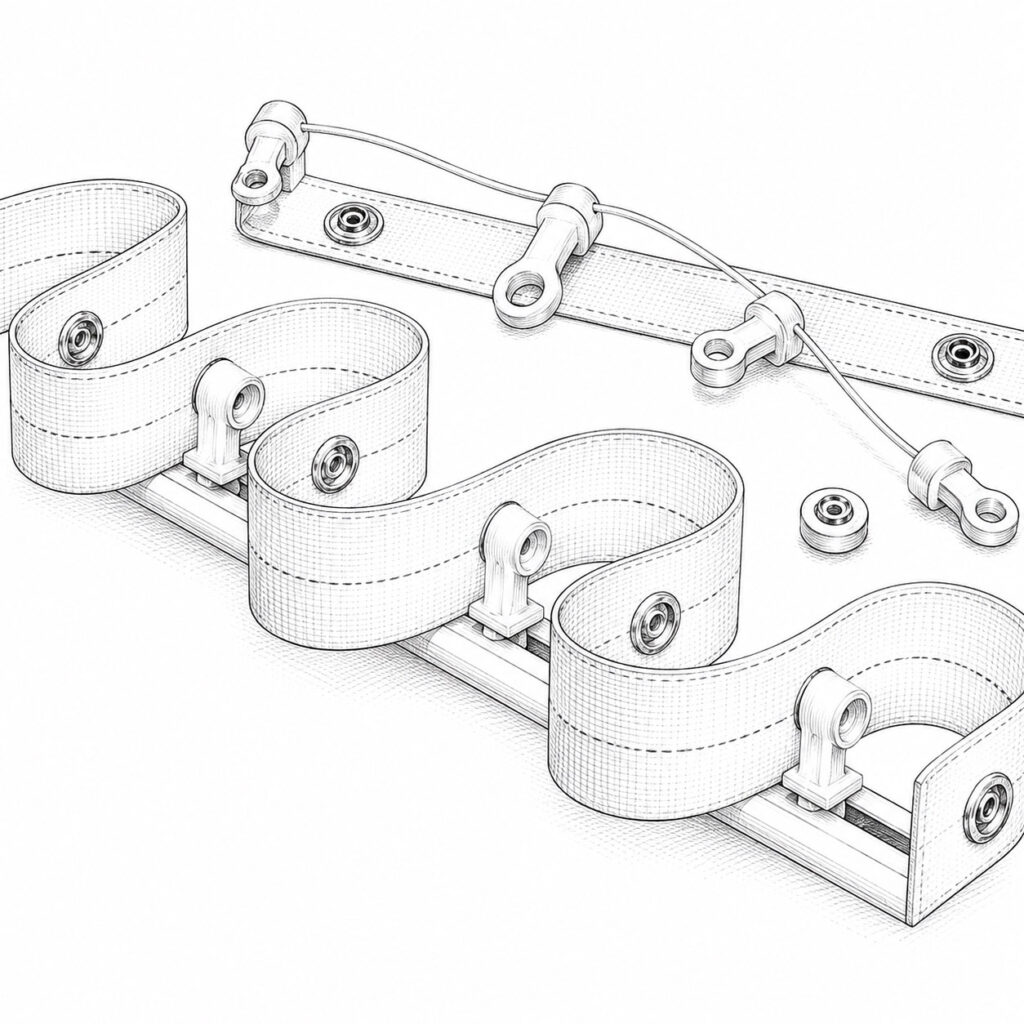
This system uses fixed snaps on the tape and matching snap carriers. The spacing cord keeps the carriers evenly spaced, while the snap tape forms a controlled ripple fold pattern when attached to the track.
The main advantage of this system is that the connection is secure and standardized. The tape, carriers, master carriers, track, and fullness options are usually designed to work together as a complete system.
This type of system is often used by professional workrooms and custom drapery fabricators.
The installation may require more force and experience than some simpler systems. For installers who are not familiar with it, the snap connection may feel tight, but that tightness is also part of what helps keep the system stable.
2. Button Tape System
Button tape systems are commonly used in many export manufacturing and project-based supply chains, especially where efficiency, easy handling, and future maintenance are important.
In this type of system, the tape has raised buttons attached to it. During installation, the button is inserted directly into the hole or opening of the carrier.
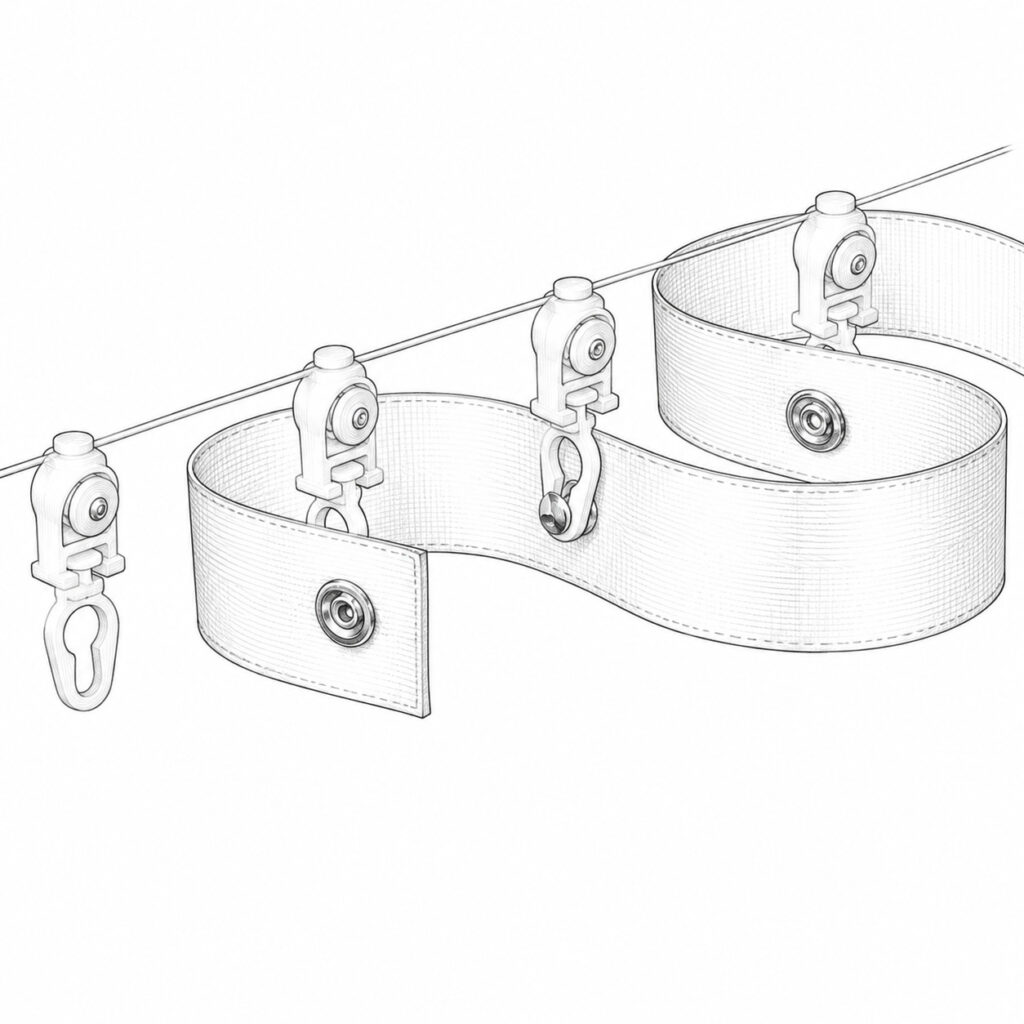
Raised buttons on the tape are inserted directly into the matching carrier openings. This method is simple, efficient, and easy to handle in production and installation.
The advantage of this method is efficiency. It is easy to install, relatively easy to remove, and simple for workers to handle. For large production runs, project work, export orders, and installations that require fast handling or future maintenance, this system can be very practical.
The stability of a button tape system depends on the fit between the button and the carrier hole. If the connection is too loose, long-term stability may be affected. For heavier fabrics, it is also important to confirm the load capacity and running quality of the track and carrier system.
3. Clear Wave Tape with Hooks
Clear wave tape with hooks is closer to many European wave curtain systems. Forest / Forest Group wave systems are a representative example of this approach.
This type of tape is usually clear or semi-transparent. It often has grid markings, guide lines, or hook-position indicators. During fabrication, hooks are inserted into the tape according to the marked positions and then connected to the gliders or runners in the track system.
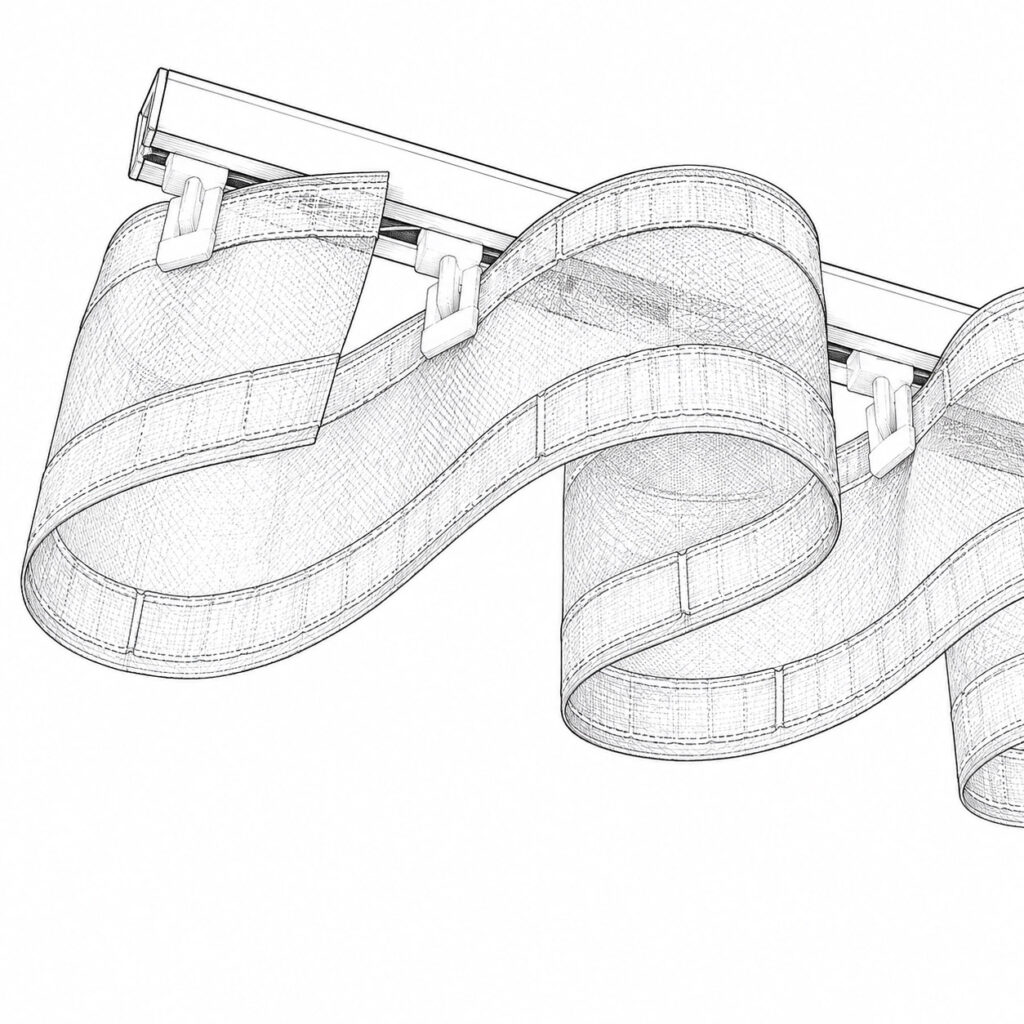
Hooks are inserted into the marked positions on the clear tape and then connected to matching gliders or runners. This system creates a clean, lightweight wave curtain appearance.
The main advantage is a lighter and cleaner visual appearance. Clear tape is especially suitable for sheers, light-colored fabrics, semi-transparent fabrics, and projects where the back of the curtain needs to look less visible.
Because the tape is less visually intrusive than a white tape, it is often preferred for soft, lightweight wave curtain applications.
This system may look simple, but it requires accuracy in fabrication. The hook position, tape marking, carrier spacing, and track system must correspond correctly in order to create a consistent wave rhythm.
• The Role of Carriers
In a ripple fold or wave curtain system, carriers are not just small sliding parts inside the track. They also help control the rhythm of the wave.
Different hardware brands and track systems use different types of carriers. Some systems use fixed-spacing carriers. Some use carriers connected by spacing cords. Others use carriers designed specifically for a certain tape or hook system.
Regardless of the carrier style, the key principle is the same: the carrier spacing must match the snap, button, or hook position on the tape.
If the carrier spacing and tape spacing do not work together, the curtain may not form even waves. Some sections may become too tight, while others may become too loose. The heading may twist, and the curtain may not move smoothly.
For this reason, it is important to confirm that the tape and carrier system are compatible before fabrication or installation.
• Understanding Fullness
Fullness is one of the most important decisions in a ripple fold or wave curtain system.
In traditional pinch pleat drapery, fullness is often understood as two times or two-and-a-half times the fabric width. Ripple fold and wave curtain systems work differently.
The top of the curtain is not shaped by fixed pleats. Instead, the wave is created by the relationship between the tape points and the carrier spacing.
The tape determines where the fabric connects.
The carriers determine the distance between those connection points.
Together, they determine the depth of the wave and the final fullness.

Different brands and markets may use different tape spacing and carrier spacing specifications. The exact measurements may vary, but the principle remains the same: the tape spacing and carrier spacing must work together to create a stable and consistent wave.
• Common Fullness Options
Common ripple fold or wave curtain fullness options include 60%, 80%, 100%, and 120%. The exact specifications may vary by system, but these percentages help designers and clients understand the difference in wave depth and fabric volume.
60% Fullness
60% fullness creates a shallower wave and uses less fabric. The overall look is cleaner, flatter, and more economical.
It may work well for smaller spaces, tighter budgets, or projects where a lighter appearance is desired.
However, with very thin fabrics, 60% fullness may look too flat. With stiffer fabrics, the wave may not fall naturally.
80% Fullness
80% fullness is a balanced and commonly used option. It creates a clear wave without making the curtain feel too heavy.
For many modern residential and light commercial projects, 80% fullness offers a clean, contemporary look.
It is often a safe choice when the client wants a modern wave effect without too much volume.
100% Fullness
100% fullness creates a fuller and more defined wave. The curtain has more presence and a more finished custom appearance.
It is often suitable for living rooms, bedrooms, large windows, hotel spaces, and projects where a more substantial drapery effect is desired.
120% Fullness
120% fullness creates deeper waves and a richer visual effect. It uses more fabric and creates more stackback when the curtain is open.
This option can work beautifully for sheers, lightweight fabrics, or spaces where a stronger wave effect is desired.
However, 120% fullness requires more stackback space. If there is not enough wall space beside the window, the open curtain may cover more of the glass.
For this reason, higher fullness is not always better. The right fullness should be selected based on fabric weight, track width, window size, stackback space, function, and desired appearance.
• Closure Options: Butt and Overlap
Closure is another important part of ripple fold and wave curtain design, especially for center-opening curtains.
The two common closure options are butt closure and overlap closure.
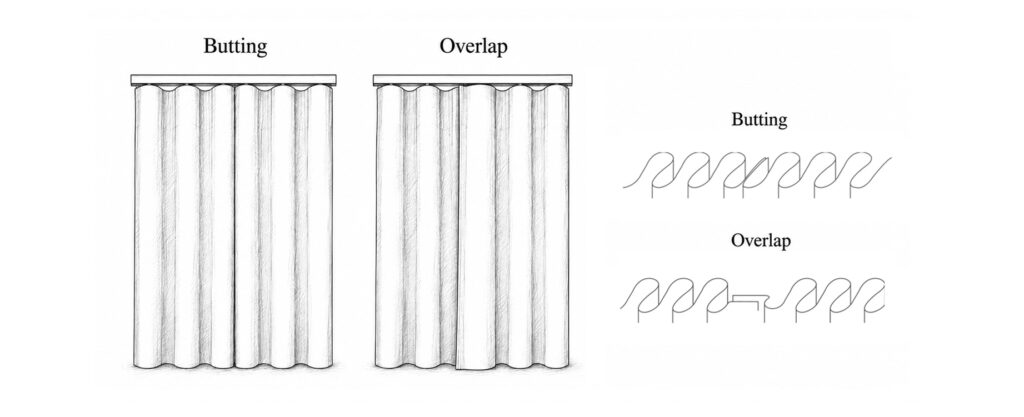
Butt Closure
Butt closure means the left and right curtain panels meet edge to edge at the center.
This creates a clean, simple look. The wave can continue more naturally toward the center, and the overall appearance remains modern and minimal.
Butt closure is often suitable for sheers, decorative curtains, light-filtering applications, or spaces where complete blackout is not the main concern.
The limitation is that the center may have a small gap. For bedrooms, hotel rooms, or blackout drapery, butt closure may not provide enough privacy or light control.
Overlap Closure
Overlap closure means one curtain panel overlaps the other slightly at the center.
This helps reduce the center gap and improves light control and privacy.
Overlap closure is often a better choice for bedrooms, hotel rooms, blackout drapery, and spaces where privacy is important.
The trade-off is that the center structure is more complex. It requires the correct master carrier and accurate fabrication. Visually, the center may include a flatter or less continuous section compared with butt closure.
When choosing between butt closure and overlap closure, the key question is what the project values most: a clean and continuous wave appearance, or better light control and privacy.
For decorative sheers or light-filtering drapery, butt closure is often visually cleaner. For bedrooms, hotel rooms, and blackout drapery, overlap closure is usually the safer functional choice.
• What to Confirm Before Ordering
Because ripple fold and wave curtain styles depend on system compatibility, several details should be confirmed before ordering:
- Ripple fold or wave curtain system
- Track type or hardware brand
- Tape connection method
- Carrier type and carrier spacing
- Fullness percentage
- One-way draw or center draw
- Butt closure or overlap closure
- Hand draw, baton draw, cord draw, or motorized operation
- Fabric weight, thickness, and drape
- Lining or blackout requirements
- Stackback space
- Privacy and light control needs at the center closure
These details may seem technical, but they directly affect the final appearance, movement, stackback, light control, and long-term performance of the curtain.
• Final Thoughts
Ripple fold drapery and wave curtains look simple, but they rely on a carefully matched system.
North American markets often use the term ripple fold and may use snap tape and snap carrier systems. European markets often use the term wave curtain and may use clear wave tape with hooks. In Chinese manufacturing and export supply chains, button tape systems are also very common, especially where installation efficiency, cost control, and easy maintenance are important.
No single method is automatically better than the others.
The most important principle is that the tape, carriers, track, and fullness must work together as a complete system.
When these details are planned correctly, ripple fold drapery or wave curtains can create a clean, continuous, stable, and modern window treatment effect.
Related Notes
Ripplefold vs. Wave Curtain: Systems, Fullness, and Space Planning
A closer comparison of Ripplefold and Wave curtain systems, including tape and carrier spacing, fullness, closure options, stack behavior, and installation depth.
Understanding Drapery Fullness: Fabric Ratio, Pleat Style, and Finished Appearance
A practical look at how fullness affects folds, fabric volume, stack back, light control, and the overall appearance of custom drapery.
Understanding Drapery Stack Back: Planning Space Beyond the Window
A closer look at the space drapery requires when open and how heading style, fullness, fabric thickness, lining, and hardware influence stack back.
Understanding Drapery Leading Edges and Side Edges
A visual reference to leading edges and side edges, including returns, pinned and unpinned finishes, and different overlap conditions on decorative rods and traverse tracks.
Comments are closed.