
Valances are one of the more varied forms of top treatment in window design.
They can be very simple, adding only a soft layer of fabric above the window, or they can become much more decorative through pleating, draping, shaping, trim, and different mounting structures.
In practice, valances do not follow one universally consistent classification system. Manufacturers, workrooms, and designers may use different names for similar forms, while the same term can sometimes describe slightly different constructions.
For that reason, this article is not intended to create a strict naming system.
Instead, it provides a practical framework for understanding valances: what they are, the common terms used to describe them, where they can be mounted, the main visual forms, and the factors that influence the finished result.
Future articles will look more closely at individual valance types and construction approaches.
1. What Is a Valance?
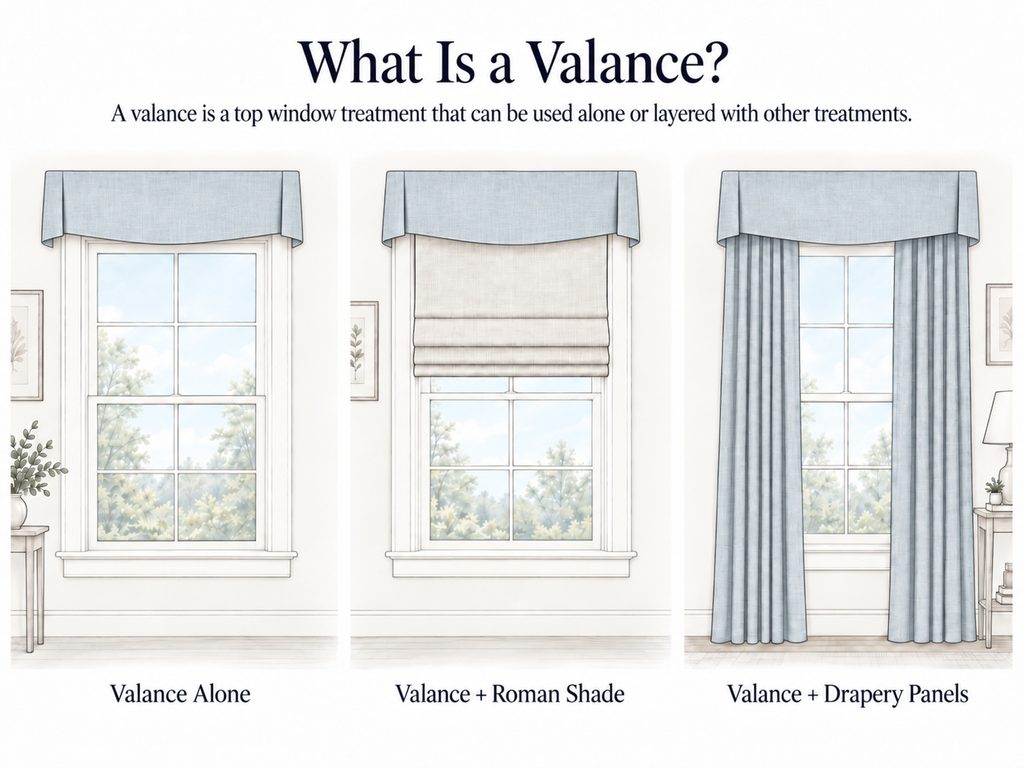
A valance is a top treatment installed at the upper portion of a window or window treatment.
It can be used on its own, or combined with other window treatments such as:
- drapery panels
- Roman shades
- roller shades
- woven shades
- blinds
- and other shades or undertreatments
In the illustration above, Roman shades and drapery panels are used simply as representative examples. A valance is not limited to these combinations.
In practice, it can be layered with many different types of shades, blinds, drapery, or other undertreatments depending on the functional requirements, architecture, and overall design direction.
Its role is also broader than simply hiding hardware.
Depending on the design, a valance can help:
- adjust the visual proportion of a window;
- create an upper visual layer;
- establish a focal point;
- soften architectural lines;
- connect the different elements of a window treatment composition.
The same basic valance can look quite different when paired with different shades, blinds, drapery, or other undertreatments.
2. Common Valance Terms
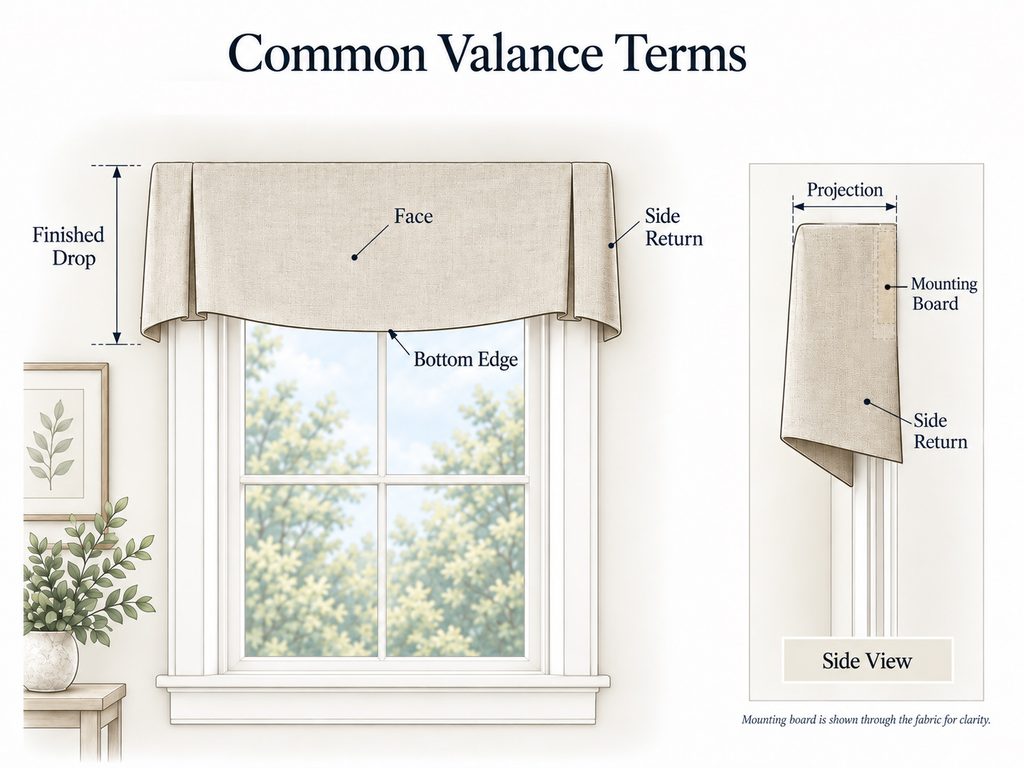
Because valances take so many different forms, not every style shares exactly the same anatomy.
Some include pleats, some rely on gathering, some form swags, and others are supported by decorative rods or other mounting systems.
Rather than trying to define every valance through one diagram, it is more useful to begin with a few common terms.
Face
The primary visible front surface of the valance.
Finished Drop
The finished vertical distance from the top of the valance to its lower edge.
The finished drop has a direct influence on the relationship between the valance, the window, the undertreatment, and the overall treatment proportion.
Bottom Edge
The lower edge of the valance.
It may be straight or shaped into a curve, arch, scallop, or other profile.
Side Return
The section that extends from the face of the valance back toward the wall.
Return depth is often related to the mounting structure and to whatever undertreatment needs to be covered.
Projection
The distance the treatment extends forward from the wall.
In some board-mounted treatments, projection is closely related to the return and to the space required for shades, blinds, or drapery underneath.
Mounting Board
Some valances are attached to a mounting board.
In a finished treatment, the board is normally covered with fabric and is not directly visible. In the illustration, it is shown slightly through the fabric simply to clarify the internal structure.
Published measuring guidance also notes that valance return depth is determined by the projection of the undertreatment being covered, so the return should not be treated as a fixed dimension.
3. Where Can a Valance Be Mounted?
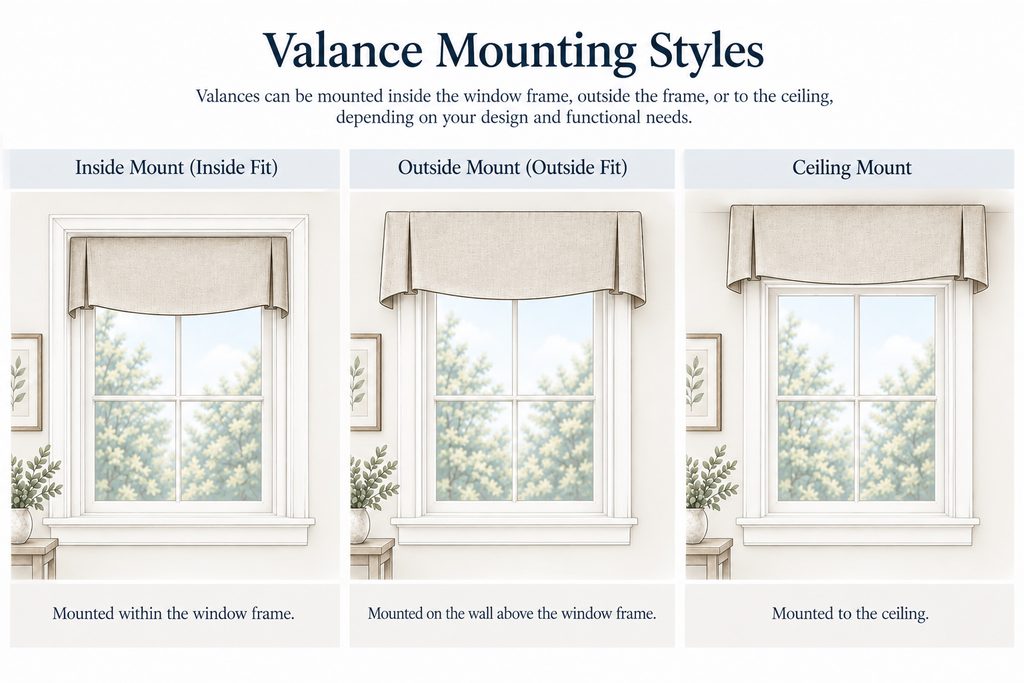
Valances can be positioned in several different mounting locations.
Inside Mount
The valance is installed within the window opening.
This creates a more contained relationship with the window frame and depends on having enough usable space inside the opening.
Outside Mount
The valance is installed outside or above the window opening.
This approach generally allows more flexibility in width, drop, and overall proportion.
Ceiling Mount
In some applications, the valance can be mounted directly to the ceiling.
This can be useful when there is limited wall space above the window or when the treatment is intended to begin at a higher visual point.
It is useful to distinguish between mounting location and mounting system.
Inside, outside, and ceiling mount describe where the treatment is installed.
Mounting boards, decorative rods, sconces, and other supports describe how the treatment is supported.
Those mounting systems will be explored separately in later articles.
4. Common Valance Styles
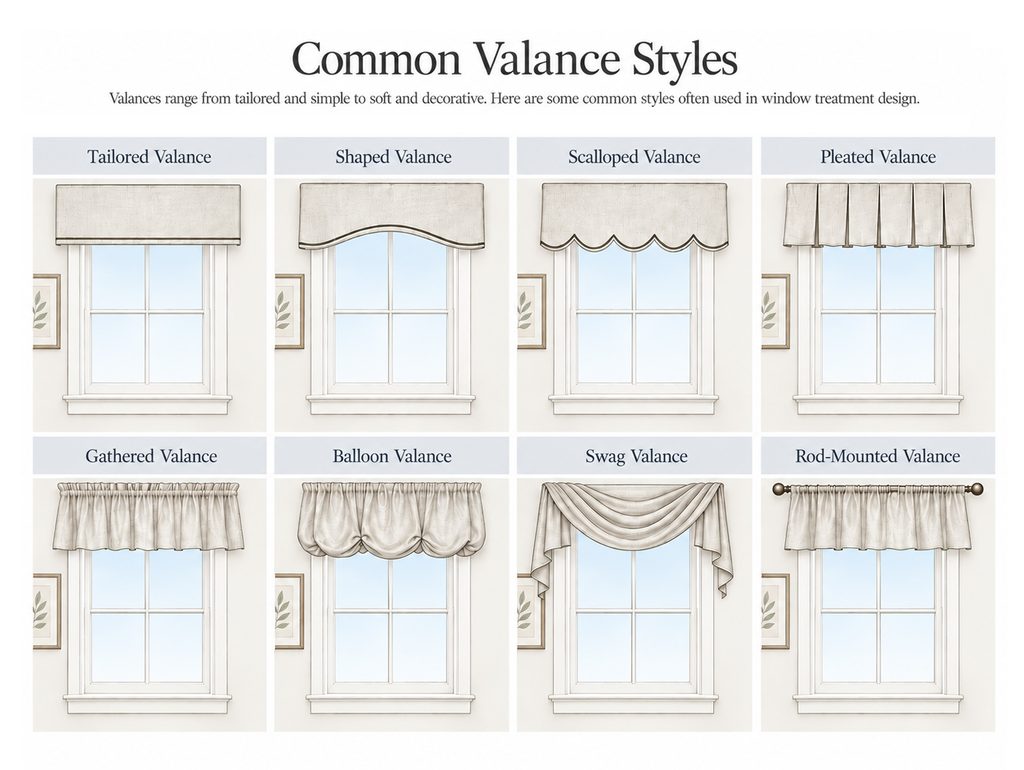
Valances can take many different forms.
Some emphasize clean structure and controlled lines. Others organize fullness through pleating or gathering, while softer styles depend more heavily on drape and fabric movement.
A few common visual directions include:
Tailored Valance
A cleaner, more controlled treatment with relatively little fullness.
Shaped Valance
A valance defined by a shaped lower edge, which may include curves or geometric profiles.
Scalloped Valance
A treatment with repeated scalloped forms along the lower edge, creating a more decorative silhouette than a straight profile.
Pleated Valance
A valance in which pleats create structure and visual rhythm.
Pleated valances also have a distinct construction logic. Installation guidance, for example, relates mounting-board dimensions to the end pleats and return size, which makes this category useful to study separately.
Gathered Valance
A softer treatment in which gathering creates fullness across the width.
Balloon Valance
A fuller style that forms rounded volume along the lower portion of the treatment.
Swag Valance
A draped treatment in which fabric forms one or more curved swags, sometimes combined with cascades or other side elements.
Rod-Mounted Valance
A treatment mounted directly in relation to a decorative rod.
Rod pockets, rings, tabs, straps, and other attachment details can all change the rhythm and character of the finished design.
Installation references also treat decorative-rod-mounted valances as a distinct mounting system.
These terms are best understood as practical design and communication references rather than rigid universal categories.
5. Valance Styles in Real Spaces
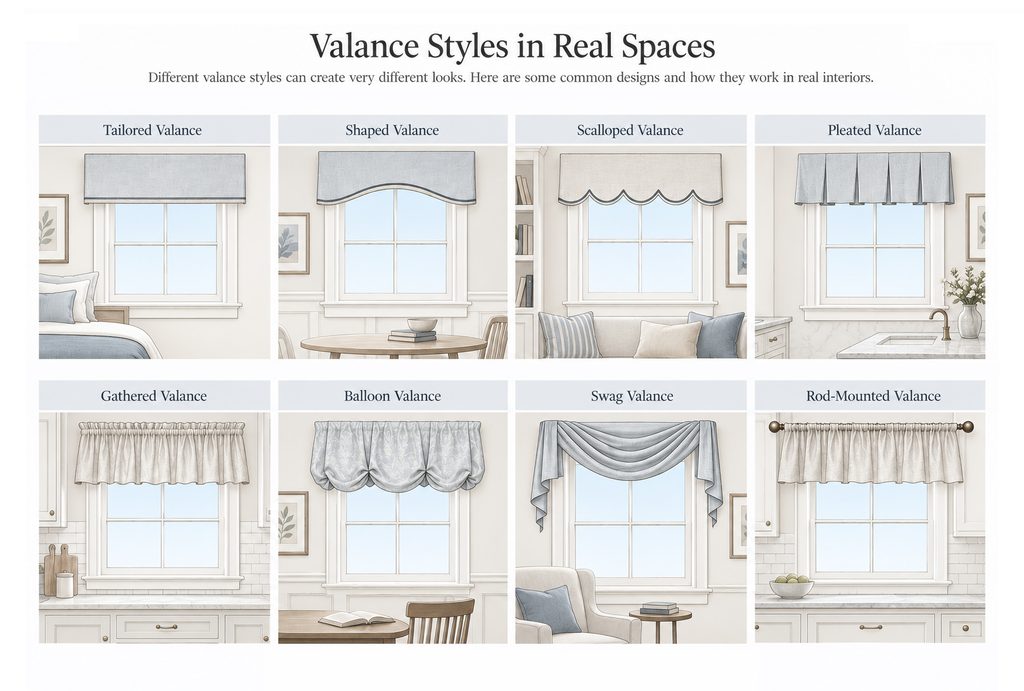
When a valance is viewed by itself, it is easy to focus only on its shape.
But in a finished room, the result comes from the relationship between:
valance + window + architecture + fabric + furniture + surrounding treatments
A simple tailored form can feel very different in a bedroom, dining area, or living space depending on the fabric, scale, and surrounding elements.
Gathered, balloon, or swag treatments generally introduce more visible softness, fullness, and movement.
For that reason, choosing a valance by style name alone is rarely enough.
It is often more useful to consider whether the treatment should feel:
- flat or dimensional;
- tailored or relaxed;
- structured or softly draped;
- visually quiet or more decorative.
The same valance form can take on a very different character from one project to another.
6. What Affects the Final Look?
Even when two valances share a similar basic outline, the finished result can look very different.
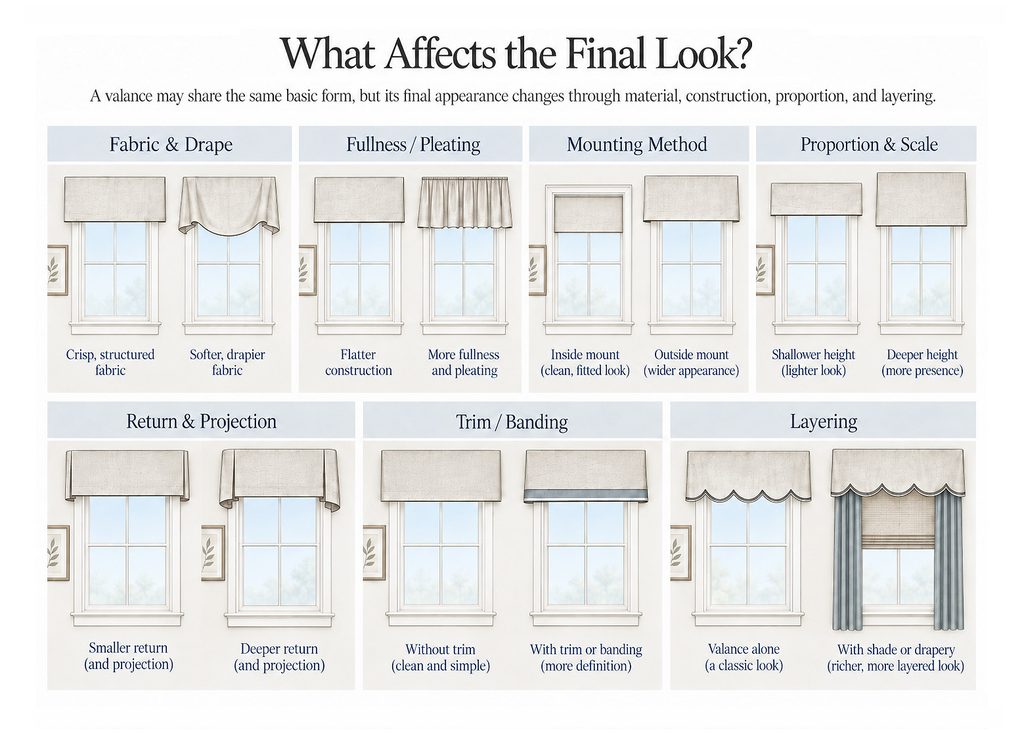
Fabric & Drape
A firmer fabric tends to reinforce structure, while a softer fabric with more drape usually creates a more relaxed effect.
Fullness & Pleating
Gathering, pleating, and fullness all influence rhythm, volume, and surface character.
Mounting Method
Both mounting location and mounting system can change the relationship between the valance and the window. An inside or outside mount affects placement, while board-mounted and rod-mounted constructions influence structure and presentation.
Proportion & Scale
Valance drop should not be considered as an isolated measurement.
Published measuring guidance relates valance height to the scale of the undertreatment or overall treatment and gives approximately 15%–18% as a general reference, while noting that too much depth can appear top-heavy and too little may feel underscaled. This is better understood as a design guideline than a fixed rule.
Return & Projection
When a valance is covering a Roman shade, blind, drapery, or other undertreatment, enough space must be allowed for the treatment underneath.
Return and projection therefore need to be considered together with the layers below.
Trim & Banding
Contrast banding, decorative trim, fringe, and tape can all change the definition of the edges and shift the visual emphasis of the treatment.
Layering
A valance used by itself will read differently from the same valance layered with shades, blinds, or drapery.
The finished look is therefore not determined by the style name alone.
It is the result of several elements working together: shape, fabric, construction, mounting, proportion, and layering.
7. A Framework for Exploring Valances
Valances may appear to be a single category, but once the subject is broken down, each form has its own structural and mounting logic.
Board-mounted valances involve mounting boards, returns, projection, and different attachment methods. Installation literature distinguishes between pre-mounted treatments, tack-strip attachment, and hook-and-loop attachment methods.
Swag and cascade treatments introduce another set of considerations, including high point, lowest point, overlap, and cascade proportion. Measuring guidance also treats the relationship between swag depth and the overall treatment height as a separate design issue.
Scarf valances may use sconces as support points, with the finished form determined by fabric length, tail length, placement, and dressing.
For that reason, this article is best understood as an overview and a starting point.
Future articles will look more closely at topics such as:
- Board-Mounted Valances
- Pleated Valances
- Rod-Mounted Valances
- Swag & Cascade Valances
- Pole Swag Valances
- Scarf Valances
- Measuring for Valances
This structure allows each valance type to be explored in greater detail, while this overview remains a central reference for readers looking for a particular style, construction, or mounting approach.
Closing Thoughts
Valances do not have one fixed expression.
Through changes in fabric, shape, pleating, mounting, proportion, and layering, a top treatment can range from a very quiet tailored form to a much softer swag or scarf composition with visible movement and volume.
This article establishes the overall framework.
The following articles in this series will look more closely at the structure, mounting, proportion, and application of individual valance types.
Related Reading
If you’d like to explore related top treatments and valance design references, these articles may also be useful:
- Exploring Valance Styles: A Visual Reference for Design and Structure
A visual overview of common valance forms, including tailored, pleated, gathered, swag, and rod-mounted variations. - Swags, Cascades, Jabots & Tails
A closer look at several traditional draped elements commonly used in decorative top treatments. - Cornice Shapes: A Visual Reference for Window Treatment Design
A comparison of common cornice profiles and structural expressions used in top treatments.
Comments are closed.