
Roman shades may look similar from the front, but the systems used to raise, lower, and hold them in position can be quite different.
From traditional cord-operated mechanisms to cordless and motorized options, lift systems have evolved to offer different operating experiences, installation requirements, and performance capabilities.
Understanding these differences helps designers, workrooms, and fabricators select an appropriate system based on the shade’s construction, window conditions, and intended use.
This overview introduces common Roman shade operating options and the key considerations involved in selecting a lift system, rather than focusing on the technical specifications of individual manufacturers.
1. Understanding Roman Shade Lift Systems
A Roman shade lift system controls how the shade moves and remains in position.
In many traditional constructions, lift cords run through rings or guides attached to the back of the fabric, allowing the shade to form folds as it rises. Other systems use different combinations of drive mechanisms, lift cords, tapes, spools, or balancing components.
The operating mechanism, headrail arrangement, and fabric lifting structure work together as a complete system.
Although the finished appearance may be similar, these internal differences can affect operating effort, weight capacity, installation space, adjustment, and maintenance.
2. Manual Operating Systems
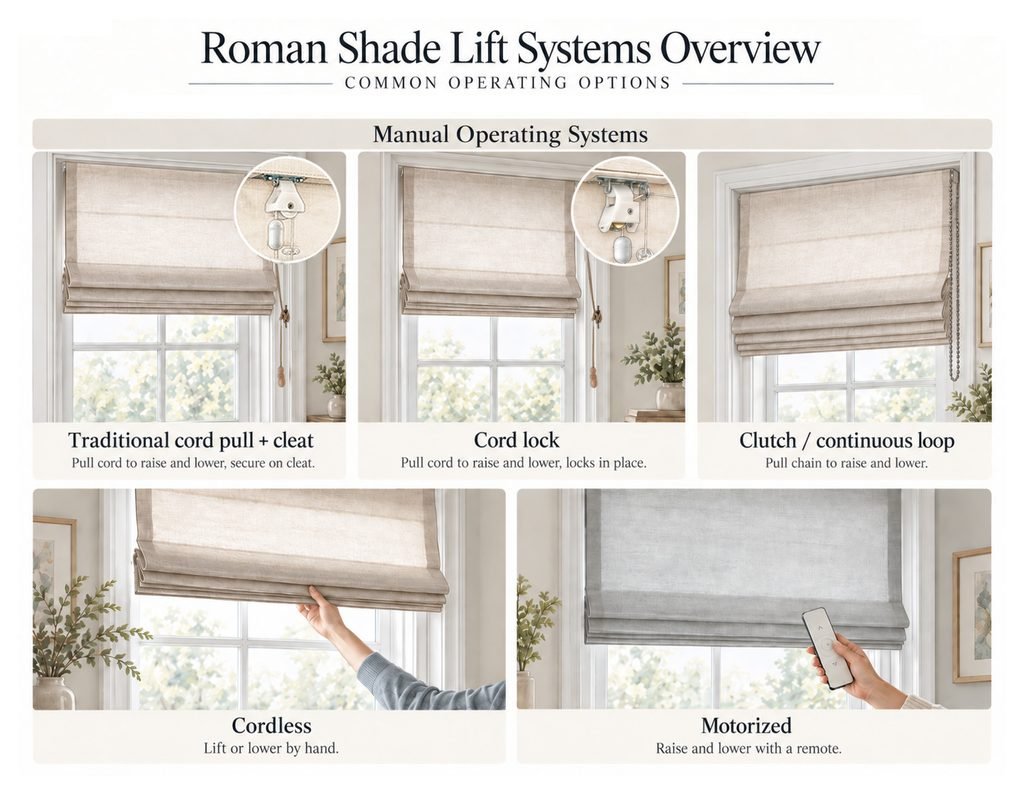
Manual systems rely on the user to operate the shade. Traditional Roman shades have used several types of cord-operated mechanisms.
Traditional Cord Pull with Cleat
In this arrangement, the user pulls the operating cord directly to raise the shade and secures it around a wall-mounted cord cleat to hold the desired position.
The cleat provides the primary means of securing the operating cord, without a separate cord-locking mechanism.
Cord Lock
A cord lock incorporates a mechanical locking device, typically near the headrail, to hold the lift cords in position.
The user operates the shade by pulling and releasing the cord through the locking mechanism. A cord cleat may also be provided to organize or secure the remaining operating cord, depending on the product design.
Clutch / Continuous Loop
A clutch system uses a continuous cord loop or bead chain to operate a transmission mechanism that raises and lowers the shade.
Depending on the design, the clutch may drive a shaft, spool, or other lifting arrangement. Properly selected systems can provide controlled operation, particularly where additional mechanical assistance is useful.
Safety note: Traditional free-hanging cords and accessible continuous loops present potential entanglement hazards. Current U.S. requirements restrict many traditional cord arrangements. These examples are included to explain operating principles, not to recommend a particular configuration for new installations.
3. Cordless Systems
Cordless Roman shades are designed to operate without an exposed hanging operating cord.
Many are raised or lowered by gently moving the bottom of the shade. Depending on the manufacturer and system design, internal springs, balancing mechanisms, or other components help control movement and maintain the selected position.
It is important to distinguish the operating method from the internal lifting structure. A cordless Roman shade may still contain internal lift cords.
Cordless systems can differ considerably in operating effort, lifting capacity, positioning stability, and adjustment features.
For example, some systems provide mechanisms for tension adjustment or correction of uneven lifting. Others use different balancing arrangements to accommodate various shade sizes and weights.
Because these technologies continue to evolve, cordless should be understood as an operating category rather than a single mechanical design.
The suitability of a particular system should be determined using the manufacturer’s current specifications and the completed shade’s actual construction.
4. Motorized Systems
Motorized Roman shades use an electric motor to drive the lifting mechanism.
Depending on the system, the motor may operate a rotating tube, shaft, cord-lift mechanism, or another transmission arrangement.
Power Options
Common power arrangements include:
- Battery-powered systems: Including rechargeable battery solutions, often useful when wiring is not readily available.
- Hardwired systems: Typically using a compatible low-voltage power supply or other manufacturer-specified electrical arrangement.
Control Options
Motorized Roman shades may be operated through handheld remotes, wall controls, compatible mobile applications, or integrated smart home systems.
Some systems also support scheduled operation, scene settings, and coordinated control of multiple shades.
Motorization can be particularly useful for high windows, difficult-to-reach locations, or rooms with multiple window treatments.
However, motorization does not automatically make a system suitable for oversized or heavy shades. Motor capacity, lifting mechanism, finished shade weight, installation requirements, and manufacturer limits must still be reviewed.
5. What Makes Lift Systems Different?
The differences between Roman shade systems extend beyond how the user operates them.
Several characteristics can influence both the fabrication process and long-term performance.
Operating Effort
Consider how much force is required to raise or lower the shade and whether the movement feels smooth and controlled.
Weight Capacity
The total finished weight includes the face fabric, lining, interlining where applicable, bottom rail, and other incorporated components.
Size Limitations
Shade width, height, lifting travel, and overall construction can affect system compatibility.
Positioning and Leveling
Consider whether the shade can stop reliably at the selected height and whether uneven lifting can be adjusted.
Headrail and Installation Requirements
Different mechanisms may require different headrail dimensions, mounting configurations, or clearance.
Service and Maintenance
Access to adjustment components, replacement parts, and the operating mechanism may influence long-term usability.
These characteristics should be evaluated for the specific product rather than assumed from the terms manual, cordless, or motorized.
6. Choosing the Right Lift System
Selecting an appropriate lift system begins with understanding both the shade and the window where it will be installed.
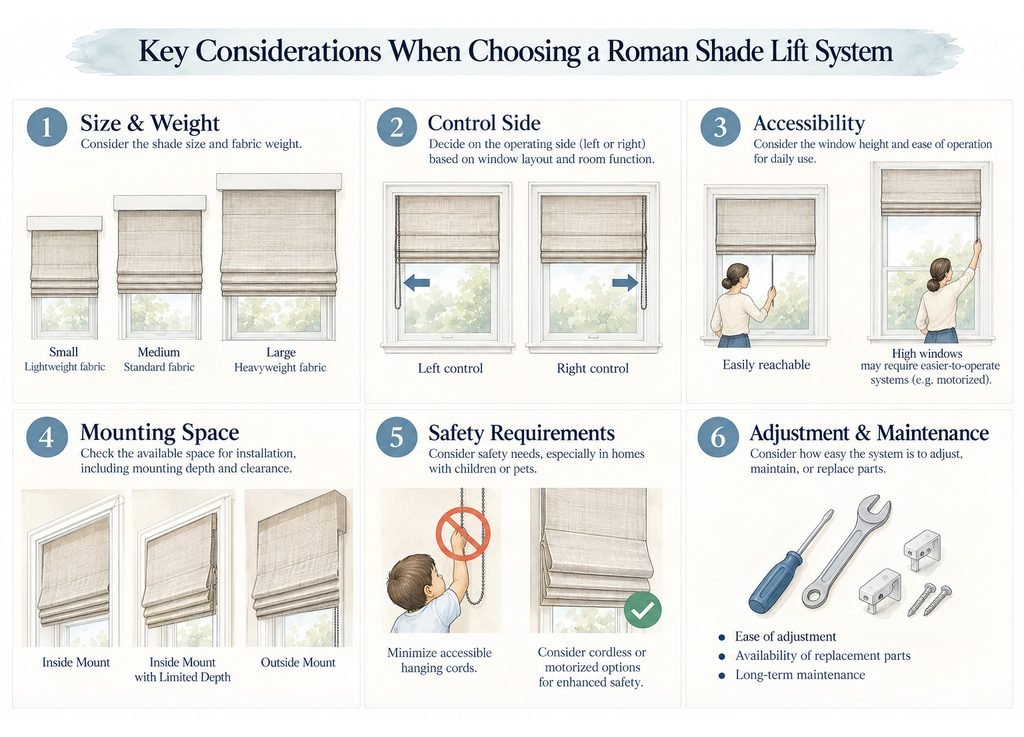
Shade Size and Weight
Fabric type, lining, finished dimensions, and construction details all contribute to the overall weight.
Larger or heavier shades may require systems with greater lifting capacity, but the appropriate choice depends on the manufacturer’s rated specifications.
Frequency of Use and Operating Convenience
For shades that are raised and lowered frequently, ease of operation and positioning stability are important considerations.
High or difficult-to-reach windows may benefit from motorized operation.
Control Side and Accessibility
For manually operated systems with cords or bead chains, the control side should be determined before fabrication.
Left- or right-side operation should be selected according to window placement, furniture arrangement, nearby obstructions, and the user’s normal approach to the window.
For multiple Roman shades installed together, considering control locations as part of the overall layout can improve everyday convenience.
Mounting Space
The available installation depth and surrounding clearance should be reviewed early in the design process.
Inside mounts, shallow window recesses, and outside mounts can create different space requirements.
Headrail dimensions and clearance requirements vary by system, so the chosen mechanism should be checked against actual field measurements.
Safety and Compliance
Safety requirements are an essential part of system selection.
In the United States, window covering cord safety requirements address operating cords, continuous loops, and internal cords. The ANSI/WCMA A100.1-2022 revision, which took effect on June 1, 2024, introduced stricter requirements for custom products.
A product should not be considered compliant simply because it is described as cordless or motorized. The complete configuration, including any accessible internal cords, must meet the applicable requirements.
Manufacturers and fabricators should verify current regulations, standards, and product documentation for the intended market.
Adjustment and Maintenance
Consider whether the finished shade allows for convenient leveling, tension adjustment, access to components, and future servicing.
These features can be particularly valuable where shades are used frequently or installed in locations that are difficult to access.
7. Final Considerations
Roman shade lift systems continue to evolve, offering a growing range of operating methods and mechanical solutions.
Understanding the general differences between traditional manual, cordless, and motorized systems provides a useful starting point. However, the final selection should always be based on the requirements of the individual shade and the capabilities of the specific system.
Rather than treating one mechanism as suitable for every application, it is more useful to evaluate how its operating method, lifting capacity, adjustment features, and installation requirements work together.
Future studies will explore selected Roman shade systems in greater detail, including their construction, components, and practical applications.