
While reviewing traditional valances and top treatments, I kept coming across the same terms: swag, cascade, jabot, and tail.
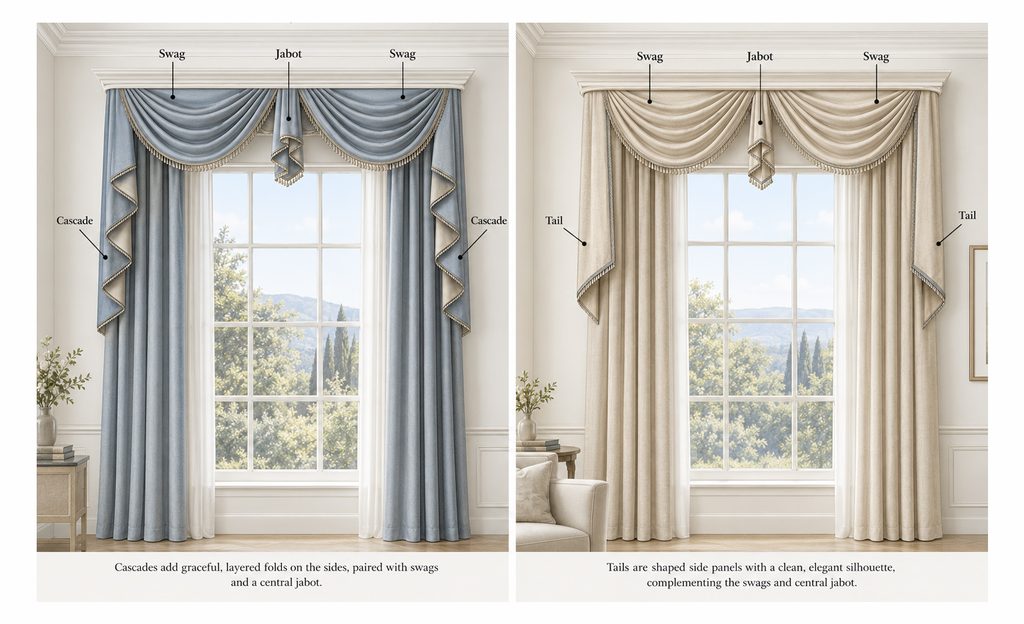
They often appear together, but the way they are used can vary from one book, workroom, manufacturer, or reference source to another. Similar forms may be described by different names, while the same term may sometimes be used for slightly different constructions.
Rather than trying to create a strict classification system, I wanted to organize a few of the most common terms by looking at their position, structure, and visual character within a complete window treatment.
For me, understanding the construction first is often more useful than memorizing the name alone.
Swag
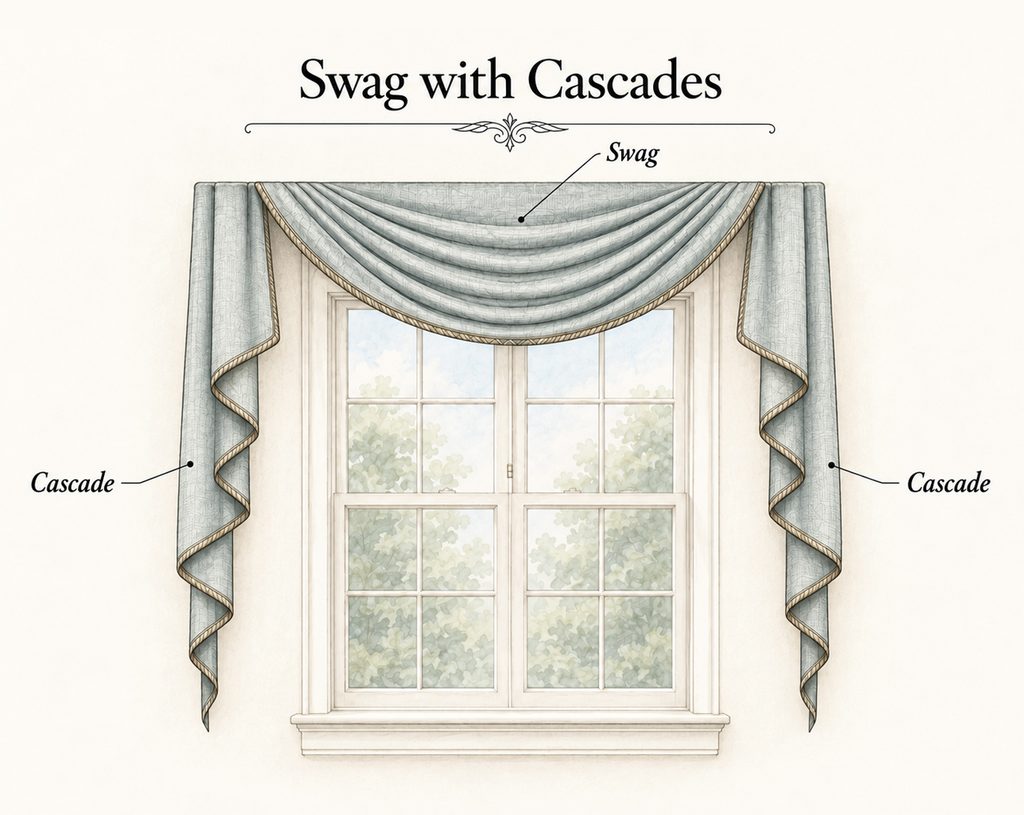
A swag is one of the most recognizable horizontal elements in traditional top treatments.
It is created by allowing fabric to drape between two support points, forming a curved shape that is usually deeper in the center and higher at the sides. Depending on the construction, the fabric may be pleated, shirred, gathered, or simply draped into position.
The most useful way to recognize a swag is by its overall direction:
It is a horizontal draped element.
Swags may be used on their own or combined with cascades, jabots, or tails.
Common Swag Forms
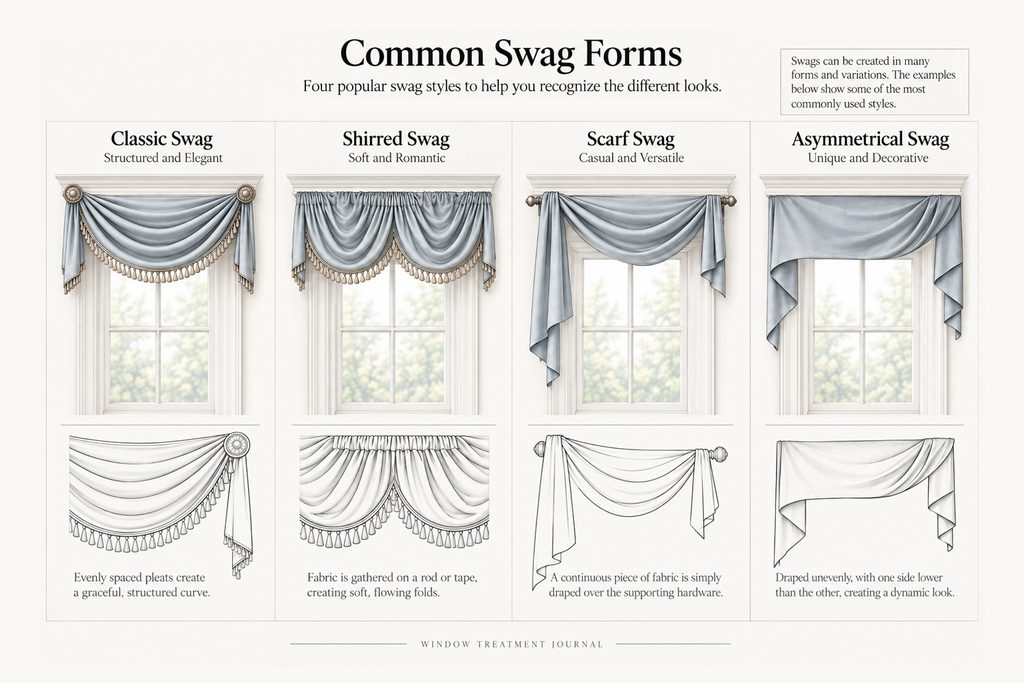
To make the category easier to recognize, I selected a few representative examples.
Classic Swag
A more controlled and balanced form, with clearly defined folds and a traditional curved silhouette.
Shirred Swag
The top is gathered or shirred, creating softer and more closely spaced folds.
Scarf Swag
Usually formed from a continuous length of fabric draped over a rod, holder, or other support. Its appearance depends greatly on the way the fabric is arranged and allowed to fall.
Asymmetrical Swag
The drape is intentionally unbalanced, using different support points, depths, or side lengths to create a less symmetrical composition.
Swag forms can vary widely, and many reference sources use additional names to describe specific shapes or construction details.
Cascade
If a swag is mainly horizontal, a cascade is easier to understand as a vertical side element.
Cascades are often positioned at the sides of swags or pelmets. Their shape is usually created through unequal lengths, folding, stacking, or pleating, which allows the fabric to descend in a repeated pattern.
Typical visual characteristics include:
- descending folds
- a zigzag edge
- a waterfall-like movement
- alternating views of the face fabric and lining
For me, a cascade is best recognized as:
a vertical element defined by falling folds and layered movement.
Common Cascade Forms
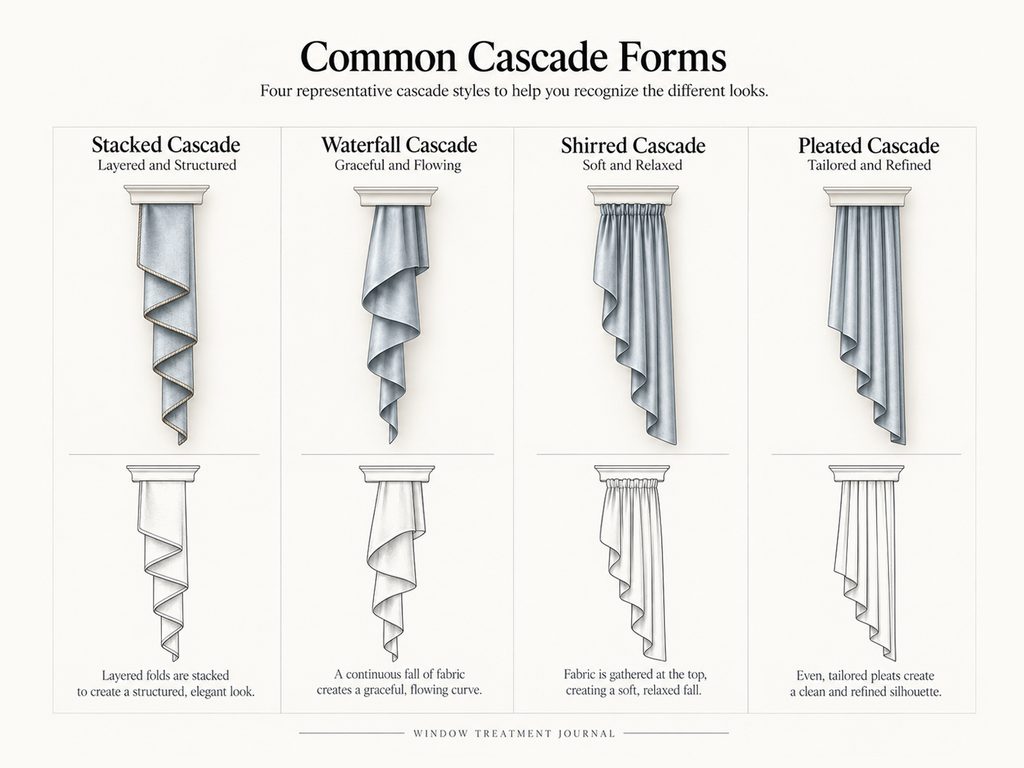
Again, the examples here are simply a few representative forms.
Stacked Cascade
The folds are arranged in a more layered, stepped sequence, creating a stronger sense of structure.
Waterfall Cascade
The edge falls in a more continuous sequence, producing a flowing waterfall effect.
Shirred Cascade
Shirring or gathering creates a softer and less rigid appearance.
Pleated Cascade
More controlled pleating gives the cascade a clearer and more tailored vertical rhythm.
One interesting thing about cascade terminology is that some names describe the overall silhouette, while others describe the way the fabric is pleated, gathered, or stacked. This is one reason the terminology can become difficult to organize.
Jabot
A jabot is also a vertical decorative element, but its visual logic is different from a cascade.
Jabots often feel more concentrated and sculptural. They may form:
- horn-like shapes
- cone-like shapes
- sleeve-like forms
- pointed or folded structures
They can appear between swags or as part of a larger decorative composition.
Compared with the repeated descending folds of a cascade, a jabot often reads more like a distinct shaped decorative component.
Common Jabot Forms
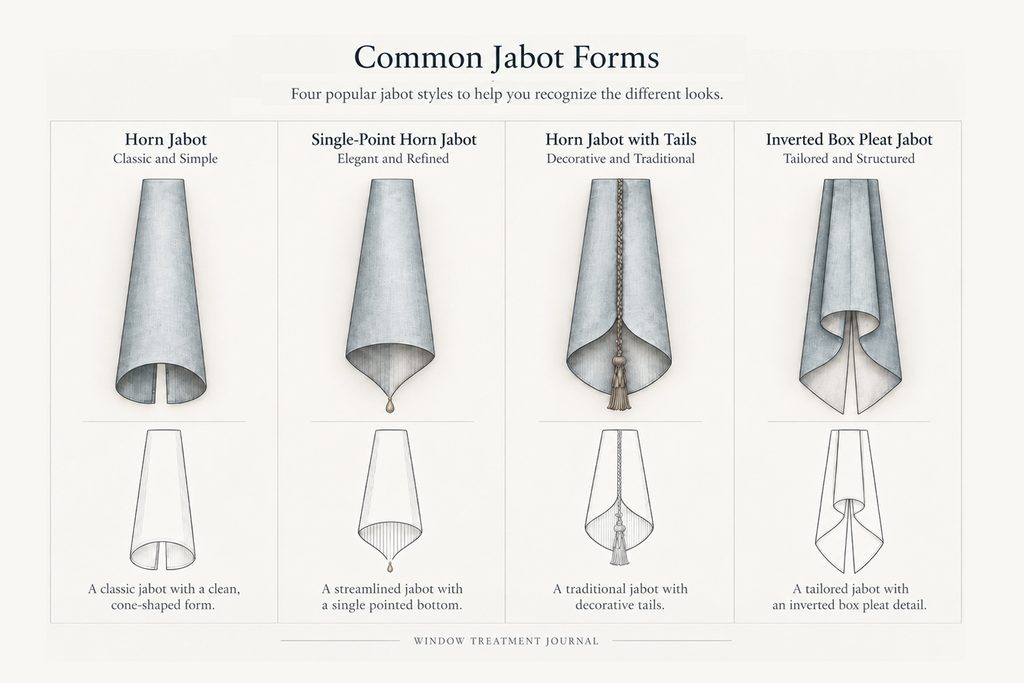
Horn Jabot
A classic cone- or horn-shaped form that makes the basic jabot structure easy to recognize.
Single-Point Horn Jabot
A more elongated variation with a clear point at the bottom.
Horn Jabot with Tails
A more decorative form that combines the horn shape with additional tail-like elements.
Inverted Box Pleat Jabot
A more tailored construction in which the pleat structure becomes part of the overall silhouette.
Jabot names often combine several kinds of information at once: the basic form, the lower shape, the pleat structure, and sometimes the decorative finish.
Tail
A tail can be easy to confuse with a cascade because both may appear as vertical elements in a swag or pelmet composition.
Visually, I find it useful to separate them this way:
Cascade = folds.
Tail = shape.
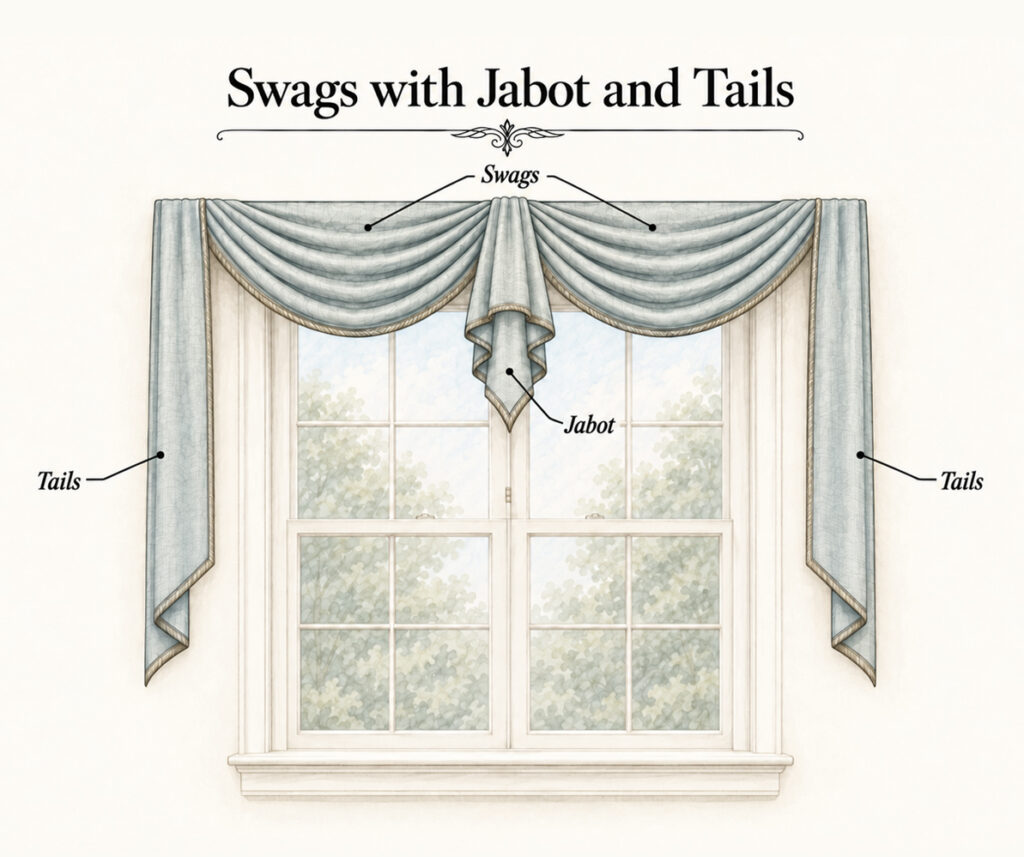
A tail is usually flatter and less dependent on repeated layered folding. Its character often comes from the outer silhouette and the shape of the lower edge.
Common variations may include:
- pointed shapes
- curved profiles
- necktie-like forms
- reversed shapes
- fringed edges
Common Tail Forms
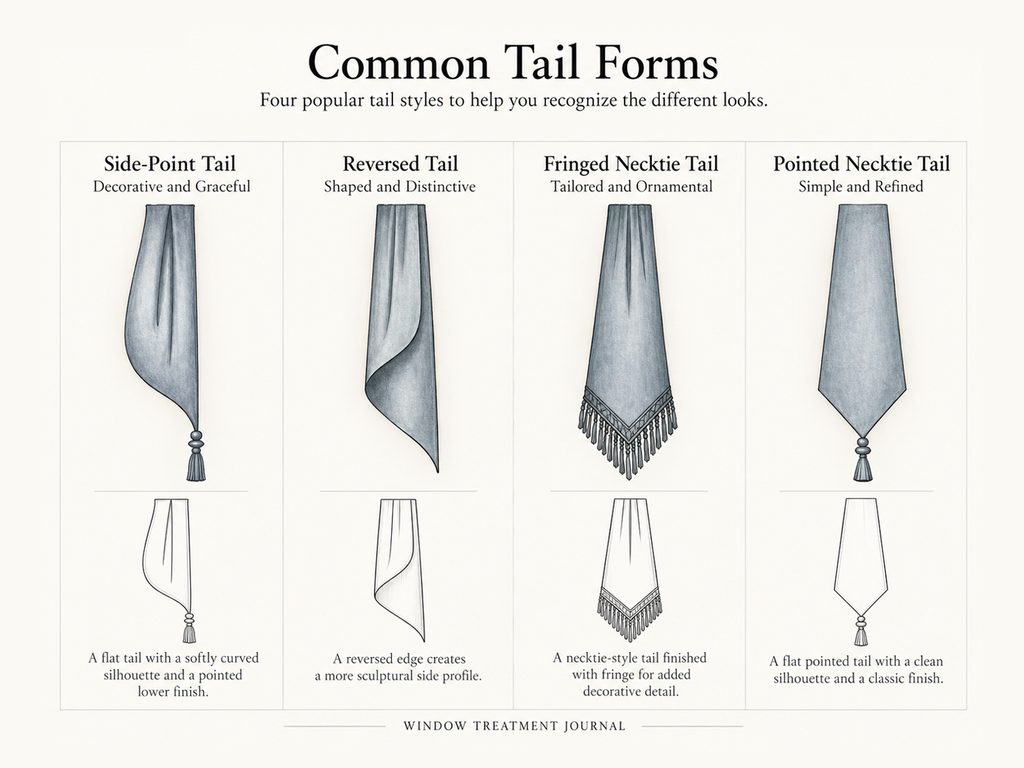
Side-Point Tail
A flatter form with a distinct point extending toward one side.
Reversed Tail
The outer edge changes direction, creating a more pronounced shaped profile.
Fringed Necktie Tail
A narrow, necktie-like form finished with fringe for a more decorative effect.
Pointed Necktie Tail
A cleaner version that emphasizes the pointed lower silhouette.
These examples show how tail variations are often defined more by outline and proportion than by layered folds.
Why These Terms Can Be Confusing
This is one of the things I noticed most while reviewing traditional window treatment references.
The terminology is not always used in exactly the same way.
For example:
- a cascade may sometimes be referred to as a tail
- jabot may appear together with terms such as horn or trumpet
- tail may also appear within the name of a jabot style
- the same basic construction may be described differently by different workrooms or pattern systems
Because of this, I find it more useful to first look at the structure itself:
- Is the element horizontal or vertical?
- Is the visual effect created mainly by folds or by silhouette?
- Is it flat or dimensional?
- Is it formed through pleating, shirring, stacking, or simple draping?
Once those relationships are clear, the terminology becomes much easier to understand.
A Simple Way to Read the Structure
Swag
A horizontal draped element.
Cascade
A vertical element defined by descending folds and layered movement.
Jabot
A more sculptural and shaped vertical decorative element.
Tail
A flatter vertical element defined more by silhouette and lower-edge shape.
Conclusion
Traditional window treatments include many variations of swags, cascades, jabots, and tails, and the terminology is not always consistent from one reference source to another.
I will continue studying, researching, and organizing these terms in the hope that they can help us better understand the structure and design language of window treatments.
Related Articles
- Exploring Valance Styles: A Visual Reference for Design and Structure
https://windowtreatmentjournal.com/exploring-valance-styles-visual-reference/ - Cornice Shapes: A Visual Reference for Window Treatment Design
https://windowtreatmentjournal.com/cornice-shapes-visual-reference/ - Drapery Heading Styles: A Visual Reference Guide
https://windowtreatmentjournal.com/drapery-heading-styles-a-visual-reference-guide/ - Drapery Design: A Visual Guide to Structure and Style
https://windowtreatmentjournal.com/drapery-design-visual-guide/
Comments are closed.