
In custom window treatment design, fabric is not simply a decorative material chosen at the end of the process. It is one of the foundations that shapes the finished result. The same window, the same style, and the same room can look very different when the fabric changes.
Many people begin by looking at color and pattern, but for draperies, Roman shades, and other soft window treatments, fabric texture, weight, light filtering, and stability are just as important. These qualities determine whether a window treatment feels soft, structured, light, substantial, quiet, or expressive.
Texture: The Surface Changes the Light
Texture is one of the most easily overlooked parts of fabric selection. Linen-like weaves, plain cottons, fine jacquards, velvets, coarse open weaves, and sheer fabrics can all look very different, even when the color is similar.
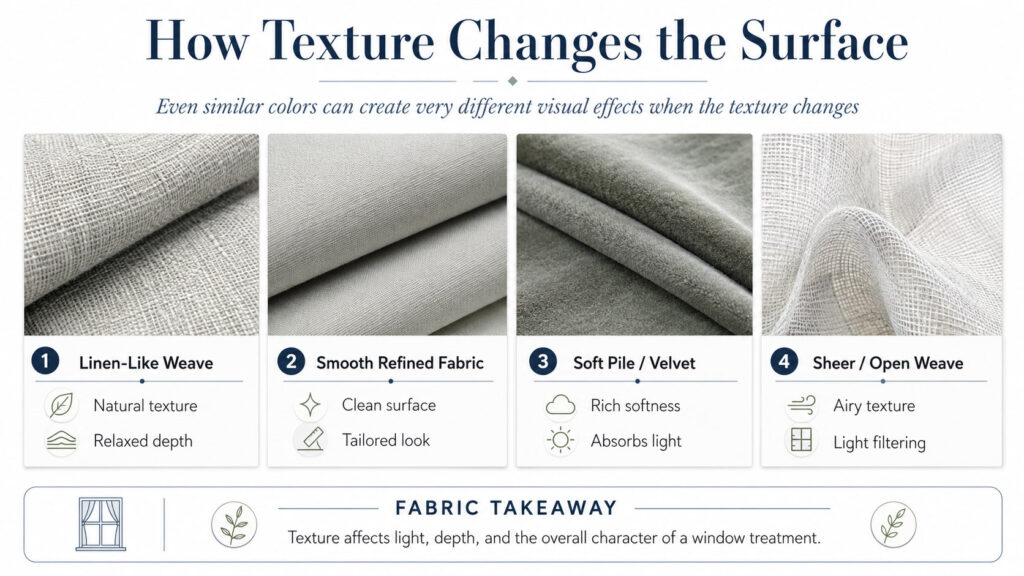
A fabric with visible texture often creates a more natural and relaxed feeling. It adds subtle shadows and depth to the surface, so the finished window treatment does not feel too flat. Linen, cotton-linen blends, and coarse woven textures often work well in rooms that call for a relaxed, natural, or casually elegant atmosphere.
Smoother and more refined fabrics can create a cleaner and more tailored look. Fine blends, satin-like finishes, and fabrics with a slight sheen can make pleat lines appear sharper and more formal. They often support a more polished or structured design.
This is why fabric should not be judged by color alone. It is also important to see how the surface reacts to light, whether it has depth up close, and whether it still looks clean and balanced from a distance.
Weight: Fabric Weight Affects Drape and Structure
Fabric weight has a direct effect on how draperies hang and how Roman shades fold.
For draperies, a fabric with some weight often creates more stable vertical lines. The pleats can hold their shape more easily, and the panel tends to fall in a cleaner way. A fabric that is too light may feel unstable or too airy for the design. A fabric that is too heavy or stiff may make the pleats look bulky and increase the stackback.
For Roman shades, fabric weight needs even more careful consideration. A Roman shade needs to look flat when lowered, but it also needs to fold neatly when raised. If the fabric is too soft, the face of the shade may not stay smooth. If the fabric is too thick, the folds may become bulky when the shade is lifted.
This is why a fabric that works beautifully for drapery may not always be the best choice for a Roman shade. Drapery can use flow, fullness, and pleats to express the fabric. Roman shades rely more on flatness, stability, and clean folding.
Light: Light Filtering Changes the Mood of a Room
Window treatments are different from many other soft furnishings because they always interact with light. The way a fabric filters light can change the entire feeling of a room.
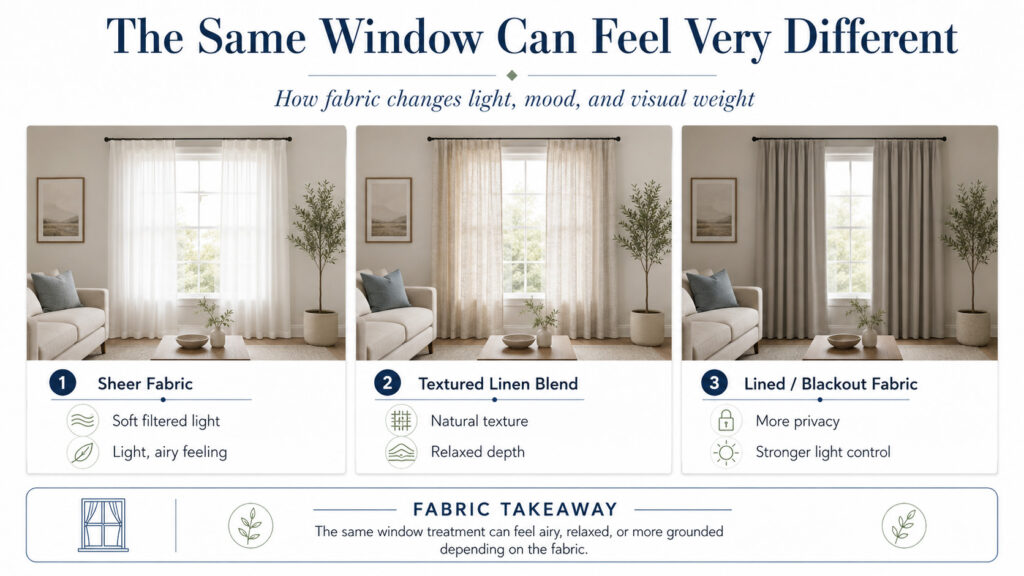
A light-colored fabric with a semi-sheer quality can soften daylight and make the room feel calm and airy. A similar color in a lined or blackout fabric may feel more solid, grounded, and private. The color may be close, but the effect in the room can be very different.
Sheer fabrics are useful for softening light and adding layers, but they do not provide full privacy or light control. Lined draperies can improve drape, protect the face fabric, and add weight. Blackout lining can change the hand, thickness, and silhouette of the finished treatment.
For this reason, fabric should be considered in both daytime and evening conditions. During the day, the important questions are light filtering, texture, and softness. At night, color, outline, privacy, and the overall presence of the window treatment become more noticeable.
Application: Not Every Beautiful Fabric Works for Every Style
Not every beautiful fabric is suitable for every type of window treatment.
Drapery is well suited to showing movement, fullness, and vertical drape. Fabrics that are soft but stable, with enough weight to fall naturally, often create a more graceful result.
Roman shades usually need fabrics that are more stable, smooth, and less prone to distortion. Because the face of a Roman shade is more like a flat panel, a fabric that is too loose, stretchy, or unstable may not produce a clean finished surface.
Valances and cornices also require different fabric qualities. A soft valance can work with a more flexible fabric, while an upholstered cornice needs a fabric that can wrap cleanly over a structure and keep crisp edges.
This is why fabric selection should not be separated from the final window treatment style. A fabric may look beautiful on a sample board, but it may behave very differently once it is made into a finished treatment. Fabric and construction need to be considered together.
Fabric Is Part of the Design
A successful window treatment is not created by style alone, and it is not created by color alone. Fabric is part of the design.
It determines how light enters the room, how pleats fall, how Roman shades fold, and whether the finished treatment feels light or substantial, natural or formal, quiet or expressive.
In custom window treatment design, fabric selection should not be treated as the final step. It should be part of the design decision from the beginning. When fabric texture, weight, light filtering, and construction all work together, the finished window treatment feels more natural, complete, and refined.
Fabric Note:
When choosing fabric for window treatments, color and pattern are only part of the decision. Texture, weight, light filtering, and stability all affect the finished result. Drapery requires attention to drape and pleat behavior, while Roman shades require attention to flatness and folding structure. The right fabric is what allows the design to work.
Related Notes
Understanding Fabric Types for Window Treatments: Fiber, Weave and Surface
A practical introduction to understanding fabric through fiber content, weave structure, and surface character—the basic qualities behind how a fabric looks and behaves in a finished window treatment.
Read the article →
Understanding Drapery Lining, Blackout Lining & Interlining
A closer look at how lining, blackout lining, and interlining affect light control, structure, drape, thickness, and the finished appearance of custom drapery.
Read the article →
Ripplefold vs. Wave Curtain Systems: Fullness and Space Planning
A comparison of two wave-style drapery systems, including fabric suitability, fullness, spacing, stack considerations, and how these factors influence the finished treatment.
Read the article →